
 Buy Crypto
- Markets
 Futures
- Spot
- Copy Trade
- Earn
- More
2025 Crypto Violence Retrospective: 65 Physical Assaults, 4 Fatal Incidents

Original Article Title: In Defense of Exponentials
Original Article Author: Haseeb Qureshi, Dragonfly General Partner
Original Article Translation: Azuma, Odaily Planet Daily
Editor's Note: Do you remember the recent news about the Russian cryptocurrency billionaire Roman Novak and his wife Anna being found dismembered and buried on a beach in Dubai? In 2025, another dark side of the cryptocurrency industry is the increasing frequency of violent attacks against holders, especially the wealthy.
As a highly recognizable figure in the industry, Haseeb Qureshi, the bald-headed General Partner of Dragonfly, has today conducted a data analysis of violent incidents in the cryptocurrency field in recent years and explained that the reason for writing this article is because he is "increasingly scared." The data shows that in 2025, there were a total of 65 violent incidents in the industry, including 4 major fatal cases. Not only is the number of attack incidents rapidly increasing, but the attacks themselves are becoming more violent. Therefore, at the end of the article, Haseeb thoughtfully includes some personal safety recommendations.
Below is Haseeb's full article, translated by Odaily Planet Daily.
Are violent attacks against cryptocurrency holders on the rise?
Jameson Lopp has been quietly maintaining a database known as "wrench attacks," which are violent attacks against cryptocurrency holders aimed at coercing them to hand over their crypto assets. This is currently our closest source of "real-world benchmark data" to assess whether holding crypto assets is becoming more dangerous over time.
I have recently become increasingly afraid of such attacks, so I took Lopp's dataset and used a somewhat Vibe Coding method to visualize some of it to see what's really going on. Here are my findings.
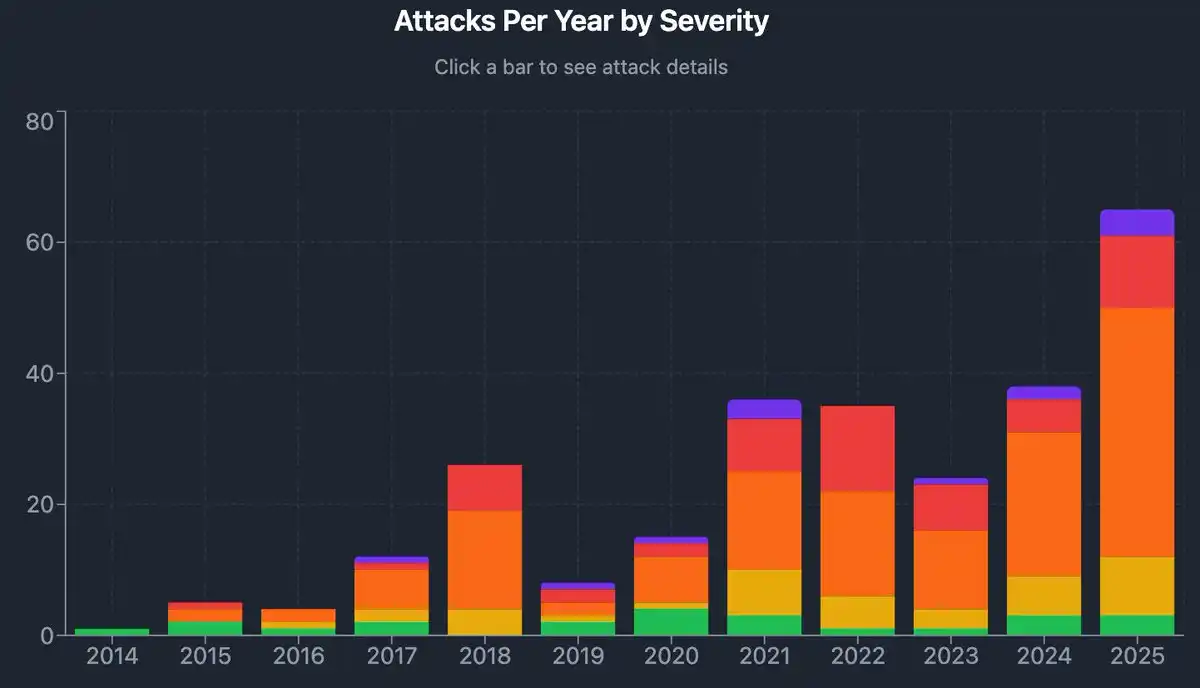
You are not mistaken—the number of attack incidents is indeed increasing over time (with 65 incidents in 2025). Furthermore, the attacks themselves are becoming more violent.
I had Claude categorize each attack into 5 levels, with the specific classification scheme as follows:
· Minor (3 incidents in 2025): Theft without physical confrontation, attempted theft, ATM/device theft.
· Moderate (9 incidents in 2025): Robbery with some level of violence or assault, drugging, extortion;
· Severe (38 incidents in 2025): Armed robbery, kidnapping, home invasion with firearms or weapons;
· Extremely Severe (11 incidents in 2025): Kidnapping involving torture, dismemberment, severe beating, gunshot wounds;
· Fatal (4 incidents in 2025): Victim fatality.
From the results, it can be seen that on average, the level of violence per single attack is continuously increasing.
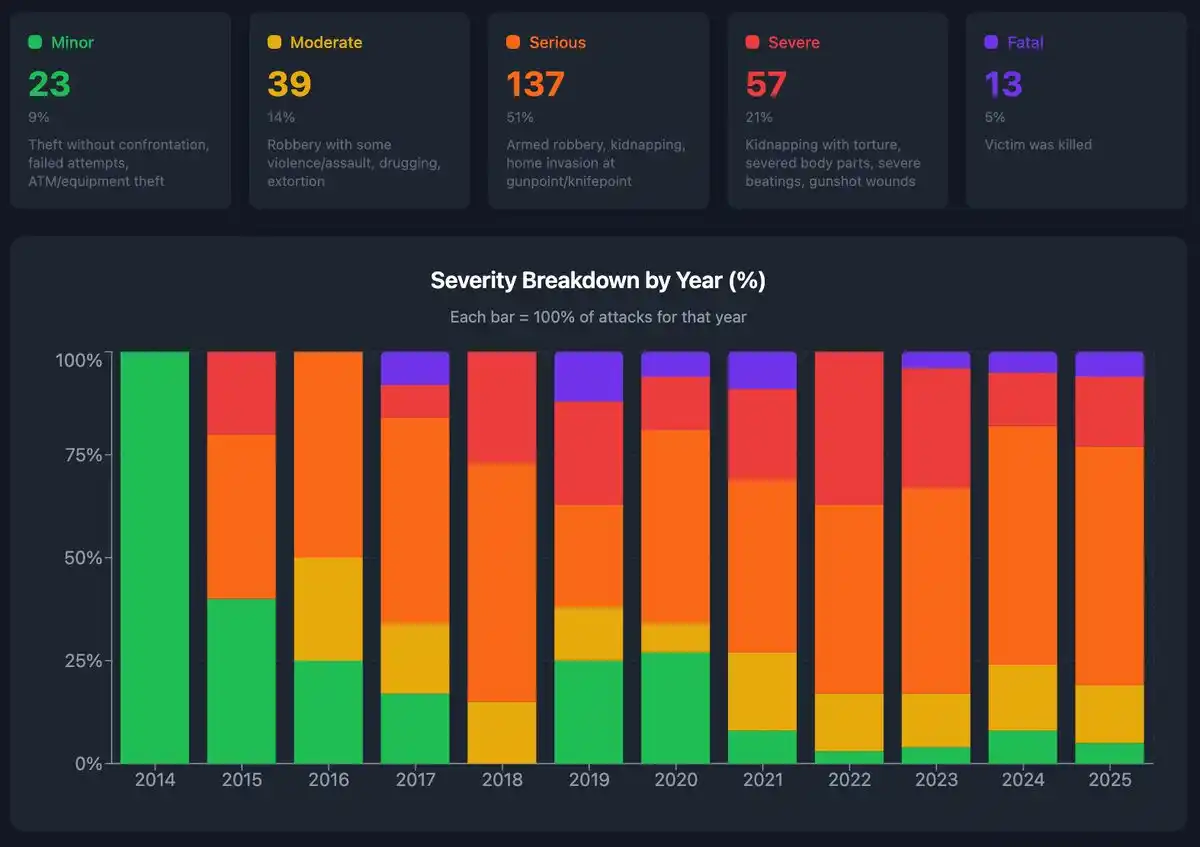
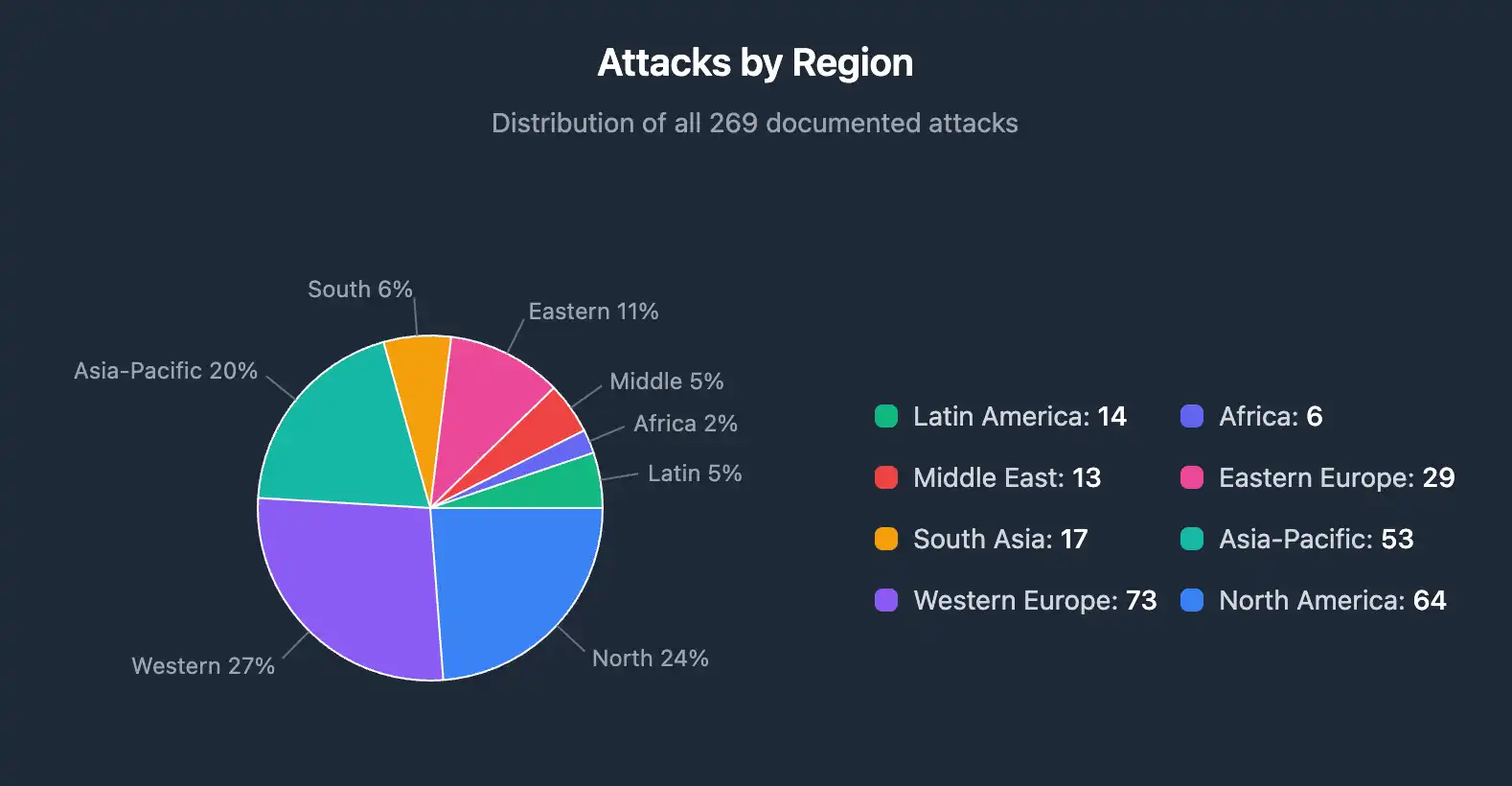
Geographically, Western Europe and the Asia-Pacific region saw the highest increase in violent incidents. North America is currently still relatively the safest region, but even in North America, there has been an upward trend in absolute numbers.
So, what is causing the rise in violent incidents?
One of the most straightforward explanations is to link the frequency of violent incidents to the total market capitalization of the cryptocurrency market. In simple terms—higher prices, more crime.
Take a look at the chart results: the white line represents the total market cap of cryptocurrency; the colored area represents the number of violent incidents.
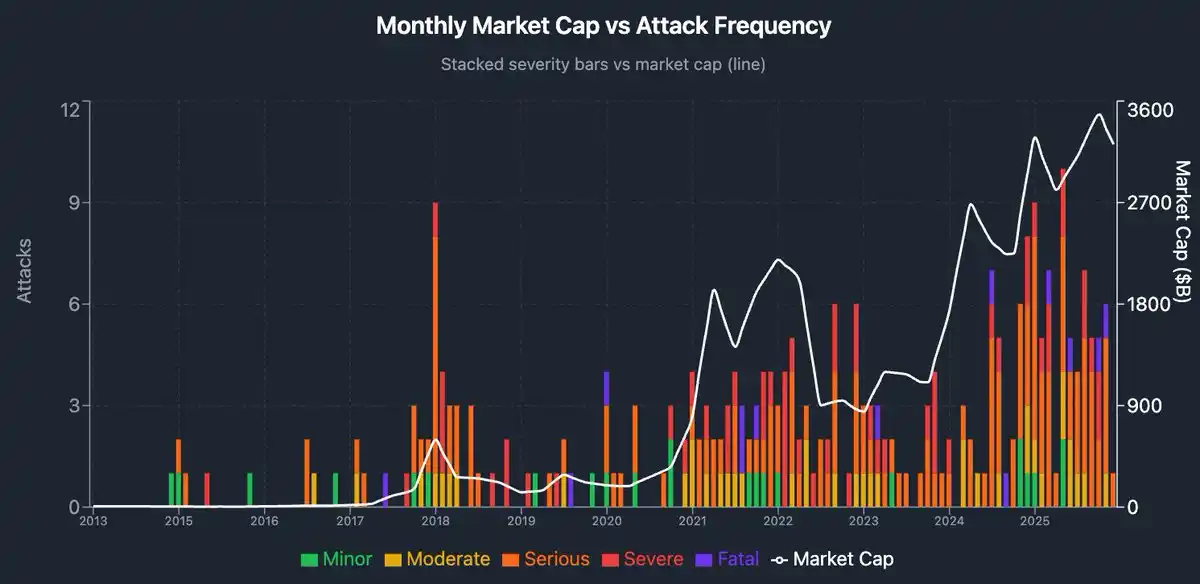
Conducting a simple regression analysis, the provided R² result is 0.45, meaning that 45% of the variation in violent incidents can be explained solely by the price itself. In other words, as we mentioned earlier, when prices rise, violent incidents increase—I have also run regression analyses on other variables, but none are as convincing as total market cap.
So, is it that simple? Does this already prove that holding cryptocurrency will pose an increasing personal danger?
We can perform another "stress test" to see if there are other hypotheses that could explain why the number of violent incidents is on the rise?
One possible explanation is that the increase in cryptocurrency prices inherently means more people hold cryptocurrency assets. In other words, the increase in criminal events may simply be because the "population base" has increased, and the actual risk of violence faced by each individual may not have truly risen.
Let's conduct a rationality check on this. Since accurately measuring the total number of cryptocurrency users is difficult, I chose two alternative indicators:
· The first is Coinbase's monthly active users, not cumulative registered users, as we want to exclude those who have already churned and no longer hold coins;
· The second method is more rudimentary, analyzing the number of violent incidents per unit market cap to derive an approximate measure of the "likelihood of theft per dollar."
Once you standardize the above data, you will see completely different conclusions: the blue line represents the number of violent incidents per Coinbase user; the green line represents the number of violent incidents per dollar of wealth
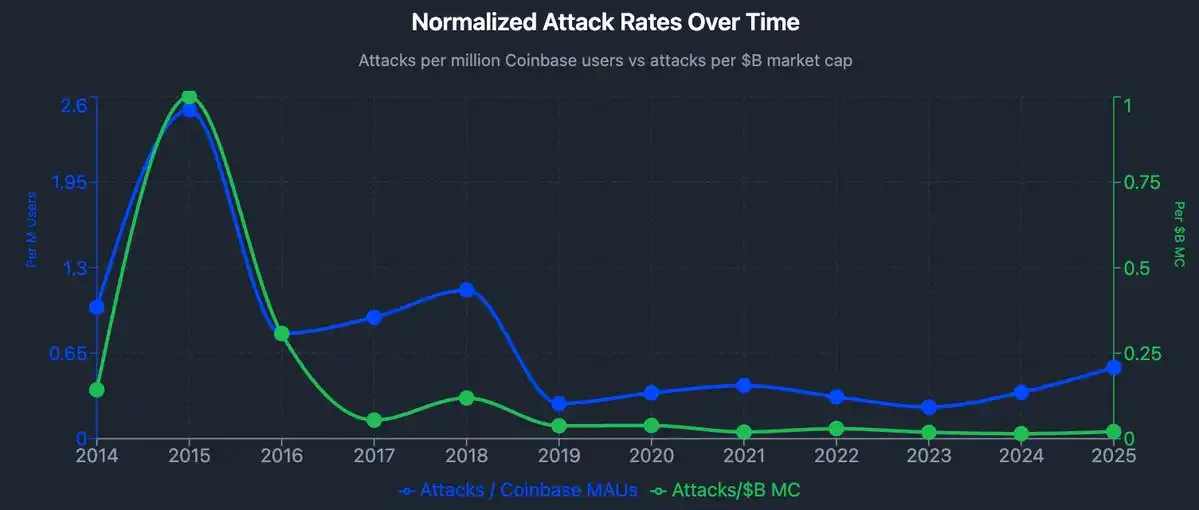
This data set suggests that 2015 and 2018 were actually the most dangerous periods to hold crypto. Yes, even though the number of attack incidents was much lower at that time, the number of cryptocurrency holders was also much, much lower.
From 2015 to 2025, Coinbase's monthly active users grew from 2 million to 120 million, a whopping 60x increase, but violent incidents did not increase proportionally.
Certainly, in recent years, the number of violent incidents per user has indeed increased, but the increase has been relatively modest, roughly equivalent to the 2021 violence levels and significantly lower than pre-2019 levels. Meanwhile, the rate of violent incidents per dollar of wealth has remained nearly unchanged.
We must also consider the alternative hypothesis of "news reporting bias"—whether incidents are just more likely to be reported—but this is beyond the scope of this analysis.
Overall, the number of violent incidents is indeed increasing, and the attack methods are becoming more violent. However, this can be partially attributed to the "population effect," meaning there are now more cryptocurrency holders, so the individual risk is not increasing as dramatically as it may seem.
But ultimately, this is not just an academic discussion. This is a truly serious, real-world issue.
If you are part of a high-risk group, there are actually many ways to improve your personal security. Here are some standard offline security suggestions:
· Try to live in a secure city, preferably in a residence with 24/7 security;
· Avoid wearing cryptocurrency-related clothing or implying that you hold cryptocurrency in public;
· Use a service like DeleteMe to remove your personal information from data brokers;
· Get a PO Box and have all commercial mail sent there to prevent your address from being widely circulated;
· Set up a hot wallet with a "giveaway" amount of money that is entirely separate from your actual cold storage assets;
· Diversify your funds: use multiple services, platforms, and devices to store your assets so that you don't lose everything at once in the worst-case scenario;
· Unless necessary, avoid publicly broadcasting your specific location in real-time, especially during cryptocurrency conferences;
· If you are truly part of a high-risk group or are about to visit a high-risk area, consider hiring private security – in some areas, this can be much more useful than you think.
2026 has arrived, and the year-end is approaching, with a long holiday ahead. Please be sure to stay safe.
You may also like

The New Yorker in-depth investigation interpretation: Why do OpenAI insiders consider Altman untrustworthy?
Two Divided Worlds: Insights from the New York Digital Asset Summit, the Most Institutionalized Blockchain Conference

Top Ten Reveals of CZ's New Book: Advance Knowledge of "94", the Inside Story of Huobi's Change of Ownership Made Public for the First Time

Ceasefire Overnight Erases War Premium, Three Fault Lines Only One Sealed | Rewire News Morning Brief

Robinhood Secures 'Trump Account': Enabling Millions of Newborns to Access the Stock Market

Afraid to Open the Pandora's Box? Anthropic's Most Powerful Model Ever Dares Not Be Disclosed

US-Iran Ceasefire: A Temporary Pause or Prelude to Renewed Conflict? Market Outlook for Oil, Gold, and Bitcoin
April 8, 2026 – A temporary ceasefire between the U.S. and Iran has provided some immediate relief to the global markets, but the fundamental question remains: Will the cessation of hostilities hold, or is this merely a brief reprieve before a resumption of conflict? As the situation unfolds, market observers are closely monitoring how key assets like oil, gold, and Bitcoin will react in the coming weeks. This article explores whether the ceasefire is a sign of lasting peace, assesses the short-term market implications, and delves into the evolving role of Bitcoin in the global financial landscape.

WEEX Market Update: U.S.-Iran Ceasefire Sparks Bitcoin Price Surge
April 8, 2026 – In a significant shift in global geopolitics, U.S. President Donald Trump has announced a temporary two-week ceasefire with Iran, resulting in a notable market reaction across various asset classes. This development comes after discussions between Trump, Pakistani Prime Minister Shahbaz Sharif, and Army Chief General Asim Munir. The announcement is already reverberating through markets, particularly in oil, gold, and cryptocurrencies.
Morning Report | South Korean financial institutions pilot stablecoin payments for foreign users; Morgan Stanley Bitcoin ETF is about to be listed; CME plans to launch AVAX and SUI futures contracts

EigenCloud Founder: AI and Cryptocurrency are Creating the Next Trillion-Dollar Asset Class
From Panic to Pumps: How Bitcoin Traders Are Playing the 2-Week US-Iran Ceasefire
For most people, the two-week US-Iran ceasefire is about geopolitics, oil prices, and whether World War III gets postponed. But for crypto traders glued to their screens late Sunday night, it was something else entirely: the clearest risk-on signal in months.

US-Iran Ceasefire Triggers Oil Plunge, Bitcoin Surge, and Gold Rally
Despite the sharp rally, caution is warranted. The $70,000–$72,000 zone has historically been strong resistance. The ceasefire is only temporary (two weeks), and any breakdown in negotiations could trigger a sell-off toward the $62,000–$65,000 support zone. For now, Bitcoin needs to close decisively above $72,500 to confirm a true breakout; failure to do so within 48–72 hours could lead to a swift retracement.

OpenAI has no "New Deal," a blueprint for AI that refuses to pay.

Wall Street Flash Mob Run? Mega-Cap Stock Plunge, Goldman's Great Escape, Illustrated Guide to Private Credit Crisis

OpenAI Feud: Power, Trust, and the Uncontrollable Boundaries of AGI
「AI Doomsday Cult」 Sends Operatives into the Strait of Hormuz: What Did They Find?
Everyone is waiting for the war to end, but is the oil price signaling a prolonged conflict?


 App
App