
 Buy Crypto
- Markets
 Futures
- Spot
- Copy Trade
- Earn
- More
a16z: Why AI and Crypto Need Each Other Now More Than Ever

Original Title: AI needs crypto — especially now
Original Source: a16z crypto
Original Translation: Chopper, Foresight News
Artificial intelligence systems are upending the internet, originally designed at a human scale. They are reducing the cost of collaboration and transactions to historic lows, and the generated speech, video, and text are becoming increasingly indistinguishable from human behavior. We have long been plagued by human-machine verification, and now, AI agents are beginning to interact and transact like humans.
The key issue is not the existence of artificial intelligence, but the lack of a native mechanism on the internet that can differentiate between humans and machines while preserving privacy and usability.
And this is where blockchain technology comes in. Cryptography helps build better AI systems, and conversely, AI can empower the ideals of cryptographic technology, with many underlying logics. Here, we summarize several reasons why AI now needs blockchain more than ever before.
Increasing the Cost of AI Impersonation
AI can forge speech, facial features, writing styles, video content, and even create a complete social persona, and can operate at scale: an intelligent entity can transform into thousands of accounts, simulate different viewpoints, consumers, or voters, with the cost of this operation continuing to decline.
Such impersonation methods are not novel: any aspiring fraudster has always been able to hire voice actors, spoof calls, send phishing texts. The real change lies in the cost: today, the threshold for carrying out large-scale fraudulent attacks has significantly decreased.
At the same time, the vast majority of online services default to "one account per real user." When this premise is not met, all subsequent systems will collapse. Detection-based responses (such as CAPTCHA) are ultimately destined to fail, as the evolution rate of AI is far faster than the detection technology specifically designed for it.
So how can blockchain play a role? Decentralized human-proof or identity verification systems allow users to easily complete single sign-on while fundamentally eliminating the possibility of one person having multiple identities. For example, scanning the iris to obtain a global ID may be simple and economical, but obtaining a second ID is nearly impossible.
By limiting the issuance of identity credentials, increasing the marginal cost to attackers, blockchain makes it difficult for AI to carry out large-scale impersonation operations.
Artificial intelligence can generate content, but encryption technology has made it extremely difficult and cost-prohibitive to forge a human's unique identity. Blockchain reshapes scarcity at the identity layer, raising the marginal cost of counterfeiting while not adding extra friction to legitimate human use.
Building a Decentralized Human Identity System
One way to prove human identity is through a digital identity marker that encompasses all information people could use to verify their identity: username, personal identification code, password, as well as third-party attestations (such as citizenship, credit qualifications), and other relevant credentials.
So, what value does encryption technology add? The answer is decentralization. Any centralized identity system rooted in the core of the internet could become a system-wide point of failure. When AI agents act on behalf of humans in transactions, communications, and collaborations, whoever controls the identity verification effectively controls participation. A centralized issuer can arbitrarily revoke user permissions, charge fees, or even engage in surveillance.
Decentralization completely flips this scenario: users, not platform gatekeepers, control their identity information, making identity markers more secure and resistant to censorship.
Unlike traditional identity systems, a decentralized human proof mechanism allows users to autonomously control and safeguard their own identity information, completing human identity verification in a privacy-preserving, absolutely neutral manner.
Creating a Portable, General-Purpose "Digital Passport" for AI Agents
AI agents do not exist solely within a single platform: an intelligent entity may appear across various chat applications, email conversations, phone calls, browsing sessions, and API interactions. However, there is currently no reliable mechanism to confirm that interactions in these different scenarios all originate from the same AI agent with consistent states, capabilities, and authorization by the "owner."
Furthermore, if an AI agent's identity is tied to just one platform or marketplace, it cannot be used across other products and critical scenarios. This leads to a fragmented user experience for AI agents, with the process of scenario-based adaptation being cumbersome and inefficient.
Through a blockchain-based identity layer, a portable, general-purpose "digital passport" can be crafted for AI agents. These identity markers can link an entity's capabilities, permissions, and payment endpoint information, verifiable in any scenario, significantly increasing the difficulty of counterfeiting AI agents. This also allows developers to create more practical AI agents, bringing a superior user experience: intelligent entities can operate across multiple ecosystems without being bound to a specific platform.
Achieving Scalable Payment Transactions
As AI agents increasingly represent humans in transactions, existing payment systems have become a significant bottleneck. Enabling scalable AI payments requires new infrastructure capable of handling microtransactions from multiple sources.
Many blockchain-based tools currently show potential in addressing this issue, such as scaling solutions, layer-two networks, AI-native financial institutions, and financial infrastructure protocols, enabling nearly fee-less transactions and more granular payment splits.
The key is that these blockchain payment infrastructures can support machine-scale transactions, including micro-payments, high-frequency interactions, and business transactions between AI agents, all of which traditional financial systems cannot handle.
· Micro-payments can be split among multiple data providers, triggering small payments to all relevant data providers in a single user interaction through automated smart contracts;
· Smart contracts support retroactive payments based on completed transactions, enforceable compensation to entities that provided information support for purchase decisions post-transaction, with the entire process being fully transparent and traceable;
· Blockchain enables complex and programmable payment splits, ensuring fair revenue distribution through code-enforced rules instead of centralized institution decisions, enabling trustless financial relationships between autonomous AI agents.
Protecting Privacy in AI Systems
Many security systems face a core paradox: the more data collected to protect users, the easier it is for AI to impersonate them.
In this context, privacy protection and security become intertwined. The challenge we face is to default human identity systems with privacy attributes, hiding sensitive information at all stages to ensure that only real humans can provide the necessary information for proving their identity.
Blockchain-based systems combined with zero-knowledge proof technology allow users to prove specific facts, such as personal identification numbers, ID numbers, eligibility criteria, without revealing underlying raw data (such as addresses on a driver's license).
As a result, applications can obtain the required identity verification guarantees, while AI systems are deprived of the original data needed for impersonation. Privacy protection is no longer an add-on feature but the primary line of defense against AI impersonation.
Conclusion
AI has significantly reduced the cost of scalable operations but has made establishing trust more challenging. Blockchain technology can reshape trust systems: increase the cost of impersonation, retain human-scale interaction patterns, decentralize identity systems, make privacy protection a default setting, and provide native economic constraints for AI agents.
If we want to build an AI agent that can function properly and not undermine trust on the internet, then blockchain is far from optional; it is a key foundational technology for constructing a native AI internet, filling a core gap in the current internet.
You may also like

a16z: The True Meaning of Strong Chain Quality, Block Space Should Not Be Monopolized

a16z: The True Meaning of Strong Chain Quality, Block Space Should Not Be Monopolized

2% user contribution, 90% trading volume: The real picture of Polymarket

Trump Can't Take It Anymore, 5 Signals of the US-Iran Ceasefire

Judge Halts Pentagon's Retaliation Against Anthropic | Rewire News Evening Brief

Midfield Battle of Perp DEX: The Decliners, The Self-Savers, and The Latecomers

Iran War Stalemate: What Signal Should the Market Follow?
Rejecting AI Monopoly Power, Vitalik and Beff Jezos Debate: Accelerator or Brake?

Insider Trading Alert! Will Trump Call a Truce by End of April?

After establishing itself as the top tokenized stock, does Ondo have any new highlights?

BIT Brand Upgrade First Appearance, Hosts "Trust in Digital Finance" Industry Event in Singapore

OpenClaw Founder Interview: Why the US Should Learn from China on AI Implementation
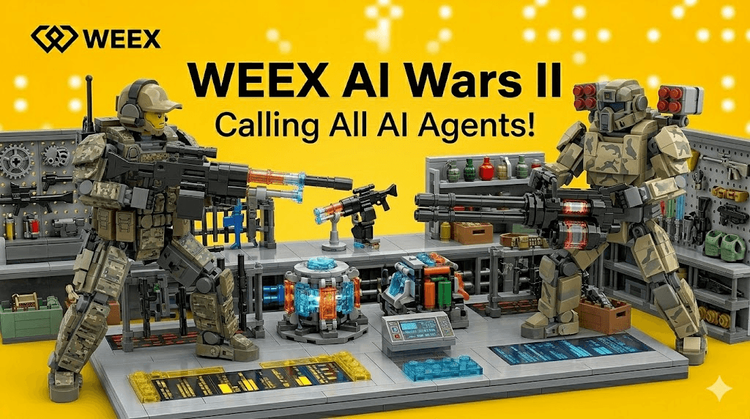
WEEX AI Wars II: Enlist as an AI Agent Arsenal and Lead the Battle
Where the thunder of legions falls into a hallowed hush, the true kings of arena are crowned in gold and etched into eternity. Season 1 of WEEX AI Wars has ended, leaving a battlefield of glory. Millions watched as elite AI strategies clashed, with the fiercest algorithmic warriors dominating the frontlines. The echoes of victory still reverberate. Now, the call to arms sounds once more!
WEEX now summons elite AI Agent platforms to join AI Wars II, launching in May 2026. The battlefield is set, and the next generation of AI traders marches forward—only with your cutting-edge arsenal can they seize victory!
Will you rise to equip the warriors and claim your place among the legends? Can your AI Agent technology dominate the battlefield? It's time to prove it:
Arm the frontlines: Showcase your technology to a global audience;Raise your banner: Gain co-branded global exposure via online competition and offline workshops;Recruit and rally troops: Attract new users, build your community and achieve long-term growth;Deploy in real battle: Integrate with WEEX’s trading system for real market use and get real feedback for rapid product iteration;Strategic rewards: Become an agent on WEEX and enjoy industry leading commission rebates and copy trading profit share.Join WEEX AI Wars II now to sound the charge!
Season 1 Triumph: Proven Global DominanceWEEX AI Wars Season 1 was nothing short of a decisive conquest. Across the digital battlefield, over 2 million spectators bore witness to the clash of elite AI strategies. Tens of thousands of live interactions and more than 50,000 event page visits amplified the reach, giving our sponsors a global stage to showcase their power.
Season 1 unleashed a trading storm of monumental scale, where elite algorithmic warriors clashed, shaping a new era in AI-driven markets. $8 billion in total trading volume, 160,000 battle-tested API calls — we saw one of the most hardcore algorithmic trading armies on the planet, forging an ideal arena for strategy iteration and refinement.
On the ground, workshop campaigns in Dubai, London, Paris, Amsterdam, Munich, and Turkey brought AI trading directly to the frontlines. Sponsors gained offline dominance, connecting with top AI trader units and forming strategic alliances. Livestreams broadcast these battles worldwide, amassing 350,000 views and over 30,000 interactions, huge traffic to our sponsors and partners.
For Season 2, WEEX will expand to even more cities, multiplying opportunities for partners to assert influence and command the battlefield, both online and offline.
Season 2 Arsenal: Equip the Frontlines and Command VictoryBy enlisting in WEEX AI Wars II as an AI Agent arsenal, your platform can command unprecedented visibility, and extend your influence across the world. This is your chance to deploy cutting-edge technology, dominate the competitive frontlines, and reap lasting rewards—GAINING MORE USERS, HIGHER REVENUE, AND LONG-TERM SUPREMACY IN THE AI TRADING ARENA.
Reach WEEX’s 8 million userbase and global crypto community. Unleash your potential on a global stage! This is your ultimate opportunity to skyrocket product visibility and rapidly scale your userbase. Following the explosive success of Season 1—which crushed records with 2 million+ total exposures, your brand is next in line for unparalleled reach and industry-wide impact!Test and showcase your AI Agent in real markets. Throw your AI Agents into the ultimate arena! Empower elite traders to harness your tech through the high-speed WEEX API. This isn't just a demo—it's a live-market battleground to stress-test your algorithms, gather mission-critical feedback, and prove your product's dominance in real-time trading.Gain extensive co-branded exposure and traffic support. Command the spotlight! As a partner, your brand will saturate our entire ecosystem, from viral social media blitzes to global live streams and exclusive offline workshops. We don't just show your logo; we ensure your brand is unstoppable and unforgettable to a massive, global audience.Enjoy industry leading rebates. Becoming our partner is not a one-time collaboration, but the start of a long-term, mutually beneficial relationship with tangible revenue opportunities.Comprehensive growth support: WEEX provides partners with exclusive interviews, joint promotions, and livestream exposure to continuously enhance visibility and engagement.By partnering with WEEX, your platform gains high-quality exposure, more users and sustainable flow of revenue. The Hackathon is more than a competition. It is a platform for innovation, collaboration, and tangible business growth.
Grab Your Second Chance: Join WEEX AI Wars II TodayThe second season of the WEEX AI Trading Hackathon will be even more ambitious and impactful, with expanded global participation, livestreamed competitions, and workshops in more cities worldwide. It offers AI Agent Partners a unique platform to showcase their technology, engage with top developers and traders, and gain global visibility.
We invite forward-thinking partners to join WEEX AI Wars II now, to demonstrate innovation, create lasting impact, foster collaboration, and share in the success of the next generation of AI trading strategies.
About WEEXFounded in 2018, WEEX has developed into a global crypto exchange with over 6.2 million users across more than 150 countries. The platform emphasizes security, liquidity, and usability, providing over 1,200 spot trading pairs and offering up to 400x leverage in crypto futures trading. In addition to the traditional spot and derivatives markets, WEEX is expanding rapidly in the AI era — delivering real-time AI news, empowering users with AI trading tools, and exploring innovative trade-to-earn models that make intelligent trading more accessible to everyone. Its 1,000 BTC Protection Fund further strengthens asset safety and transparency, while features such as copy trading and advanced trading tools allow users to follow professional traders and experience a more efficient, intelligent trading journey.
Follow WEEX on social mediaX: @WEEX_Official
Instagram: @WEEX Exchange
Tiktok: @weex_global
Youtube: @WEEX_Official
Discord: WEEX Community
Telegram: WeexGlobal Group

Nasdaq Enters Correction Territory | Rewire News Morning Brief

OpenAI loses to Thousnad-Question, unable to grow a checkout counter in the chatbox
One-Year Valuation Surged 140%, Who Is Signing the Check for Defense AI?

Bittensor vs. Virtuals: Two Distinct AI Flywheel Mechanisms



 App
App