
- Buy Crypto
- Markets
 Futures
- Spot
- Copy Trade
- Earn
- More
AgriDex ($AGRI) Brings $2.7 Trillion Agriculture Industry On-Chain via Solana’s RWA Ecosystem
By: bitcoin ethereum news|2025/05/08 02:15:02
0
Share
Key Takeaways: AgriDex tokenizes farmland and agricultural goods using Solana’s fast, low-fee blockchain network $AGRI is one of the few Solana-based RWA tokens focused on agriculture, alongside Baxus and Ondo The platform enables fractional ownership, smart contract-based trading, and low-cost international transfers Bringing real-world assets (RWAs) on-chain, AgriDex ($AGRI) is changing the agriculture economy. AgriDex uses Solana’s infrastructure to increase cross-border agricultural product and farmland trading efficiency and transparency as the worldwide agriculture industry exceeds $2.7 trillion in value. AgriDex: Blockchain Meets Agriculture A Solana-based distributed market, AgriDex facilitates on-chain trade of agricultural goods and land. AgriDex tokenizes real-world assets like land and goods using their RWA paradigm, converting them into digital tokens tradeable by anybody with internet connection. This approach brings much-needed openness and accessibility to a sector famous for its inefficiencies, high entrance hurdles, and dependence on middlemen. Now farmers, exporters, and investors may participate in cross-border transactions free of conventional obstacles. AgriDex’s smart contract framework automates transactions and ownership transfers. Instead of relying on notaries, lawyers, or brokers, parties can settle trades through verifiable blockchain code. This reduces settlement times from days to seconds and brings down transaction fees from traditional rates of 3–6% to just 0.15%. Solana’s Infrastructure Powers the Platform Fast, Cheap, and Transparent Transactions Solana’s fast, low-cost network is essential to the platform’s success. With network rates as low as $0.00025 per transaction, Solana runs thousands of transactions per second (TPS). For AgriDex, this translates to real-time trade confirmations and reduced expenses for end-users. Every on-chain transaction is recorded immutably, hence enabling stakeholders to monitor asset ownership, trade history, and contract execution. Especially in agricultural supply chains with several vendors and geographic areas, this openness lowers counterparty risks. Smart contracts replace traditional paperwork, making deals faster and more secure. By using tokenized ownership, AgriDex simplifies participation for both small-scale farmers and institutional investors. Read More: Solana Surges as Solaxy Gains Traction – Could This Be the Innovative Crypto Projects in 2025? Institutional Attention and Analyst Endorsement Nick Ducoff, Head of Institutional Growth at the Solana Foundation, recently highlighted AgriDex ($AGRI) as one of the ecosystem’s most promising RWA projects. In a public discussion on RWA innovation within Solana, he placed $AGRI alongside Baxus (tokenized wine and spirits) and Ondo Finance (tokenized U.S. Treasuries) as key examples of Solana’s growing RWA footprint. Crypto analyst Michaël van de Poppe also singled out $AGRI for its practical use case and sector-specific potential. He emphasized the agricultural market’s global scale and inefficiencies, noting that blockchain adoption can significantly improve access to capital and efficiency across borders. Despite its current status as a micro-cap token, $AGRI is attracting attention because of its unique focus. With real use cases and early traction—such as a $165,000 farmland sale in Zambia and commodity exports from South Africa to London—AgriDex is moving beyond the conceptual phase into actual deployment. Real-World Use Cases and Market Expansion Tokenized Farmland and Commodities in Action AgriDex is already demonstrating how tokenized agriculture works in the real world. One of its notable milestones includes a farmland transaction worth $165,000 conducted entirely on-chain. Executed in Zambia, the agreement used smart contracts to directly transfer land ownership, therefore avoiding traditional legal channels. AgriDex enables several investors to co-own agricultural land or commodities by means of tokenized ownership. Instead of buying an entire farm, users can buy fractions, receive proportional returns, and trade their stakes on secondary markets. This model democratizes access to an asset class traditionally limited to wealthy investors or large corporations, enabling global participation regardless of geography. Solana’s RWA Ecosystem Gains Momentum AgriDex is part of a broader movement within the Solana ecosystem focused on real-world assets. While Ondo Finance offers tokenized exposure to yield-bearing U.S. government bonds and Baxus brings fine wines and spirits on-chain, AgriDex focuses squarely on agriculture—a market that has been largely overlooked in the RWA space. AgriDex’s early success may pave the way for more agriculture-based RWA projects on Solana, including tokenized futures, weather derivatives, and agricultural insurance products. As the sector matures, more institutions are expected to enter, drawn by the potential for stable yields from real-world production. Read More: Solana’s Surge Ignites Utility Tokens – Here’s Why $SOLX Could Be the Major Gainer From Solana’s Growth Why $AGRI Is One to Watch According to Michaël van de Poppe , while $AGRI is still small in terms of market capitalization, its unique focus and working use cases make it a standout in the RWA landscape. The agriculture industry’s size, combined with its inefficiencies, makes it ripe for disruption. By being one of the first movers in this space, AgriDex is positioning itself to lead the tokenized agriculture narrative on Solana. Source: https://www.cryptoninjas.net/news/agridex-agri-brings-2-7-trillion-agriculture-industry-on-chain-via-solanas-rwa-ecosystem/
You may also like

Particle Founder: The entrepreneurial insights I have gained the most from in the past year
Stop lean startup, stop lightning entrepreneurship, and think carefully about what your product aspirations are.

Huang Renxun's latest podcast transcript: The future of Nvidia, the development of embodied intelligence and agents, the explosion of inference demand, and the public relations crisis of artificial intelligence
The competition in the future is not just about whose model is larger or whose computing power is stronger, but also about who understands the industry better, who can embed AI more deeply into real processes, and who can organize these capabilities into a runnable and scalable system.

OKX Ventures Research Report: AI Agent Economic Infrastructure Research Report (Part 1)
The existing infrastructure is hostile to the Agent economy. Agents can think and act independently at the "capability level," but at the "economic level," they are still locked into infrastructure designed for humans.

The migration of settlement rights: B18 and the institutional starting point of on-chain banks
In the traditional system, banks decide the settlement; in the on-chain system, code begins to take over this responsibility.

From Tencent and Circle: Looking at the Simple and Difficult Questions of Investment
The AI narrative continues to ferment, but the recent performance of related stocks varies, with some in the midst of summer and others as if in winter.

The second half of stablecoins no longer belongs to the crypto circle
What Coinbase doesn't want, Mastercard is eager to buy.

Cursor "Shell" Kimi Controversy Reversed: From Copyright Infringement Allegations to Authorized Collaboration, China's Open Source Model Once Again Becomes a Global AI Foundation
Cursor was accused of being based on Kimi K2.5, which sparked controversy, and was later confirmed to be compliant through Fireworks AI due diligence.

The Real Reason Tokens Don't Sell: 90% of Crypto Projects Overlook Investor Relations
Provide an Investor Relations Best Practices Guide for Crypto Projects.

Is the income of pump.fun real, earning a million dollars a day despite the market downturn?
If it can really earn this much, what is the reason for the low price of $PUMP?

The real reason why tokens are not selling: 90% of crypto projects neglect investor relations
Investor Relations Practice Guide for Cryptocurrency Projects.

Who is the true winner of the "Tokenization" narrative?
Virtually everyone benefits, but the reason for the benefit, the timing, and the underlying logic are completely different.

Moss: The Era of AI-Traded by Anyone | Project Introduction
AI Trading Agent is rapidly growing its infrastructure.

Chip Smuggling Case Exposes Regulatory Loophole | Rewire News Evening Update
AI chips have become a strategic asset more sensitive than missiles

How a Structured AI Crypto Trading Bot Won at the WEEX Hackathon
Ritmex demonstrates how disciplined risk control and structured signals can make an AI crypto trading bot more stable and reliable on WEEX, highlighting the importance of combining execution discipline with scalable AI trading systems.

Old Indicator Fails, Three Major New Signals Emerge: BTC True Bottom May Still Be Below $60K
When the grocery shopping auntie on the subway, or Tony the hairdresser, start asking you about BTC, crypto, and cryptocurrency investments, selling immediately will be the only best option.

Meeting OpenClaw Founder at a Hackathon: What Else Can Lobsters Do?
Imperial College London MetaGame: AI Agent × Web3 Landing Three Major Directions.
Huang Renxun's Latest Podcast Transcript: NVIDIA's Future, Embodied Intelligence and Agent Development, Soaring Demand for Inferencing, and AI's PR Crisis
The future of competition is not only about whose model is bigger, whose computing power is stronger, but also about who understands the industry better, who can more deeply integrate AI into real processes, and who can organize these capabilities into a set of executable, scalable systems
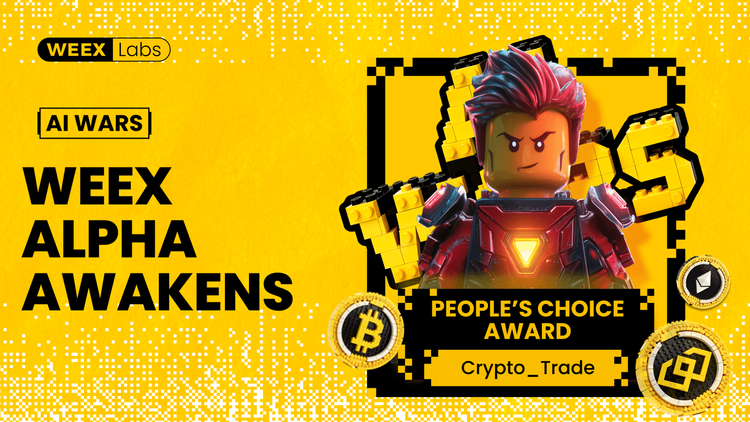
How a Structured AI Crypto Trading Bot Won at the WEEX Hackathon
Crypto_Trade shows how structured inputs and controlled adaptability can build a more stable and reliable AI crypto trading bot within the WEEX AI Trading Hackathon, highlighting a practical path toward scalable AI trading systems.
Particle Founder: The entrepreneurial insights I have gained the most from in the past year
Stop lean startup, stop lightning entrepreneurship, and think carefully about what your product aspirations are.
Huang Renxun's latest podcast transcript: The future of Nvidia, the development of embodied intelligence and agents, the explosion of inference demand, and the public relations crisis of artificial intelligence
The competition in the future is not just about whose model is larger or whose computing power is stronger, but also about who understands the industry better, who can embed AI more deeply into real processes, and who can organize these capabilities into a runnable and scalable system.
OKX Ventures Research Report: AI Agent Economic Infrastructure Research Report (Part 1)
The existing infrastructure is hostile to the Agent economy. Agents can think and act independently at the "capability level," but at the "economic level," they are still locked into infrastructure designed for humans.
The migration of settlement rights: B18 and the institutional starting point of on-chain banks
In the traditional system, banks decide the settlement; in the on-chain system, code begins to take over this responsibility.
From Tencent and Circle: Looking at the Simple and Difficult Questions of Investment
The AI narrative continues to ferment, but the recent performance of related stocks varies, with some in the midst of summer and others as if in winter.
The second half of stablecoins no longer belongs to the crypto circle
What Coinbase doesn't want, Mastercard is eager to buy.


 App
App