
- Buy Crypto
- Markets
 Futures
- Spot
- Copy Trade
- Earn
- More
Circle’s plan to disrupt global finance
By: bitcoin ethereum news|2025/05/05 19:30:02
0
Share
Homepage > News > Finance > Rise of stablecoins: Circle’s plan to disrupt global finance Until recently, stablecoins were a bit of a lackluster product. Their primary use case was to give cryptocurrency traders a safe haven asset they could easily move into when exiting a trading position and out of when they were ready to re-enter the market. Beyond that, real-world use cases were few and far between. Some traders liked holding sizable stablecoin positions because they could earn interest by staking them, but in the United States, staking quickly became illegal in many states, which caused that use case to shrink. However, in 2025, things started to shift. Stablecoins exploded in popularity, not just in crypto circles, but across traditional finance, too. Practically overnight, it felt like every major company was announcing a stablecoin launch or stablecoin support. The profit and policy shift fueling the stablecoin boom The newfound interest in stablecoins can be boiled down to profit and regulations. Launching a stablecoin is relatively easy (if you have decamillions or more). Once a company launches one, exchanges, wallets, and other partners need to buy it for operational reasons, providing the issuer with immediate customers and demand. From there, the issuer rakes cash from holding customer deposits in safe, yield-generating assets like U.S. Treasury bills. As long as the stablecoin is fully backed 1:1 with real dollars or short-term treasuries, it’s a low-risk, high-profit business model. From the issuer’s side, the fact that stablecoins are reliable money makers is enough incentive for any big name to launch one. On the regulatory side, strict policies around the banking and finance industry made it almost impossible for traditional players to engage with blockchain technology—including stablecoins—in any meaningful way. But now, under a new administration that is actively deregulating parts of the banking and payments sectors, the obstacles that once prevented the cross-pollination of blockchain and the traditional financial system are beginning to fade away, and even more, barriers are expected to be dismantled over the next four years. A turning point for crypto and traditional finance These two elements, the regulatory shift in particular, enabled blockchain goods and services to integrate into the traditional financial system. Circle saw this shift happening–and to be fair, they were probably benefiting from their relationship with the White House and U.S. President Donald Trump—and moved fast, taking an approach to stablecoins different from the run-of-the-mill safe haven use case. Instead, the company began making an effort to use blockchain infrastructure to power global payments for banks and institutions. Circle first broke this news when they recently announced the launch of the Circle Payments Network (CPN), a global payment system that runs on blockchain rails and settles payments with stablecoins. From the looks of it, Circle designed this product to disrupt the legacy payment networks that have historically been the backbone of domestic and international finance. How Circle Payments Network works Operationally, the Circle Payments Network is similar to a blockchain transaction you might already be familiar with, but it’s been tailored specifically for financial institutions. To kick off a transaction, a customer tells their bank or payment provider (called an “Originating Financial Institution” or OFI) that they want to send money to someone abroad. The OFI converts the customer’s dollars into USDC stablecoin. Then, using the CPN—which functions like a marketplace or coordinating protocol—the OFI finds a partner bank or payment company in the receiver’s country (a “Beneficiary Financial Institution” or BFI). The USDC is sent across a blockchain network to the BFI almost instantly. Once received, the BFI either converts the USDC into the local currency and deposits it into the receiver’s account or allows the receiver to keep it as digital dollars. Compare that to the incumbent model in traditional finance, where a sender goes to their bank, requests an international wire transfer, and then the money hops through one to three intermediary banks before reaching the receiver’s bank. Each intermediary charges a fee and performs compliance checks, introducing additional time delays. If the transfer crosses time zones, occurs over the weekend, or involves currency conversions, it can take 2–5 days to complete. The benefits of stablecoins in the banking system In its whitepaper, Circle highlights four core benefits of CPN over traditional global payment systems: lower costs, faster settlement times, greater transparency, and the ability to continuously innovate. However, the two most compelling benefits are lower costs and faster settlements, which are the two factors that will most likely get banks and institutions to join the CPN. According to McKinsey’s Global Payments Report 2024, the average cost of sending $200 internationally was 6.65%. Currency conversion fees, liquidity issues, and compliance checks all add to this burden. By contrast, Circle’s Payment Network claims to significantly reduce these costs. While there are still some fees such as the payout fees to BFIs, FX spreads, and a CPN network fee, the overall cost is expected to be multitudes lower than incumbent methods. On top of that, what currently takes 2–5 days to move through the incumbent system could happen almost instantaneously through the CPN. As you can imagine, the cost savings and reduced settlement times alone could be enough to incentivize banks, as it benefits both the banks themselves—lower costs—and their customers who will receive their money faster. Could Circle’s Payments Network be blockchain’s killer app? The Circle Payment Network’s development could be one of the most important milestones for the blockchain and digital asset industry. For over a decade, blockchain technology existed, but its real-world impact beyond trading and speculating was limited. Despite all the promises of disruption and innovation, blockchain and digital currency never quite became the core piece of infrastructure and technology its advocates preached that it would be. However, CPN could change that. It can potentially be what I would call blockchain’s second killer app—that’s assuming trading and speculation is killer app #1—by embedding itself into the plumbing of the global financial system and becoming a viable alternative to giants like SWIFT and ACH. Of course, the success of the Circle Payments Network hinges on adoption. If only a handful of institutions use it, its impact will be minimal. However, if a critical mass of major players, the world’s largest transactors by volume, start using CPN, the resulting cost savings, efficiency gains, and speed improvements could be significant. If Circle’s payment network succeeds, it will do a lot in helping the blockchain and digital asset industry mature. To date, blockchain and digital assets have arguably been a bit of a joke to legacy players and operations in the finance industry. From their point of view, even though they would acknowledge the potential, blockchain and digital assets historically haven’t had much utility and often added unnecessary layers of friction to a process that oftentimes made it more complicated than just using fiat currency for a transaction. However, by giving institutions a legitimate value proposition that should at least get them to try the CPN, Circle could end up making blockchain technology a permanent fixture in the global financial system. Watch: Blockchain is much more than digital assets title=”YouTube video player” frameborder=”0′′ allow=”accelerometer; autoplay; clipboard-write; encrypted-media; gyroscope; picture-in-picture; web-share” referrerpolicy=”strict-origin-when-cross-origin” allowfullscreen=””> Source: https://coingeek.com/rise-of-stablecoins-circle-plan-to-disrupt-global-finance/
You may also like

More brutal than a bear market, OpenClaw founder advises young people to stay away from crypto
This is not just a disdain for financial nihilism, but also a migration of talent, capital, and attention that is currently happening.

JPMorgan and Goldman raise gold price targets; will on-chain finance welcome a new reserve asset cycle?
Wall Street giants adjust gold price expectations, Matrixdock proposes the concept of Reserve Layer: tokenized gold XAUm, with its institutional-grade compliance structure, is evolving into the underlying reserve asset of on-chain finance.

dFans: OnlyFans of the AI Era
As the industrialization capability of AI video matures, the "industrialization singularity" of AI content creation has arrived. Tools like OpenAI, Google Veo, and Runway have achieved controllable creation, significantly lowering the barriers to content production. AI content creators are emerging ...

Tron Industry Weekly Report: Geopolitical Turmoil Escalates, BTC Continues to Test $60,000, Detailed Explanation of the Protocol Konnex for AI Autonomous Collaboration and Settlement on the Chain
TRON Industry Weekly Report
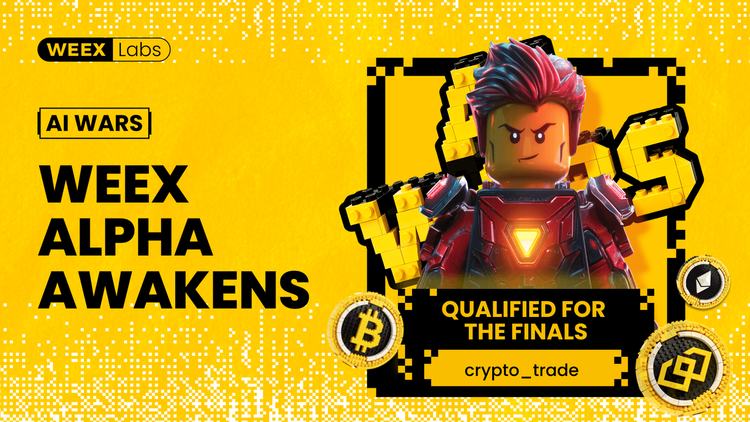
From CTA to AI: The Evolution of Adaptive Quant Strategies in Crypto Markets
Explore how an LLM-powered AI market-neutral trading strategy achieved a 2.75 Sharpe ratio with controlled drawdown. Inside crypto_trade’s adaptive hedging system at the WEEX AI Trading Hackathon.

How 30+ Global Sponsors Powered WEEX AI Trading Hackathon Into a $1.88M Carnival
Discover how 30+ global sponsors including AWS helped power the $1.88M WEEX AI Trading Hackathon, turning AI strategies into live crypto market competition.

Key Market Information Discrepancy on March 2nd - A Must-See! | Alpha Morning Report
1. Top News: Last Night's US-Iran Situation Recap, Iranian High-ranking Officials Killed, Over 200 Ships Stranded in the Strait of Hormuz
2. Token Unlock: $ENA
Iran Missile Strike in Dubai: Three Chinese Nationals Tell Their Story 48 Hours Later
The sound is still in the distance, so the days can still go on.

72 Minutes Before Attack, Six Mysterious Accounts Raked in $1.2 Million
These accounts were all registered in February, with most of them making their first deposit within 24 hours before the attack, and they have no other transaction history. Their behavior closely resembles insider trading.

How to Preserve Life and Wealth in Turbulent Times | Bill It Up Memo
In times of chaos, only through diversified allocation and keen observation can one preserve wealth and life in the face of great changes.

I have given up using OpenClaw
Instead of struggling with expensive and unstable AI assistants, it's better to use Claude to create a more stable, cost-effective, and understanding personal system.
WLFI is involved in insider dealings again? The banking license controversy under a $500 million investment
The UAE's investment in World Liberty Financial has intensified concerns about whether it receives special treatment and whether it involves national security issues.
Morning News | Iranian Supreme Leader Khamenei Assassinated; Kalshi to Refund Fees for "Will Khamenei Step Down" Related Market; Bitcoin Spot ETF Sees Net Inflow of $787 Million This Week
Overview of Important Market Events on March 1

The harvesting tactics of the quantitative giant Jane Street
Quantitative giant Jane Street has been accused of manipulating the liquidity and derivatives of markets such as the Indian stock market and Bitcoin, earning billions of dollars in the process.

Cryptocurrency ETF Weekly | Last week, the net inflow for Bitcoin spot ETFs in the U.S. was $787 million; the net inflow for Ethereum spot ETFs in the U.S. was $80.2 million
Top universities like Harvard have started to allocate to Bitcoin ETFs in their endowment funds.
WLFI at it Again? Banking License Controversy Amid $500M Investment
The UAE's investment in World Liberty Financial has heightened concerns over whether it received special treatment and whether national security issues are involved

The Aave civil war escalates, Morpho quietly doubles: Is the lending throne about to change hands?
Wall Street asset management giant Apollo Global Management invested $160 million in Morpho.

Dune Stablecoin Research: The Flow and Demand of a $300 Billion Market
In the dataset, transfers are no longer simply labeled as pure "transaction volume," but are classified as different on-chain activities. This is the difference between "just knowing that $100 trillion has been transferred" and "understanding why it was transferred."
More brutal than a bear market, OpenClaw founder advises young people to stay away from crypto
This is not just a disdain for financial nihilism, but also a migration of talent, capital, and attention that is currently happening.
JPMorgan and Goldman raise gold price targets; will on-chain finance welcome a new reserve asset cycle?
Wall Street giants adjust gold price expectations, Matrixdock proposes the concept of Reserve Layer: tokenized gold XAUm, with its institutional-grade compliance structure, is evolving into the underlying reserve asset of on-chain finance.
dFans: OnlyFans of the AI Era
As the industrialization capability of AI video matures, the "industrialization singularity" of AI content creation has arrived. Tools like OpenAI, Google Veo, and Runway have achieved controllable creation, significantly lowering the barriers to content production. AI content creators are emerging ...
Tron Industry Weekly Report: Geopolitical Turmoil Escalates, BTC Continues to Test $60,000, Detailed Explanation of the Protocol Konnex for AI Autonomous Collaboration and Settlement on the Chain
TRON Industry Weekly Report
From CTA to AI: The Evolution of Adaptive Quant Strategies in Crypto Markets
Explore how an LLM-powered AI market-neutral trading strategy achieved a 2.75 Sharpe ratio with controlled drawdown. Inside crypto_trade’s adaptive hedging system at the WEEX AI Trading Hackathon.
How 30+ Global Sponsors Powered WEEX AI Trading Hackathon Into a $1.88M Carnival
Discover how 30+ global sponsors including AWS helped power the $1.88M WEEX AI Trading Hackathon, turning AI strategies into live crypto market competition.


 App
App