
- Buy Crypto
- Markets
 Futures
- Spot
- Copy Trade
- Earn
- More
Congressional Hearing Questions Trump’s World Liberty Financial Over Potential Subsidies Linked to USD1 Stablecoin Deal
By: en coinotag|2025/05/08 02:00:06
0
Share
The recent congressional hearing has unveiled potential conflicts of interest surrounding President Trump’s crypto-related firm, World Liberty Financial (WLFI). Lawmakers scrutinized a $2 billion no-interest deal that could substantially benefit Trump’s affiliated cryptocurrency, raising questions about financial transparency. A documented quote from Rep. Brad Sherman highlights the concern: “Is this interest‐free loan of $2 billion worth $80 million every year to WLFI and its Trump owners?” In a controversial congressional hearing, lawmakers questioned the financial implications of Trump’s crypto firm, spotlighting conflicts of interest and potential subsidies. Congressional Hearing Draws Attention to Trump’s Crypto Activities U.S. Treasury Secretary Scott Bessent faced tough questions from the House Financial Services Committee regarding the operations of World Liberty Financial, a company deeply connected to former President Trump. Founded in 2024, WLFI claims to have raised approximately $550 million through its governance token, amidst significant political scrutiny. In March, WLFI launched its new stablecoin, USD1, which is pegged to the U.S. dollar and supported by U.S. Treasuries and cash equivalents. Just weeks after its launch, the firm announced a $2 billion deployment of USD1 by Abu Dhabi’s state-backed MGX. This agreement has catapulted USD1 to the forefront of the stablecoin market by capitalizing on its substantial market cap. Rep. Brad Sherman emphasized the financial implications of this arrangement, suggesting that, based on a typical market interest rate of 4%, the no-interest loan effectively acts as an $80 million annual subsidy to Trump and his company’s interests. As Sherman articulated, “Abu Dhabi just announced that they were going to give $2 billion to a stablecoin put forward by World Liberty Financial, and it pays no interest.” This raises alarming questions about whether such arrangements could fall under hidden financial support favoring politically connected individuals. Concerns Regarding Transparency and Policy Influence Bessent has so far maintained that no regulations prohibit such arrangements from being considered hidden subsidies, despite the lawmakers’ urgent call for regulatory clarity. The concern is that this financial structure could obscure potential political favors, prompting lawmakers to press for comprehensive disclosures regarding stablecoin frameworks. Investigative reports, including one by the New York Times, have indicated several concerning aspects surrounding WLFI, such as undisclosed multimillion-dollar “endorsements” and financial arrangements benefiting foreign entities. This brings to light the firm’s unprecedented blurring of lines between commerce and governmental policymaking. Legislative Proposals on the Horizon In light of these revelations, Democratic lawmakers have indicated plans to introduce legislation aimed at enforcing mandatory expense-ratio disclosures for stablecoins. This initiative also includes proposals to prohibit no-interest financial structures characterized as effective subsidies. Such measures are crucial to establish much-needed transparency in the rapidly evolving crypto landscape, especially when politically intertwined firms are at play. Conclusion The ongoing scrutiny of World Liberty Financial highlights the imperative for greater regulatory oversight in cryptocurrency markets, particularly concerning entities with political connections. As Congress debates the ramifications of these financial arrangements, transparency and integrity in governmental dealings are more critical than ever. These discussions will likely influence not only the future of WLFI but the regulatory landscape for the entire cryptocurrency sector.
You may also like

Particle Founder: The entrepreneurial insights I have gained the most from in the past year
Stop lean startup, stop lightning entrepreneurship, and think carefully about what your product aspirations are.

Huang Renxun's latest podcast transcript: The future of Nvidia, the development of embodied intelligence and agents, the explosion of inference demand, and the public relations crisis of artificial intelligence
The competition in the future is not just about whose model is larger or whose computing power is stronger, but also about who understands the industry better, who can embed AI more deeply into real processes, and who can organize these capabilities into a runnable and scalable system.

OKX Ventures Research Report: AI Agent Economic Infrastructure Research Report (Part 1)
The existing infrastructure is hostile to the Agent economy. Agents can think and act independently at the "capability level," but at the "economic level," they are still locked into infrastructure designed for humans.

The migration of settlement rights: B18 and the institutional starting point of on-chain banks
In the traditional system, banks decide the settlement; in the on-chain system, code begins to take over this responsibility.

From Tencent and Circle: Looking at the Simple and Difficult Questions of Investment
The AI narrative continues to ferment, but the recent performance of related stocks varies, with some in the midst of summer and others as if in winter.

The second half of stablecoins no longer belongs to the crypto circle
What Coinbase doesn't want, Mastercard is eager to buy.

Cursor "Shell" Kimi Controversy Reversed: From Copyright Infringement Allegations to Authorized Collaboration, China's Open Source Model Once Again Becomes a Global AI Foundation
Cursor was accused of being based on Kimi K2.5, which sparked controversy, and was later confirmed to be compliant through Fireworks AI due diligence.

The Real Reason Tokens Don't Sell: 90% of Crypto Projects Overlook Investor Relations
Provide an Investor Relations Best Practices Guide for Crypto Projects.

Is the income of pump.fun real, earning a million dollars a day despite the market downturn?
If it can really earn this much, what is the reason for the low price of $PUMP?

The real reason why tokens are not selling: 90% of crypto projects neglect investor relations
Investor Relations Practice Guide for Cryptocurrency Projects.

Who is the true winner of the "Tokenization" narrative?
Virtually everyone benefits, but the reason for the benefit, the timing, and the underlying logic are completely different.

Moss: The Era of AI-Traded by Anyone | Project Introduction
AI Trading Agent is rapidly growing its infrastructure.

Chip Smuggling Case Exposes Regulatory Loophole | Rewire News Evening Update
AI chips have become a strategic asset more sensitive than missiles

How a Structured AI Crypto Trading Bot Won at the WEEX Hackathon
Ritmex demonstrates how disciplined risk control and structured signals can make an AI crypto trading bot more stable and reliable on WEEX, highlighting the importance of combining execution discipline with scalable AI trading systems.

Old Indicator Fails, Three Major New Signals Emerge: BTC True Bottom May Still Be Below $60K
When the grocery shopping auntie on the subway, or Tony the hairdresser, start asking you about BTC, crypto, and cryptocurrency investments, selling immediately will be the only best option.

Meeting OpenClaw Founder at a Hackathon: What Else Can Lobsters Do?
Imperial College London MetaGame: AI Agent × Web3 Landing Three Major Directions.
Huang Renxun's Latest Podcast Transcript: NVIDIA's Future, Embodied Intelligence and Agent Development, Soaring Demand for Inferencing, and AI's PR Crisis
The future of competition is not only about whose model is bigger, whose computing power is stronger, but also about who understands the industry better, who can more deeply integrate AI into real processes, and who can organize these capabilities into a set of executable, scalable systems
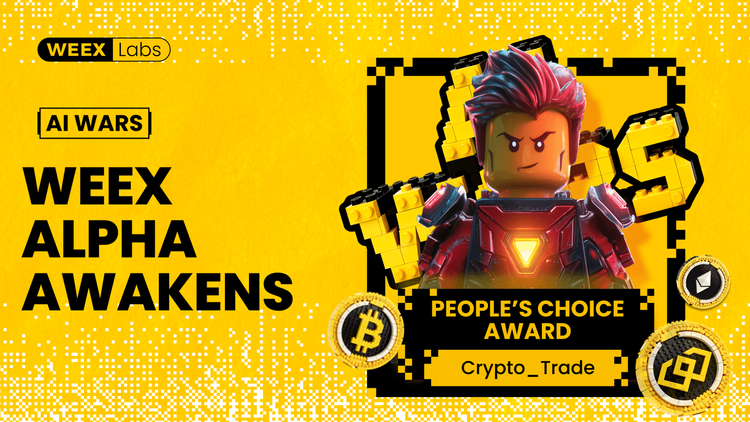
How a Structured AI Crypto Trading Bot Won at the WEEX Hackathon
Crypto_Trade shows how structured inputs and controlled adaptability can build a more stable and reliable AI crypto trading bot within the WEEX AI Trading Hackathon, highlighting a practical path toward scalable AI trading systems.
Particle Founder: The entrepreneurial insights I have gained the most from in the past year
Stop lean startup, stop lightning entrepreneurship, and think carefully about what your product aspirations are.
Huang Renxun's latest podcast transcript: The future of Nvidia, the development of embodied intelligence and agents, the explosion of inference demand, and the public relations crisis of artificial intelligence
The competition in the future is not just about whose model is larger or whose computing power is stronger, but also about who understands the industry better, who can embed AI more deeply into real processes, and who can organize these capabilities into a runnable and scalable system.
OKX Ventures Research Report: AI Agent Economic Infrastructure Research Report (Part 1)
The existing infrastructure is hostile to the Agent economy. Agents can think and act independently at the "capability level," but at the "economic level," they are still locked into infrastructure designed for humans.
The migration of settlement rights: B18 and the institutional starting point of on-chain banks
In the traditional system, banks decide the settlement; in the on-chain system, code begins to take over this responsibility.
From Tencent and Circle: Looking at the Simple and Difficult Questions of Investment
The AI narrative continues to ferment, but the recent performance of related stocks varies, with some in the midst of summer and others as if in winter.
The second half of stablecoins no longer belongs to the crypto circle
What Coinbase doesn't want, Mastercard is eager to buy.


 App
App