
- Buy Crypto
- Markets
 Futures
- Spot
- Copy Trade
- Earn
- More
Ethereum quietly flips the switch on Pectra
By: bitcoin ethereum news|2025/05/08 02:15:02
0
Share
This is a segment from the 0xResearch newsletter. To read full editions, subscribe. Ethereum’s most ambitious upgrade since the Merge is now live. The Pectra hard fork, which activated smoothly shortly after 6 am ET, delivers a powerful set of upgrades to Ethereum’s execution and consensus layers, affecting everything from validator operations to transaction UX and data availability. What’s changed? The upgrade introduces several important features, grouped roughly into three categories: Smart accounts (EIP-7702) This upgrade lets EOAs temporarily behave like smart contracts, opening the door to batched transactions, stablecoin and sponsored gas payments — a massive UX unlock, according to Hart Lambur, co-founder of Risk Labs (which built Across and UMA). For example, “users will be able to sign a single intent that seamlessly triggers actions across chains — no need for native gas, no extra wallet setup and no extra developer work,” Lambur told Blockworks. “It gets us closer to a world where bridging is invisible and cross-chain coordination just happens under the hood.” Data availability scaling (EIP-7691) By doubling blobspace capacity from six to 12 blobs per block, Ethereum increases throughput for rollups and reduces L2 fees. But as Ansgar Dietrichs pointed out, saturation of this new capacity would be good for Ethereum, provided it can continue scaling bandwidth to avoid too much fee pressure as demand grows. Validator UX and efficiency Pectra raises the maximum effective validator balance from 32 ETH to 2,048 ETH, which Alluvial co-founder Matt Leisinger calls “a meaningful unlock for institutions.” “Institutions can now autocompound rewards natively — no more skimming and aggregating 32 ETH to stay efficient,” Leisinger told Blockworks. Bohdan Opryshko at Everstake thinks it may be the “most institution-friendly update yet.” He notes EIP-7002 also allows validators to exit using execution-layer controls, reducing trust assumptions for stakers and protocols alike — altogether making “staking at scale with operational clarity” possible for more conservative capital. What happens next? Pectra sets the stage for Fusaka, Ethereum’s next major upgrade — now tentatively pushed to 2026. That fork is expected to introduce PeerDAS, a more efficient data availability sampling scheme for rollups, and continue laying the groundwork for future upgrades like Verkle trees and full account abstraction. But in the coming months, attention will shift to ecosystem adoption as teams try to showcase the real-world capabilities of the upgrade. How will wallets, L2s and dapps move to support EIP-7702? We can expect features like batched transactions, gas sponsorship and stablecoin fee payments. According to OP Labs’ Sam McIngvale, “apps drive this adoption curve.” “Wallets will follow once there’s clear demand,” McIngvale told Blockworks. “If widely adopted, 7702 could finally make one-click onboarding and abstracted UX the norm.” Now that rollups can post more data to Ethereum cheaply, how long will it take to saturate that bandwidth? This could have consequences for rollups’ adoption of alternative DA layers such as EigenDA, Celestia and Avail. If L2 activity fails to match blob supply, scaling momentum could stall. Conversely, if demand rises too quickly, Ethereum may need to accelerate PeerDAS or further blob increases to prevent bottlenecks. Large operators can collapse thousands of validators into a few, but testnets couldn’t simulate how much that will improve efficiency, so it will be interesting to observe the concrete effects. Solo stakers may benefit indirectly, according to Preston van Loon, a core developer with Offchain Labs. Fewer attestations from consolidated validators means lower network bandwidth requirements. “It really does help everybody,” van Loon told Blockworks. “It’s hard to say which group has the outsized benefit.” Dashboards tracking validator set composition, message propagation and slashing rates will become key indicators. The “unpredictability of network behavior” may be a risk in the future, MIT professor and Optimum co-founder Muriel Médard warned. “As blob sizes and message throughput increase, Ethereum’s ability to propagate data efficiently and predictably will define how far it can scale,” Médard told Blockworks. Considering the fork involved more EIPs than any prior upgrade, Pectra’s quiet launch may signal just how much Ethereum has matured as a decentralized protocol. Still, the protocol has a long way to go and faces more competition than ever. Get the news in your inbox. Explore Blockworks newsletters: Source: https://blockworks.co/news/ethereum-pectra-fork-live
You may also like

Particle Founder: The entrepreneurial insights I have gained the most from in the past year
Stop lean startup, stop lightning entrepreneurship, and think carefully about what your product aspirations are.

Huang Renxun's latest podcast transcript: The future of Nvidia, the development of embodied intelligence and agents, the explosion of inference demand, and the public relations crisis of artificial intelligence
The competition in the future is not just about whose model is larger or whose computing power is stronger, but also about who understands the industry better, who can embed AI more deeply into real processes, and who can organize these capabilities into a runnable and scalable system.

OKX Ventures Research Report: AI Agent Economic Infrastructure Research Report (Part 1)
The existing infrastructure is hostile to the Agent economy. Agents can think and act independently at the "capability level," but at the "economic level," they are still locked into infrastructure designed for humans.

The migration of settlement rights: B18 and the institutional starting point of on-chain banks
In the traditional system, banks decide the settlement; in the on-chain system, code begins to take over this responsibility.

From Tencent and Circle: Looking at the Simple and Difficult Questions of Investment
The AI narrative continues to ferment, but the recent performance of related stocks varies, with some in the midst of summer and others as if in winter.

The second half of stablecoins no longer belongs to the crypto circle
What Coinbase doesn't want, Mastercard is eager to buy.

Cursor "Shell" Kimi Controversy Reversed: From Copyright Infringement Allegations to Authorized Collaboration, China's Open Source Model Once Again Becomes a Global AI Foundation
Cursor was accused of being based on Kimi K2.5, which sparked controversy, and was later confirmed to be compliant through Fireworks AI due diligence.

The Real Reason Tokens Don't Sell: 90% of Crypto Projects Overlook Investor Relations
Provide an Investor Relations Best Practices Guide for Crypto Projects.

Is the income of pump.fun real, earning a million dollars a day despite the market downturn?
If it can really earn this much, what is the reason for the low price of $PUMP?

The real reason why tokens are not selling: 90% of crypto projects neglect investor relations
Investor Relations Practice Guide for Cryptocurrency Projects.

Who is the true winner of the "Tokenization" narrative?
Virtually everyone benefits, but the reason for the benefit, the timing, and the underlying logic are completely different.

Moss: The Era of AI-Traded by Anyone | Project Introduction
AI Trading Agent is rapidly growing its infrastructure.

Chip Smuggling Case Exposes Regulatory Loophole | Rewire News Evening Update
AI chips have become a strategic asset more sensitive than missiles

How a Structured AI Crypto Trading Bot Won at the WEEX Hackathon
Ritmex demonstrates how disciplined risk control and structured signals can make an AI crypto trading bot more stable and reliable on WEEX, highlighting the importance of combining execution discipline with scalable AI trading systems.

Old Indicator Fails, Three Major New Signals Emerge: BTC True Bottom May Still Be Below $60K
When the grocery shopping auntie on the subway, or Tony the hairdresser, start asking you about BTC, crypto, and cryptocurrency investments, selling immediately will be the only best option.

Meeting OpenClaw Founder at a Hackathon: What Else Can Lobsters Do?
Imperial College London MetaGame: AI Agent × Web3 Landing Three Major Directions.
Huang Renxun's Latest Podcast Transcript: NVIDIA's Future, Embodied Intelligence and Agent Development, Soaring Demand for Inferencing, and AI's PR Crisis
The future of competition is not only about whose model is bigger, whose computing power is stronger, but also about who understands the industry better, who can more deeply integrate AI into real processes, and who can organize these capabilities into a set of executable, scalable systems
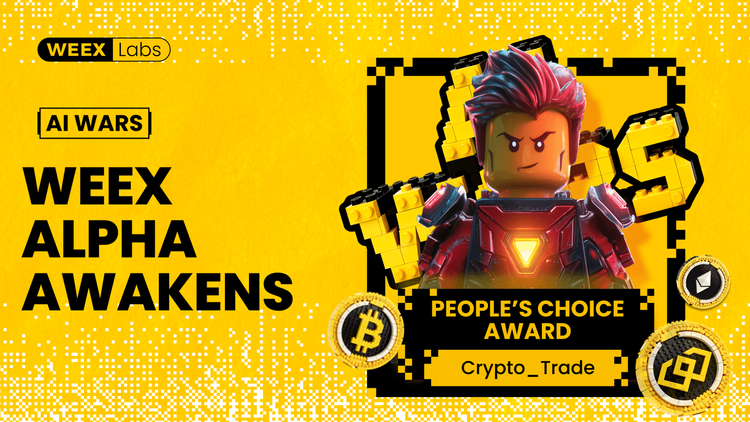
How a Structured AI Crypto Trading Bot Won at the WEEX Hackathon
Crypto_Trade shows how structured inputs and controlled adaptability can build a more stable and reliable AI crypto trading bot within the WEEX AI Trading Hackathon, highlighting a practical path toward scalable AI trading systems.
Particle Founder: The entrepreneurial insights I have gained the most from in the past year
Stop lean startup, stop lightning entrepreneurship, and think carefully about what your product aspirations are.
Huang Renxun's latest podcast transcript: The future of Nvidia, the development of embodied intelligence and agents, the explosion of inference demand, and the public relations crisis of artificial intelligence
The competition in the future is not just about whose model is larger or whose computing power is stronger, but also about who understands the industry better, who can embed AI more deeply into real processes, and who can organize these capabilities into a runnable and scalable system.
OKX Ventures Research Report: AI Agent Economic Infrastructure Research Report (Part 1)
The existing infrastructure is hostile to the Agent economy. Agents can think and act independently at the "capability level," but at the "economic level," they are still locked into infrastructure designed for humans.
The migration of settlement rights: B18 and the institutional starting point of on-chain banks
In the traditional system, banks decide the settlement; in the on-chain system, code begins to take over this responsibility.
From Tencent and Circle: Looking at the Simple and Difficult Questions of Investment
The AI narrative continues to ferment, but the recent performance of related stocks varies, with some in the midst of summer and others as if in winter.
The second half of stablecoins no longer belongs to the crypto circle
What Coinbase doesn't want, Mastercard is eager to buy.


 App
App