
- Buy Crypto
- Markets
 Futures
- Spot
- Copy Trade
- Earn
- More
Fed rate decision May 2025: Fed holds rates steady
By: bitcoin ethereum news|2025/05/08 02:30:04
0
Share
The Federal Reserve on Wednesday held its key interest rate unchanged as it awaits fluctuations in trade policy and the direction of a sputtering economy. In a move that carried little suspense given the wave of uncertainty sweeping the political and economic landscape, the Federal Open Market Committee held its benchmark overnight borrowing rate in a range between 4.25%-4.5%, where it has been since December. The post-meeting statement noted the volatility and how that is factoring into policy decisions. “Uncertainty about the economic outlook has increased further,” the statement said. “The Committee is attentive to the risks to both sides of its dual mandate and judges that the risks of higher unemployment and higher inflation have risen.” However, the statement did not specifically address the tariffs, though Chair Jerome Powell is sure to be asked about them in his post-meeting news conference at 2 p.m. ET. Finding the balance between the two elements of the Fed’s so-called dual mandate of full employment and stable prices has been made more difficult lately amid President Donald Trump’s tariff push. In noting that tariffs both threaten to aggravate inflation as well as slow economic growth, the statement raises the possibility of a stagflationary scenario largely absent from the U.S. since the early 1980s. Policymakers have largely been in agreement that the central bank is in a good position, with the economy generally holding up for now, to be patient as it calibrates monetary policy. The Fed’s deliberations come as the White House is locked on negotiations with top U.S. trading partners during a 90-day negotiating period that began in early April. Trump slapped 10% across-the-board tariffs on U.S. imports and threatened other individual “reciprocal” duties pending ongoing talks. As near-daily headline changes gauge the trade war, the economy has been flashing conflicting signals on growth, inflation and consumer and business sentiment. Gross domestic product, the broadest measure of economic performance, fell 0.3% in the first quarter, the product of slower consumer and government spending and a surge in imports ahead of the tariffs. Most Wall Street economists expect the economy will return to positive growth in the second quarter. The FOMC statement noted that “swings in net exports have affected the data,” and held to its recent characterization that the economy “has continued to expand at a solid pace.” Indeed, job growth has held up despite Trump’s efforts to pare down the federal work force. Nonfarm payrolls increased by 177,000 in April and the unemployment rate held at 4.2%, giving the Fed room to breathe if it expects a further economic slowdown. Inflation has been ticking lower and approaching the Fed’s 2% target, but tariffs are expected to result in at least a one-time rise in prices. Trump has pushed the Fed to cut rates as inflation has eased. The central bank’s preferred gauge showed headline inflation at 2.3%, or 2.6% on core that excludes food and energy. However, as with all aspects of the economy, it all depends on what happens with tariffs. Recent indications of progress in negotiations along with some softening from the administration has helped reverse a huge stock market sell-off after the April 2 “liberation day” announcement from Trump. However, business surveys show a high degree of anxiety, with most managers reporting concerns about supplies and pricing from the tariffs. Market pricing regarding Fed action has been volatile as well. Heading into the meeting, pricing indicated virtually no chance of a cut this week and less than 30% probability of a move in June, with the next cut expected in July. Traders are pricing in a total three cuts this year, though that could change following Wednesday’s decision. The committee’s decision to hold the benchmark rate steady was unanimous. The fed funds rate is used by banks for overnight lending but also feeds into other consumer debt such as mortgages, auto loans and credit cards. Source: https://www.cnbc.com/2025/05/07/fed-rate-decision-may-2025.html
You may also like

Particle Founder: The entrepreneurial insights I have gained the most from in the past year
Stop lean startup, stop lightning entrepreneurship, and think carefully about what your product aspirations are.

Huang Renxun's latest podcast transcript: The future of Nvidia, the development of embodied intelligence and agents, the explosion of inference demand, and the public relations crisis of artificial intelligence
The competition in the future is not just about whose model is larger or whose computing power is stronger, but also about who understands the industry better, who can embed AI more deeply into real processes, and who can organize these capabilities into a runnable and scalable system.

OKX Ventures Research Report: AI Agent Economic Infrastructure Research Report (Part 1)
The existing infrastructure is hostile to the Agent economy. Agents can think and act independently at the "capability level," but at the "economic level," they are still locked into infrastructure designed for humans.

The migration of settlement rights: B18 and the institutional starting point of on-chain banks
In the traditional system, banks decide the settlement; in the on-chain system, code begins to take over this responsibility.

From Tencent and Circle: Looking at the Simple and Difficult Questions of Investment
The AI narrative continues to ferment, but the recent performance of related stocks varies, with some in the midst of summer and others as if in winter.

The second half of stablecoins no longer belongs to the crypto circle
What Coinbase doesn't want, Mastercard is eager to buy.

Cursor "Shell" Kimi Controversy Reversed: From Copyright Infringement Allegations to Authorized Collaboration, China's Open Source Model Once Again Becomes a Global AI Foundation
Cursor was accused of being based on Kimi K2.5, which sparked controversy, and was later confirmed to be compliant through Fireworks AI due diligence.

The Real Reason Tokens Don't Sell: 90% of Crypto Projects Overlook Investor Relations
Provide an Investor Relations Best Practices Guide for Crypto Projects.

Is the income of pump.fun real, earning a million dollars a day despite the market downturn?
If it can really earn this much, what is the reason for the low price of $PUMP?

The real reason why tokens are not selling: 90% of crypto projects neglect investor relations
Investor Relations Practice Guide for Cryptocurrency Projects.

Who is the true winner of the "Tokenization" narrative?
Virtually everyone benefits, but the reason for the benefit, the timing, and the underlying logic are completely different.

Moss: The Era of AI-Traded by Anyone | Project Introduction
AI Trading Agent is rapidly growing its infrastructure.

Chip Smuggling Case Exposes Regulatory Loophole | Rewire News Evening Update
AI chips have become a strategic asset more sensitive than missiles

How a Structured AI Crypto Trading Bot Won at the WEEX Hackathon
Ritmex demonstrates how disciplined risk control and structured signals can make an AI crypto trading bot more stable and reliable on WEEX, highlighting the importance of combining execution discipline with scalable AI trading systems.

Old Indicator Fails, Three Major New Signals Emerge: BTC True Bottom May Still Be Below $60K
When the grocery shopping auntie on the subway, or Tony the hairdresser, start asking you about BTC, crypto, and cryptocurrency investments, selling immediately will be the only best option.

Meeting OpenClaw Founder at a Hackathon: What Else Can Lobsters Do?
Imperial College London MetaGame: AI Agent × Web3 Landing Three Major Directions.
Huang Renxun's Latest Podcast Transcript: NVIDIA's Future, Embodied Intelligence and Agent Development, Soaring Demand for Inferencing, and AI's PR Crisis
The future of competition is not only about whose model is bigger, whose computing power is stronger, but also about who understands the industry better, who can more deeply integrate AI into real processes, and who can organize these capabilities into a set of executable, scalable systems
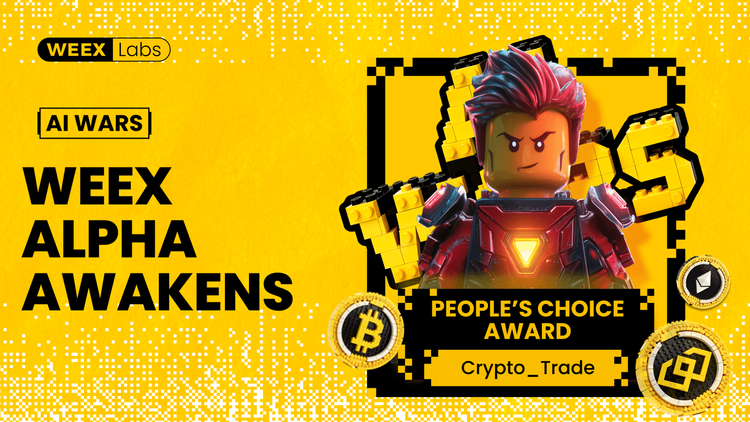
How a Structured AI Crypto Trading Bot Won at the WEEX Hackathon
Crypto_Trade shows how structured inputs and controlled adaptability can build a more stable and reliable AI crypto trading bot within the WEEX AI Trading Hackathon, highlighting a practical path toward scalable AI trading systems.
Particle Founder: The entrepreneurial insights I have gained the most from in the past year
Stop lean startup, stop lightning entrepreneurship, and think carefully about what your product aspirations are.
Huang Renxun's latest podcast transcript: The future of Nvidia, the development of embodied intelligence and agents, the explosion of inference demand, and the public relations crisis of artificial intelligence
The competition in the future is not just about whose model is larger or whose computing power is stronger, but also about who understands the industry better, who can embed AI more deeply into real processes, and who can organize these capabilities into a runnable and scalable system.
OKX Ventures Research Report: AI Agent Economic Infrastructure Research Report (Part 1)
The existing infrastructure is hostile to the Agent economy. Agents can think and act independently at the "capability level," but at the "economic level," they are still locked into infrastructure designed for humans.
The migration of settlement rights: B18 and the institutional starting point of on-chain banks
In the traditional system, banks decide the settlement; in the on-chain system, code begins to take over this responsibility.
From Tencent and Circle: Looking at the Simple and Difficult Questions of Investment
The AI narrative continues to ferment, but the recent performance of related stocks varies, with some in the midst of summer and others as if in winter.
The second half of stablecoins no longer belongs to the crypto circle
What Coinbase doesn't want, Mastercard is eager to buy.


 App
App