
 Buy Crypto
- Markets
 Futures
- Spot
- Copy Trade
- Earn
- More
From Crypto Social Underdog to "Wallet First": Farcaster's Misunderstood Pivot




Original Article Title: "Social Walletization, Wallet Socialization"
Original Author: 0xLuo, Senior Player at Farcaster
Recently, Farcaster co-founder Dan Romero's post regarding Farcaster's current shift in focus from "social-first" to "wallet-first" has sparked widespread attention and discussion. For active Farcaster users, the transition has been noticeable ever since the introduction of the in-app wallet feature in the Farcaster App back in February, with support for more chains and increasingly rich functionality. This announcement may seem like a recurring topic to many, serving as a summary of the team's direction throughout this year. However, for those less familiar with Farcaster, this declaration appears somewhat unexpected. Many couldn't help but express their surprise, as the "sole heir of crypto social," the "hope of SocialFi village," has actually "announced a failure," "abandoned social," "strayed from its initial mission," and expressed disappointment that the "social track has been disproven" and "Web3 social does not seem viable." Concerns have been raised about the community atmosphere sliding towards "gamification," with the team seemingly "sprinting in the wrong direction."
The divergence in opinions stems from different understandings of Farcaster's wallet positioning. In fact, Farcaster App's addition of the built-in wallet this year is not a sudden strategic pivot but a natural upgrade from the previous need to connect an external wallet to perform on-chain operations. As Frames gradually evolves into more feature-rich and interactively complex Mini Apps, user demand for seamless on-chain interaction has risen. The introduction of the in-app wallet is fundamentally designed to accommodate new scenarios, supplementing the fundamental capabilities on top of the social network without abandoning the existing social network.
A wallet is an increment, not a replacement; it drives socialization, not overtake it; it extends socialization, not abandons it; it goes with the flow, not forced into transformation.
The underlying open social protocol remains unchanged, and the diverse client-side ecosystem is still thriving. By switching clients, you can still experience pure socialization. The social functions of the official client, Farcaster App, remain intact, with the addition of an in-app wallet this year as an extension of the original functionality. It seamlessly integrates with Mini Apps, deeply embeds into the identity graph, and interacts smoothly with the social feed.
The team has simply adjusted the product focus, aiming to steer the entire network towards a growth path, no longer spending time onboarding users from various industries for network diversity, or optimizing the minimally effective Channels community feature. They have dedicated enough time to building a small and beautiful "cozy corner," but the "social-first" strategy did not achieve sufficient product-market fit, with tens of thousands of daily active users still being niche. Thus, they have very pragmatically returned to the first principles of crypto applications: serving the flow of value.
Building on this foundation, the integration of wallets and social features is not only a stronger product differentiation and a more realistic growth path, but also closer to the PMF tipping point of crypto social. In fact, the shift in focus of Farcaster's work this year is also a punctuation mark for the development direction of the entire crypto social app, where "social walletization, wallet socialization" is the natural convergence direction of consumer-grade crypto applications. Now, almost all products with some social aspect have wallet functionality, and wallet apps are now attempting to incorporate social elements. Not to mention, there are also many apps that have taken a social + wallet approach as their native positioning from the beginning.
Social App Walletization
If you want to stand out, all crypto apps actually have to answer what sets them apart from similar traditional off-chain apps, and of course, crypto social apps also have to answer where they differ from traditional social products. Product manager Yu Jun once proposed a famous formula to measure whether a new product is attractive enough to users:
Product Value = (New Experience − Old Experience) − Migration Cost
Some new products have very low migration costs, with Threads backed by Instagram's strong social graph able to reach one billion users in just 5 days. The luckiest thing is to encounter users who are migrating just for the sake of migration. Bluesky, just by focusing on "uncensored Twitter," has caught the elusive Twitter refugees like fish to water.
But the vast majority of crypto apps do not have such a background and luck. To attract users who are already using traditional similar products with more users and a more mature product, you can only start by enhancing the new experience. Crypto social apps initially approached from a technical perspective, focusing on how to integrate with blockchain at the foundational level to achieve decentralization. However, embedding encryption technology at the foundational level is imperceptible to the vast majority of users and does not bring a new experience. This lack of differentiation when competing with traditional social products, often leads to a more cumbersome onboarding process. For example, both Farcaster and Lens use blockchain at the core of their social protocols, with Farcaster storing identity data on the OP chain and Lens storing identities and social graphs on the Lens Chain, ensuring "not your private key, not your social account." But the vast majority of users are not concerned about the underlying technology; they care about what new experiences the product offers at the product level.
The Farcaster team certainly realized this early on, with their philosophy being "product-driven protocol development," hoping to drive the growth of the entire Farcaster network through a benchmark product. If they had just thought of creating a social protocol, then the team's mission would have been basically accomplished, having implemented many theories of decentralized social from the start, creating a protocol that is "sufficiently decentralized." In reality, they emphasize the openness, programmability, and composability of the protocol, allowing developers to build various applications based on an open social graph. However, if they were to allow the ecosystem to develop as freely as Nostr, ActivityPub, Lens, etc., users would not migrate just because your underlying technology is different. The ecosystem's unbridled growth brings about content noise that further reduces the user experience, and the end result is often that users do not want to come, and if they come, they won't stay. The Farcaster team's decision to develop a client of their own is aimed at attracting users at the product level.
A high-quality social circle is a new experience, unique alpha information is a new experience, and the combination of encryption and socialization is a new experience. In the early stages, Farcaster achieved the first point by onboarding a group of high-quality users, which is also a rare moat, but growth is limited. It is very difficult to attract the vast majority of users characterized as "early risers with no gains, empty-handed wolves." Interestingly, Farcaster was once criticized for being too pure. For a long time, discussing token price fluctuations on Farcaster was seen as deviant behavior, only able to hide in a corner of the /DEGEN Channel, where few and far between. So, it wasn't until the beginning of 2024 when Frames was launched, offering a slightly different encrypted native feature compared to traditional social apps, and the community grew the $DEGEN creator economy project, that Farcaster's daily active users saw a significant increase. By the end of January 2024, the daily active users had grown rapidly from around 2,000 to more than 10 times that number. This was partly due to product innovation and partly due to the already established high-quality community's ability to support this open social networking project.
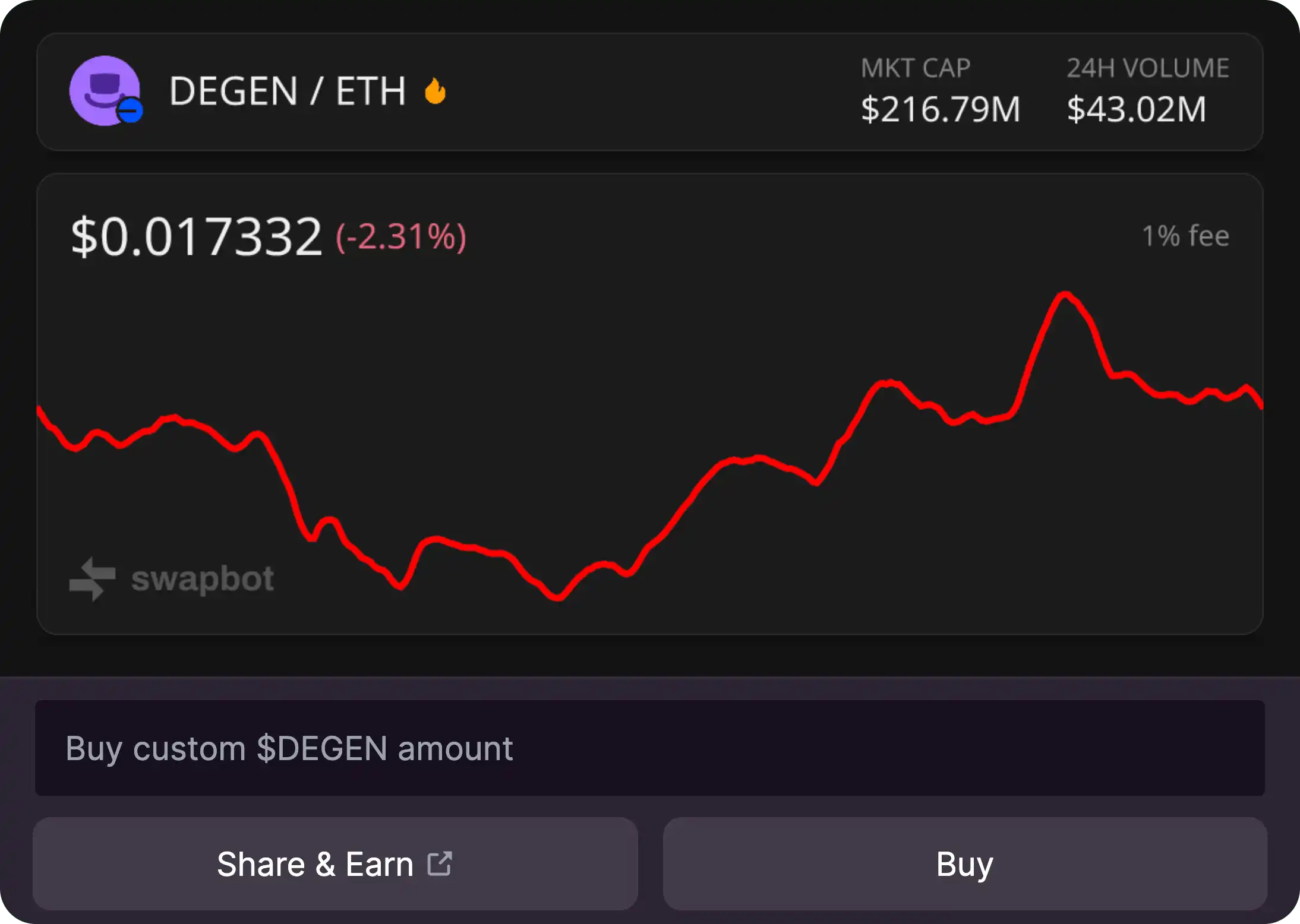
Farcaster's early version mini-program, a transaction Frame
At that time, Farcaster had actually completed the transition from the "farming age" of a pure social network to the "craftsmanship age" of initial integration with encrypted features: Social Graph + Frames + External Wallet, for the first time truly connecting social content flow with on-chain operations. Solana also attempted to enable wallet and encrypted mini-app interactions in the Twitter feed through the Actions protocol via a browser plugin. Social Media × Crypto App × Wallet Interaction is a direction everyone wants to explore. Through Frames, users can mint NFTs and execute transactions in the social feed, which is indeed a new experience. However, there are at most four operational buttons, the screen transitions are like PowerPoint, and both the functionality and performance are very limited. Additionally, as soon as wallet authorization is involved, users must navigate to an external wallet, resulting in restricted functionality and a fragmented user experience, which is still not seamless enough. So, in reality, from the first day Frames was launched, the community was calling for full wallet functionality, but it took a year to materialize.

In the Farcaster Chinese community WeChat group, when Frames was first launched in early 2024, everyone started excitedly envisioning wallet functionality.
With the arrival of the memecoin supercycle last year, from the popularity of PumpFun to the homegrown Clanker from Farcaster, more asset issuance has brought about more trading demand. The importance of the entire path from discovery to transaction is increasingly highlighted, and wallets have naturally become an increasingly crucial entry point in this process.
Therefore, it is not difficult to understand that in order to allow users to interact more naturally with crypto applications within a social media environment, it is necessary to:
1. Have a more flexible and higher-performing underlying framework to support more powerful mini applications
2. Shift from connecting external wallets to using built-in wallets to make on-chain interaction truly seamless
This point has also been validated on the instant messaging social app Telegram, where its Mini Apps ecosystem and built-in TON wallet have sparked a trend. Therefore, this year's Farcaster naturally completed the following upgrades:
1. Frames → Mini Apps
2. External Wallets → Built-in Wallets
What web pages can achieve, Mini Apps can achieve. Anyone can build permissionless and cross-client universal mini apps, greatly expanding the functional boundaries within social media applications. Interaction with built-in wallets also does not require transitioning to external wallets, moving from the "handcraft era" of having basic crypto functions to a more feature-rich "industrial era." This is not a deviation but a natural extension along the trend, not a forced pivot but an inevitable evolution in response to market demand.
Integrating a built-in wallet is not the death knell of encrypted social media but the industrial revolution of encrypted social media.
Crypto Apps and Decentralized Social by Linda Xie
With the presence of built-in wallets, there are naturally transaction signals based on the social graph. Asset issuance, propagation, discovery, trading, and community building can all be completed within the same application in a closed loop. It is also convenient to interact with Mini Apps, enabling almost all crypto application functionalities, including games, videos, live streaming, voice Spaces, podcasts, prediction markets, DeFi, and more. The rich ecosystem of Mini Apps and built-in wallets are driving side by side, integrating on-chain interaction into users' daily social behaviors. Applications like Noice, Bracky, QR, Harmonybot have given rise to a series of new encrypted social interaction scenes due to the existence of social graph + Mini Apps + built-in wallets, each having its moment in the spotlight. Farcaster's daily active users also hit a new high at the end of October against this backdrop.
Trending Mini Apps of Different Categories
These are all experiences that users can perceive, use, and unlock new scenarios, and they are truly the differentiation from traditional social products. Even if only because the wallet provides a more convenient entry point, lower fees, and a more seamless cross-chain experience, users who initially only use the transaction function still have the opportunity to achieve the goal of "coming for the tool, staying for the network." This is a step forward compared to the past, where the focus was solely on attracting attention from Twitter based on the attraction of social networks.
Coincidentally, some instant messaging applications have also proactively added wallet functionality on top of social features. For example, chat apps in the Farcaster ecosystem like frens and apps like DeBox allow users to simply send a CA in the chat group to trigger transactions using the built-in wallet. More and more developers have also realized that they should not avoid mainstream crypto users; the essence of crypto social interaction is not to stay away from wallets but to embrace them. The value layer should not be fragmented but integrated. A crypto social platform without a built-in wallet has taken a detour.
frens screenshots
Socializing Wallet Applications
Likewise, crypto wallet applications are also attempting to incorporate social elements. Evolving from mere asset containers and transaction gateways, they are now aiming to include social signals and interactions based on social graphs, responding to the increasingly diverse user needs and on-chain activities.
Both Zapper and Base App, originally wallet applications, have now integrated content from the Farcaster social protocol and social graph, effectively becoming clients of the Farcaster protocol. This also demonstrates the value of Farcaster as an open, programmable, and composable social protocol. The protocol is open, the interfaces are clear, and developers are free to build a client or an app based on Farcaster. Whether it's a wallet or another application, without the need for permission, they can directly integrate the Farcaster social layer into their product.
Zapper integrates Farcaster Network content on top of the wallet, along with on-chain dynamics and transaction signals based on the Farcaster social graph. This allows users to directly discover trading opportunities from the on-chain behavior of followed users and swiftly execute trades with a single click.
The Base App, on the other hand, enhances the existing wallet by incorporating Farcaster as a social information feed, Zora as a tool to tokenize creator content, and XMTP as an underlying protocol for real-time communication and community chat. This enables the Base App to facilitate content creation, asset issuance, social discovery, token trading, app interaction, community chat, and interaction with agents, forming a closed loop where content, relationships, and value coexist in the same space.
Zerion has also integrated a social graph to enable social discovery. Building upon its robust feature of tracking watched wallet addresses, Zerion has now included Twitter, Farcaster, and Lens social identities to better discover interesting users and top traders' transaction signals.
Zapper, Base App, Zerion
Centralized exchanges can also be considered wallets, and they are actively exploring integration with social elements. Since 2022, Binance has introduced Binance Feed, which evolved into Binance Square in 2023. Leveraging the world's largest gateway for crypto trading volume, Binance has established a transaction-focused comprehensive community platform. Users can now not only trade but also follow trader dynamics, access in-depth content information, engage in strategy discussions, and participate in diversified social interactions such as voice and live streaming. This enables users to spend more time within the same application.
Similarly, the centralized exchange platform Robinhood, which has expanded into cryptocurrency and prediction markets, recently announced its foray into social features. It now allows users to interact on the platform, share strategies, discover signals, and copycat trades.
However, self-built social features by centralized exchange platforms tend to create closed ecosystems where users' relationship networks, content, and identities remain within the platform's control. Unfortunately, ordinary developers cannot freely build new applications based on their social graph. All features rely on single-point iteration by the exchange platform team. Nonetheless, as the saying goes, users don't care about that; they only care if your product is useful and user-friendly.
Robinhood is exploring social
For wallets, social interaction is not just a decorative feature but a key step in transforming the wallet from a "tool" to a "network." Social interaction provides context to asset behavior, the source of transaction decisions, and a track record for content distribution. By incorporating social features, wallets can better leverage network effects, transitioning from a tool to an ecosystem.
Social + Wallet: Transaction, Discovery, Creation
Social applications are becoming more wallet-centric, while wallets are becoming more social, and the convergence of the two is increasingly aligned. This is actually the natural convergence direction of consumer-grade crypto applications. For crypto social networks, failure to actively integrate with wallets is a passive choice that goes against mainstream crypto users; not doing so will cause falling behind and inevitably be replaced by more complete product forms. Social applications need wallets to complete the puzzle of on-chain interactions. The core capabilities that constitute the differentiated experience of crypto socializing, such as the crypto app ecosystem and creator economy, all rely on comprehensive wallet functionality to be realized. Adding a value layer on top of the social layer provides leverage for the growth of social networks.
For wallets, integrating social features is like icing on the cake. Users no longer just "use and go"; instead, they stay because of relationships, content, and communities. Wallets transform from tools to networks, from entry points to scenarios, from asset managers to interactive spaces, naturally expanding into more application scenarios and network effects.
Of course, some applications have targeted the "Social + Wallet" path from the beginning, realizing early on that the two naturally complement each other and can form a value loop of content, relationships, and assets.
· interface.social: Supports the discovery of popular tokens, tracks users' on-chain activities, allows for transaction mirroring, and enables users to post transaction insights (Takes).
· 0xppl.com: Supports the discovery of popular tokens, tracks multi-chain wallet behaviors, enables transaction mirroring, and offers profit monitoring.
· Firefly.social: Firefly itself is an aggregation client for multiple social networks, including X, Farcaster, Lens, Bluesky, supporting cross-platform one-click posting, mining transaction opportunities from aggregated friend transaction dynamics.
· fomo.family: Provides real-time tracking of friends and top traders' on-chain transactions, quickly discovers new assets through built-in transaction analysis and profit/loss tracking.
· Share.xyz: Allows users to share any transaction, follow any wallet, receive real-time transaction notifications, supports copying transactions with the copier receiving a profit share.
· gmgn.ai: Supports fast discovery of popular assets, tracks smart money and user holdings and transactions, performs subsecond on-chain transactions, and provides integrated on-chain intelligence and trading tools with automatic mirroring, risk control checks, and real-time alerts.
· Vector.fun: Supports on-chain user transaction dynamics and asset discovery. Acquired by Coinbase and currently suspended.
Interface, 0xPPL, FOMO, Share
From start to finish, you will find that they are similar in many features and interfaces. "Transaction, Discovery, Creation" is Farcaster's new slogan. Applying this phrase to other "Social + Wallet" applications doesn't seem out of place either. Basically, they all focus on discovering transaction signals, quickly copying trades, and sharing trading strategies.
The difference may lie in the way each product chooses its focus. Different applications make trade-offs in terms of functionality, emphasis, depth, and breadth. Some emphasize content creation, allowing users to explain "what to buy and why"; some almost do not create content but instead focus resources on trade execution, data insights, and trade-copying efficiency. These trade-offs ultimately shape different product strengths and create significantly different user experiences.
Who can stand out? It may depend on who can specialize and delve deep into a specific aspect.
For example, 0xPPL has become increasingly specialized in on-chain graphing and is very useful for quickly identifying on-chain addresses' identities, especially during new token issuance. GMGN, on the other hand, has made transactions highly efficient from discovery to analysis to execution. In terms of multi-chain support, Zapper and Zerion as professional wallets cover a wide range of chains. As for the actual cross-chain experience, Farcaster Wallet is very smooth and has very minimal friction.
The "Takes," "Comments," or "Shares" of Interface, FOMO, and Share are the points of differentiation, allowing users to write their own transaction logic. They hope their applications can have accumulated content creation, although the centralization of content results in a slight lack of network effects. Of course, other applications can directly integrate the Farcaster protocol to achieve content creation, enabling the produced content to spread across a larger social network.
Furthermore, applications based on the Farcaster protocol have another advantage: they can reuse the hundreds or even thousands of Farcaster Mini Apps with various features, embedding mini-programs directly into social flows to easily expand the boundaries of application functionality without reinventing the wheel.
Full Landscape of "Social + Wallet" Crypto Applications
Dan Romero once said, "Adding a wallet to a social network is much easier than adding a social network to a wallet." From a product perspective, Farcaster's extension of wallet capabilities on an existing social network may be slightly easier. However, other applications can also directly integrate into existing social networks unless they are confident in their own user base.
From the "Social + Wallet" encrypted app landscape, it can also be seen that currently, if you want to create a "social + wallet" app, Farcaster and X are the most chosen in terms of selecting a social graph. Slightly different, because of the varying degrees of openness, when integrating the X social graph, many times only the wallet address is associated with the X account; but when integrating the Farcaster social graph, in addition to identity association, existing social relationships and even content produced on the social network can be easily imported, thus instantly obtaining a ready-made social network, rather than starting from scratch to accumulate social content and build a relationship graph.
As more and more applications adopt Farcaster as their social infrastructure, the value of the entire network will be inversely amplified, thereby enhancing the network effect of the entire protocol. Looking back over the past four years, the Farcaster team has built a "small but refined" social graph along a restrained development path, although growth has been limited, the accumulated social relationships, content, and culture are becoming the underlying assets and infrastructure of the open encrypted social ecosystem. In the future, this network will continue to be enriched, extended, and adopted.
Conclusion
Farcaster is not dead yet, encrypted social networking is not dead yet, and Farcaster as an encrypted social network is not dead yet. True encrypted social networking is not limited to just building a social network, but is about integrating social interaction with value transfer. Therefore, this year, the Farcaster App has successfully upgraded from an inconvenient external wallet connection to a fully functional built-in wallet, filling in a critical missing capability.
This is not abandoning social networking but driving social networking forward, giving social networking a new growth engine.
The recent "ridicule" encountered by Farcaster precisely illustrates that Farcaster's social graph is still too small, and the number of daily active users is still too limited, causing some information gaps and misinterpretations among bystanders. At the same time, in the trend of "social walletization and wallet socialization," the Farcaster App also faces ongoing competition, which are current real challenges. It needs to continue relying on Farcaster's "wallet-first" on the product side and the continuously emerging Mini Apps in the ecosystem to jointly drive growth, with the product-layer value transfer capability continuing to complement the protocol-layer composability of the ecosystem.
What will happen next? No one can guarantee the answer. But perhaps expanding wallet functionality on top of existing social media, true encrypted socialization will begin, allowing value to flow, and the encrypted social network will become more active.
You may also like

Is XRP a Good Investment in 2026? Why Is It Stuck at $1.45
XRP is up 6.7% this week, but exchange reserves remain high. Is a volatility spike imminent? We analyze price trend, ETF inflows, whale activity, and regulatory catalysts to answer: will XRP go up, why is XRP dropping, and is XRP a good investment right now?
TL; DR
What is XRP: XRP is a digital asset built for fast, low-cost international payments. It runs on the XRP Ledger and is used by Ripple for its On-Demand Liquidity (ODL) service. Unlike Bitcoin, XRP settles transactions in 3-5 seconds with near-zero fees.Why is XRP Dropping: XRP is not actively dropping, but it is struggling to rise. On the monthly chart, XRP has seen six consecutive months of decline. Currently, the price faces an additional supply wall at $1.45. About 1.24 billion XRP were bought in that range, and those holders sell when the price approaches, creating selling pressure that prevents a recovery.Will XRP Go Up: Potentially yes. XRP is trading near $1.43 and showing its best weekly performance since September 2025. If the price breaks above the $1.45 resistance, analysts expect a move toward $1.90, supported by strong institutional demand.Is XRP a Good Investment: The answer is not simple. Short-term traders may see opportunity in the coming volatility spike. Long-term investors face a bigger question that depends on one key regulatory event. However, the data reveals a surprising signal that most retail buyers are missing right now. To understand whether XRP is a smart buy or a trap at $1.43, you will need to read the full analysis below.What is XRP? A Digital Asset for Global SettlementBefore analyzing the charts, it is crucial to understand the asset in question. What is XRP? Unlike Bitcoin, which was designed as a decentralized digital gold, XRP operates on the XRP Ledger (XRPL). It was created to facilitate fast, low-cost international payments. Traditional bank transfers take days and incur high fees. XRP transactions settle in 3-5 seconds, costing fractions of a penny.
Ripple, the company associated with XRP, uses this asset for its "On-Demand Liquidity" (ODL) service. Banks and financial institutions use ODL to source liquidity during cross-border transactions without pre-funding accounts. This utility is the primary driver for institutional interest. Recently, the network hit a milestone of over 8 million active wallets, signaling growing usage despite recent price stagnation . Furthermore, Ripple is proactively preparing for the future, releasing a four-stage roadmap to make the XRPL "quantum-resistant," aiming to secure the ledger against future quantum computing threats by 2028 .
XRP Price Analysis: The Battle for $1.45The XRP price trend over the last month tells a story of exhaustion followed by cautious recovery. On the monthly chart, XRP experienced six consecutive months of decline. However, April shows signs of a bottoming process. Weekly charts reinforce this view: after four weeks of lower closes, the last two weeks have seen small rebounds.
According to data from April 22, 2026, XRP is trading at approximately $1.44. Over the last seven days, XRP has outperformed both Bitcoin and Ethereum, rising 6.7% while the broader market rose only 3.2%. Spot trading volume surged 23% to $3.79 billion, and derivative markets saw $40 billion in futures volume on a single day.
Despite this, the price remains 60% below its July 2025 high of $3.65. The current technical picture shows a "low volatility grind" higher. The 20-day EMA is at $1.3924, and the 50-day EMA is at $1.4119, both acting as support . However, the immediate hurdle is the $1.45 resistance level. This price point has rejected every rally attempt in 2026.
Why is XRP Dropping? And Will XRP Go Up?The primary reason for the recent "drop" (or lack of upward momentum) is not active selling, but rather the "supply wall." Data indicates that roughly 1.24 billion XRP tokens were purchased by investors in the $1.45 to $1.47 range. These investors have been waiting months to "break even." Every time the price approaches $1.45, these holders sell to exit their positions, creating a massive wall that retail buying cannot easily absorb.
However, the underlying momentum is shifting. Analysts suggest a xrp volatility spike imminent because the absorption capacity of buyers is increasing. Historically, when exchange reserves are high but the price refuses to drop significantly, it signals that buyers are absorbing the supply. The price has held above $1.39 despite the overhang, which is a sign of relative strength.
So, will XRP go up? Yes, potentially. But it needs a catalyst, if the price closes a daily candle above $1.45. If that happens, the next targets are $1.60 to $1.65, and eventually $1.90 .
XRP Exchange Netflow and XRP ETF Netflow: A Tale of Two MarketsThe current market dynamic is best understood by looking at two opposing data streams: XRP Exchange netflow and XRP ETF flows.
Exchange Dynamics (Retail / Whales):
Data shows a complex pattern of "large inflows and increasing reserves." Recently, a Ripple-associated wallet moved 75 million XRP (approx. $108 million) to Coinbase. This initially looks like a dump, but context matters. These transfers are likely to provide liquidity for Ripple’s ODL business, not necessarily spot market selling. However, the result is that exchange reserves have climbed to 2.76 billion XRP .
The Good News: While reserves are high, the rate of increase is slowing. Specifically, "whale" transfers to exchanges have dropped 98% from their April 11 peak. The Binance reserve has slightly decreased from 27.7 to 27.6 billion. The aggressive selling from large holders appears to have stopped.
Institutional Dynamics (ETF):
While whales were sending coins to exchanges, institutions were buying XRP ETF products. XRP ETF net flow is strongly positive.
US-listed XRP ETFs recorded four consecutive days of inflows totaling $38.86 million recently .The weekly inflow for mid-April hit $119.6 million, a multi-month high .Cumulative net inflows stand at $12.8 billion, with Assets Under Management (AUM) at roughly $10.8 billion.Analyzing the Divergence: Why Both Flows Are PositiveIt seems contradictory that exchange reserves are high (suggesting selling) while ETFs are buying (suggesting buying). However, this phenomenon reveals the current market structure.
Different Investor Profiles: The exchange inflows likely come from short-term traders, market makers, or Ripple itself providing ODL liquidity. These are "hot" coins ready to be sold. The ETF inflows represent "sticky" capital. Institutions buying ETFs are typically long-term holders (LTHs) or asset managers who do not day-trade. They are removing liquidity from the spot market by buying through custodians.The "De-risking" Trade: Sophisticated funds might be engaging in basis trading. They buy the ETF (taking a long position) while simultaneously shorting XRP futures or selling spot inventory to capture the funding rate. This keeps the price stable while volume increases.Absorption: The most likely scenario is that the market is simply absorbing the excess supply. The fact that the price is stable ($1.43) and not collapsing to $1.20 despite 2.76 billion coins sitting on exchanges is a massive win for the bulls. The ETF inflows are acting as a sponge, soaking up the selling pressure from the ODL wallets.The Regulatory Catalyst: The SEC and the CLARITY ActFundamentally, the recent price action cannot be separated from regulation. For years, the primary answer was the SEC lawsuit. That narrative is dying.
Ripple CEO Brad Garlinghouse recently praised SEC Chair Paul Atkins as "a breath of fresh air and sanity" . This regulatory thaw is critical. The SEC is reportedly considering dropping the long-standing lawsuit, and five XRP ETF applications are awaiting review.
The major catalyst on the horizon is the CLARITY Act. A Senate markup is expected before the end of April. Standard Chartered analysts project that if the bill advances, it could unlock $4 to $8 billion in institutional flows . Polymarket gives the bill a 60-66% chance of passing in 2026. If the CLARITY Act classifies XRP as a non-security (commodity), the institutional floodgates will open, likely overwhelming the $1.45 supply wall instantly.
Is XRP a Good Investment in 2026?Given all this data, is XRP a good investment? The answer depends entirely on your risk tolerance and time horizon.
The Bull Case (Why it is a good investment): The risk/reward ratio is asymmetrical to the upside. The price is near multi-year lows relative to its utility. Whale selling has stopped, ETF demand is rising, and the network is expanding (8 million wallets, quantum resistance roadmap). If the CLARITY Act passes, XRP could realistically trade between $1.60 and $1.80 in the short term, with a potential run to $3.00+ if the lawsuit is officially dropped.The Risk Case (Why it is NOT a good investment): There is a clear resistance wall at $1.45. If the CLARITY Act fails or is delayed past May (due to midterm election dynamics), the "buy the rumor, sell the news" dynamic could reverse. If the price fails to break $1.45 and loses support at $1.33, a drop back to $1.15 is technically possible .Verdict: XRP is a speculative buy for traders looking for a volatility spike. It is a hold for current investors. For new investors, it is only a good investment if you believe in regulatory clarity within the next 30 days. Technically, waiting for a confirmed break above $1.55 (to avoid the fakeout) is safer than buying at $1.43.
FAQQ: Will XRP go up if the CLARITY Act passes?
A: Yes, historically. Analysts predict that if the CLARITY Act passes, signaling that XRP is a commodity, it would remove the regulatory overhang. This could trigger a surge in institutional buying, pushing the price from the current $1.43 range to test the $1.80 - $2.00 resistance levels quickly.
Q: Why is XRP dropping when Bitcoin is going up?
A: XRP has specific supply dynamics. Unlike Bitcoin, which has a fixed supply issuance, XRP faces periodic sell-pressure from Ripple's treasury wallets used to fund ODL (liquidity) services. Additionally, the $1.45 "break-even" wall causes XRP to drop relative to BTC when short-term traders exit.
Q: Is a volatility spike imminent for XRP?
A: Yes. The Bollinger Bands on the daily chart are squeezing. The price is stuck between support at $1.33 and resistance at $1.45. Historically, when XRP volume surges 23% in a week (as it did on April 21), it precedes a violent move. The direction depends on whether the $1.45 resistance breaks.
Q: What is the XRP ETF netflow status?
A: As of late April 2026, XRP ETFs are seeing positive netflows. The US ETFs recorded a single week inflow of $119.6 million in mid-April. Cumulative inflows are strong at $12.8 billion, indicating that institutions are accumulating during this dip, which is a long-term bullish signal for price stabilization.
Q: Is XRP a good investment for beginners?
A: XRP is less volatile than "meme coins" but more volatile than Bitcoin. For beginners, it is a moderate-risk investment. Its value is tied to real utility (bank payments). However, beginners should wait to see if the price can close a weekly candle above $1.55 before entering, to avoid buying into the current resistance wall.
Disclaimer: None of the information in this article constitutes, or is intended to constitute, investment advice. Trading cryptocurrencies carries a high level of risk and may not be suitable for all investors. Always do your own research.
About WEEXFounded in 2018, WEEX has developed into a global crypto exchange with over 6.2 million users across more than 150 countries. The platform emphasizes security, liquidity, and usability, providing over 1,200 spot trading pairs and offering up to 400x leverage in crypto futures trading. In addition to the traditional spot and derivatives markets, WEEX is expanding rapidly in the AI era — delivering real-time AI news, empowering users with AI trading tools, and exploring innovative trade-to-earn models that make intelligent trading more accessible to everyone. Its 1,000 BTC Protection Fund further strengthens asset safety and transparency, while features such as copy trading and advanced trading tools allow users to follow professional traders and experience a more efficient, intelligent trading journey.
Follow WEEX on social mediaX: @WEEX_Official
Instagram: @WEEX Exchange
Tiktok: @weex_global
Youtube: @WEEX_Official
Discord: WEEX Community
Telegram: WeexGlobal Group

FC Barcelona vs Celta Vigo: Can Anyone Stop Barcelona at Home?
FC Barcelona vs Celta Vigo lineups, standings, and stats for April 22, 2026. FC Barcelona need a win to stay on track for the La Liga title. Full preview inside.

Carl Moon & WEEX Head to Mugello: The Crypto Trader's Ferrari Challenge
Forget the sidelines. WEEX is hitting the 300km/h mark at Mugello this weekend. Witness Carl Moon’s transformation from a supermarket cashier to a Ferrari racer, and discover why the world’s fastest trading floor belongs on the world’s most technical track at the official Ferrari Challenge.

How to Become a Pro Crypto Trader: WEEX Interview with Ferrari Racer Carl Moon
Ferrari racer Carl Moon on mastering crypto trading: 80/20 rule, AI tools, Bitcoin at $95K, and risk lessons from the track.

Morning Report | Amazon increases investment in Anthropic up to $25 billion; SEC plans to introduce an "innovation exemption" mechanism to support compliant on-chain trading of tokenized securities

Jeff Hoffman, founder of Booking.com: How Web3 and AI are reshaping the trillion-dollar social travel market

Top 12 Cryptocurrencies to Invest in April 2026
Key Takeaways: Bitcoin remains the dominant player with a $1.42 trillion market cap. Hyperliquid’s HYPE token gains traction,…
18 Best Crypto & Bitcoin Casinos in March 2026
Key Takeaways: Cryptocurrencies offer faster, cheaper, and more private payment options in online casinos. Top crypto casinos include…

Full Post-Mortem of the KelpDAO Incident: Why Did Aave, Which Was Not Compromised, End Up in Crisis Situation?
Key Takeaways: The KelpDAO incident exposed vulnerabilities in collateral pricing and cross-chain bridge operations, affecting Aave’s liquidity. rsETH…

Is MicroStrategy’s STRC Bitcoin’s Savior or Destroyer?
Key Takeaways: MicroStrategy’s STRC offers an annualized yield of 11.5%, driving significant Bitcoin buying pressure. Michael Saylor’s financial…

Ceasefire Expiration and Market Response: Bitcoin Defies Market Trends
Key Takeaways: The current ceasefire agreement is anticipated to expire on Wednesday in Washington, with low likelihood of…

Oil Price Dilemma: More Than a Price Hike
Key Takeaways: Global oil market has surpassed its breaking point, not solving with price hikes but facing significant…

On the Day Aave Launched rsETH, Spark Strategically Exited
Key Takeaways: Aave enabled rsETH lending at a 93% LTV, while Spark withdrew due to low utilization by…

Nasdaq Breaks Record and Crypto Transactions Surge
Key Takeaways: Nasdaq’s rise to a new intraday high indicates strong market momentum. A significant transfer of 35,000…

Powell: Fed Requires a Brand New Inflation Blueprint
Key Takeaways: Powell aims for transformative policy overhauls within the Fed if appointed. Past inflation response mistakes during…

Without Cook’s Apple, Can it Still Grow in the AI Era?
Key Takeaways: John Ternus acts more like a systematic integrator within Apple rather than a solo visionary. Apple’s…

Iran Stock Market and Crypto Developments in Focus
Key Takeaways: The Iranian stock market is set to reopen in 10 to 12 days, excluding companies impacted…
ZachXBT vs. RAVE: Seeking the Truth Behind Crypto Market Volatility
Key Takeaways: In April 2026, RAVE surged by 4500%, later collapsing 90% after investigations by ZachXBT, Binance, and…
Is XRP a Good Investment in 2026? Why Is It Stuck at $1.45
XRP is up 6.7% this week, but exchange reserves remain high. Is a volatility spike imminent? We analyze price trend, ETF inflows, whale activity, and regulatory catalysts to answer: will XRP go up, why is XRP dropping, and is XRP a good investment right now?
TL; DR
What is XRP: XRP is a digital asset built for fast, low-cost international payments. It runs on the XRP Ledger and is used by Ripple for its On-Demand Liquidity (ODL) service. Unlike Bitcoin, XRP settles transactions in 3-5 seconds with near-zero fees.Why is XRP Dropping: XRP is not actively dropping, but it is struggling to rise. On the monthly chart, XRP has seen six consecutive months of decline. Currently, the price faces an additional supply wall at $1.45. About 1.24 billion XRP were bought in that range, and those holders sell when the price approaches, creating selling pressure that prevents a recovery.Will XRP Go Up: Potentially yes. XRP is trading near $1.43 and showing its best weekly performance since September 2025. If the price breaks above the $1.45 resistance, analysts expect a move toward $1.90, supported by strong institutional demand.Is XRP a Good Investment: The answer is not simple. Short-term traders may see opportunity in the coming volatility spike. Long-term investors face a bigger question that depends on one key regulatory event. However, the data reveals a surprising signal that most retail buyers are missing right now. To understand whether XRP is a smart buy or a trap at $1.43, you will need to read the full analysis below.What is XRP? A Digital Asset for Global SettlementBefore analyzing the charts, it is crucial to understand the asset in question. What is XRP? Unlike Bitcoin, which was designed as a decentralized digital gold, XRP operates on the XRP Ledger (XRPL). It was created to facilitate fast, low-cost international payments. Traditional bank transfers take days and incur high fees. XRP transactions settle in 3-5 seconds, costing fractions of a penny.
Ripple, the company associated with XRP, uses this asset for its "On-Demand Liquidity" (ODL) service. Banks and financial institutions use ODL to source liquidity during cross-border transactions without pre-funding accounts. This utility is the primary driver for institutional interest. Recently, the network hit a milestone of over 8 million active wallets, signaling growing usage despite recent price stagnation . Furthermore, Ripple is proactively preparing for the future, releasing a four-stage roadmap to make the XRPL "quantum-resistant," aiming to secure the ledger against future quantum computing threats by 2028 .
XRP Price Analysis: The Battle for $1.45The XRP price trend over the last month tells a story of exhaustion followed by cautious recovery. On the monthly chart, XRP experienced six consecutive months of decline. However, April shows signs of a bottoming process. Weekly charts reinforce this view: after four weeks of lower closes, the last two weeks have seen small rebounds.
According to data from April 22, 2026, XRP is trading at approximately $1.44. Over the last seven days, XRP has outperformed both Bitcoin and Ethereum, rising 6.7% while the broader market rose only 3.2%. Spot trading volume surged 23% to $3.79 billion, and derivative markets saw $40 billion in futures volume on a single day.
Despite this, the price remains 60% below its July 2025 high of $3.65. The current technical picture shows a "low volatility grind" higher. The 20-day EMA is at $1.3924, and the 50-day EMA is at $1.4119, both acting as support . However, the immediate hurdle is the $1.45 resistance level. This price point has rejected every rally attempt in 2026.
Why is XRP Dropping? And Will XRP Go Up?The primary reason for the recent "drop" (or lack of upward momentum) is not active selling, but rather the "supply wall." Data indicates that roughly 1.24 billion XRP tokens were purchased by investors in the $1.45 to $1.47 range. These investors have been waiting months to "break even." Every time the price approaches $1.45, these holders sell to exit their positions, creating a massive wall that retail buying cannot easily absorb.
However, the underlying momentum is shifting. Analysts suggest a xrp volatility spike imminent because the absorption capacity of buyers is increasing. Historically, when exchange reserves are high but the price refuses to drop significantly, it signals that buyers are absorbing the supply. The price has held above $1.39 despite the overhang, which is a sign of relative strength.
So, will XRP go up? Yes, potentially. But it needs a catalyst, if the price closes a daily candle above $1.45. If that happens, the next targets are $1.60 to $1.65, and eventually $1.90 .
XRP Exchange Netflow and XRP ETF Netflow: A Tale of Two MarketsThe current market dynamic is best understood by looking at two opposing data streams: XRP Exchange netflow and XRP ETF flows.
Exchange Dynamics (Retail / Whales):
Data shows a complex pattern of "large inflows and increasing reserves." Recently, a Ripple-associated wallet moved 75 million XRP (approx. $108 million) to Coinbase. This initially looks like a dump, but context matters. These transfers are likely to provide liquidity for Ripple’s ODL business, not necessarily spot market selling. However, the result is that exchange reserves have climbed to 2.76 billion XRP .
The Good News: While reserves are high, the rate of increase is slowing. Specifically, "whale" transfers to exchanges have dropped 98% from their April 11 peak. The Binance reserve has slightly decreased from 27.7 to 27.6 billion. The aggressive selling from large holders appears to have stopped.
Institutional Dynamics (ETF):
While whales were sending coins to exchanges, institutions were buying XRP ETF products. XRP ETF net flow is strongly positive.
US-listed XRP ETFs recorded four consecutive days of inflows totaling $38.86 million recently .The weekly inflow for mid-April hit $119.6 million, a multi-month high .Cumulative net inflows stand at $12.8 billion, with Assets Under Management (AUM) at roughly $10.8 billion.Analyzing the Divergence: Why Both Flows Are PositiveIt seems contradictory that exchange reserves are high (suggesting selling) while ETFs are buying (suggesting buying). However, this phenomenon reveals the current market structure.
Different Investor Profiles: The exchange inflows likely come from short-term traders, market makers, or Ripple itself providing ODL liquidity. These are "hot" coins ready to be sold. The ETF inflows represent "sticky" capital. Institutions buying ETFs are typically long-term holders (LTHs) or asset managers who do not day-trade. They are removing liquidity from the spot market by buying through custodians.The "De-risking" Trade: Sophisticated funds might be engaging in basis trading. They buy the ETF (taking a long position) while simultaneously shorting XRP futures or selling spot inventory to capture the funding rate. This keeps the price stable while volume increases.Absorption: The most likely scenario is that the market is simply absorbing the excess supply. The fact that the price is stable ($1.43) and not collapsing to $1.20 despite 2.76 billion coins sitting on exchanges is a massive win for the bulls. The ETF inflows are acting as a sponge, soaking up the selling pressure from the ODL wallets.The Regulatory Catalyst: The SEC and the CLARITY ActFundamentally, the recent price action cannot be separated from regulation. For years, the primary answer was the SEC lawsuit. That narrative is dying.
Ripple CEO Brad Garlinghouse recently praised SEC Chair Paul Atkins as "a breath of fresh air and sanity" . This regulatory thaw is critical. The SEC is reportedly considering dropping the long-standing lawsuit, and five XRP ETF applications are awaiting review.
The major catalyst on the horizon is the CLARITY Act. A Senate markup is expected before the end of April. Standard Chartered analysts project that if the bill advances, it could unlock $4 to $8 billion in institutional flows . Polymarket gives the bill a 60-66% chance of passing in 2026. If the CLARITY Act classifies XRP as a non-security (commodity), the institutional floodgates will open, likely overwhelming the $1.45 supply wall instantly.
Is XRP a Good Investment in 2026?Given all this data, is XRP a good investment? The answer depends entirely on your risk tolerance and time horizon.
The Bull Case (Why it is a good investment): The risk/reward ratio is asymmetrical to the upside. The price is near multi-year lows relative to its utility. Whale selling has stopped, ETF demand is rising, and the network is expanding (8 million wallets, quantum resistance roadmap). If the CLARITY Act passes, XRP could realistically trade between $1.60 and $1.80 in the short term, with a potential run to $3.00+ if the lawsuit is officially dropped.The Risk Case (Why it is NOT a good investment): There is a clear resistance wall at $1.45. If the CLARITY Act fails or is delayed past May (due to midterm election dynamics), the "buy the rumor, sell the news" dynamic could reverse. If the price fails to break $1.45 and loses support at $1.33, a drop back to $1.15 is technically possible .Verdict: XRP is a speculative buy for traders looking for a volatility spike. It is a hold for current investors. For new investors, it is only a good investment if you believe in regulatory clarity within the next 30 days. Technically, waiting for a confirmed break above $1.55 (to avoid the fakeout) is safer than buying at $1.43.
FAQQ: Will XRP go up if the CLARITY Act passes?
A: Yes, historically. Analysts predict that if the CLARITY Act passes, signaling that XRP is a commodity, it would remove the regulatory overhang. This could trigger a surge in institutional buying, pushing the price from the current $1.43 range to test the $1.80 - $2.00 resistance levels quickly.
Q: Why is XRP dropping when Bitcoin is going up?
A: XRP has specific supply dynamics. Unlike Bitcoin, which has a fixed supply issuance, XRP faces periodic sell-pressure from Ripple's treasury wallets used to fund ODL (liquidity) services. Additionally, the $1.45 "break-even" wall causes XRP to drop relative to BTC when short-term traders exit.
Q: Is a volatility spike imminent for XRP?
A: Yes. The Bollinger Bands on the daily chart are squeezing. The price is stuck between support at $1.33 and resistance at $1.45. Historically, when XRP volume surges 23% in a week (as it did on April 21), it precedes a violent move. The direction depends on whether the $1.45 resistance breaks.
Q: What is the XRP ETF netflow status?
A: As of late April 2026, XRP ETFs are seeing positive netflows. The US ETFs recorded a single week inflow of $119.6 million in mid-April. Cumulative inflows are strong at $12.8 billion, indicating that institutions are accumulating during this dip, which is a long-term bullish signal for price stabilization.
Q: Is XRP a good investment for beginners?
A: XRP is less volatile than "meme coins" but more volatile than Bitcoin. For beginners, it is a moderate-risk investment. Its value is tied to real utility (bank payments). However, beginners should wait to see if the price can close a weekly candle above $1.55 before entering, to avoid buying into the current resistance wall.
Disclaimer: None of the information in this article constitutes, or is intended to constitute, investment advice. Trading cryptocurrencies carries a high level of risk and may not be suitable for all investors. Always do your own research.
About WEEXFounded in 2018, WEEX has developed into a global crypto exchange with over 6.2 million users across more than 150 countries. The platform emphasizes security, liquidity, and usability, providing over 1,200 spot trading pairs and offering up to 400x leverage in crypto futures trading. In addition to the traditional spot and derivatives markets, WEEX is expanding rapidly in the AI era — delivering real-time AI news, empowering users with AI trading tools, and exploring innovative trade-to-earn models that make intelligent trading more accessible to everyone. Its 1,000 BTC Protection Fund further strengthens asset safety and transparency, while features such as copy trading and advanced trading tools allow users to follow professional traders and experience a more efficient, intelligent trading journey.
Follow WEEX on social mediaX: @WEEX_Official
Instagram: @WEEX Exchange
Tiktok: @weex_global
Youtube: @WEEX_Official
Discord: WEEX Community
Telegram: WeexGlobal Group
FC Barcelona vs Celta Vigo: Can Anyone Stop Barcelona at Home?
FC Barcelona vs Celta Vigo lineups, standings, and stats for April 22, 2026. FC Barcelona need a win to stay on track for the La Liga title. Full preview inside.
Carl Moon & WEEX Head to Mugello: The Crypto Trader's Ferrari Challenge
Forget the sidelines. WEEX is hitting the 300km/h mark at Mugello this weekend. Witness Carl Moon’s transformation from a supermarket cashier to a Ferrari racer, and discover why the world’s fastest trading floor belongs on the world’s most technical track at the official Ferrari Challenge.
How to Become a Pro Crypto Trader: WEEX Interview with Ferrari Racer Carl Moon
Ferrari racer Carl Moon on mastering crypto trading: 80/20 rule, AI tools, Bitcoin at $95K, and risk lessons from the track.


 App
App