
- Buy Crypto
- Markets
 Futures
- Spot
- Copy Trade
- Earn
- More
How Avalanche’s 2025 Institutional Expansion Puts It in the Lead
By: financefeeds|2025/05/08 02:00:06
0
Share
Avalanche is making a concerted push in 2025 to become the blockchain of choice for institutions. A wave of new projects on Avalanche is targeting massive real-world markets—from the $7 trillion-a-day foreign exchange arena to global commodities trade and cross-border finance. Five notable launches—Nonco, Watr, SecondSwap, Axiym, and Inversion—exemplify this multi-sector expansion.Each project tackles a distinct industry pain point, bringing on-chain efficiency to foreign exchange, supply chains, token markets, payments, and even Layer-1 infrastructure. This article explores how these projects bolster Avalanche’s institutional ecosystem, and how rivals like Ethereum, Solana, and Polkadot stack up in the race for credibility in 2025.Stablecoins and FX: Nonco Targets the $7T Currency MarketOne of Avalanche’s marquee institutional wins is Nonco, an institutional trading firm that launched its FX On-Chain protocol on Avalanche. Nonco bridges deep FX liquidity with the booming stablecoin market, automating conversions between USD and non-USD stablecoins.The platform provides atomic settlement, institutional-grade pricing via an RFQ system, and bank-grade integration. Nonco addresses a major gap: non-USD stablecoin markets remain fragmented. By bringing FX on-chain, Nonco unlocks new remittance and trading efficiencies.Backed by VanEck and built with institutional reliability, Nonco chose Avalanche for its finality speed and customizable architecture.Tokenizing Trade: Watr’s Commodities and Compliance ChainWatr, a purpose-built chain for global commodities and compliance, has migrated to an Avalanche subnet. Led by former Shell, BP, and JPMorgan executives, Watr tokenizes supply chains while enforcing tariffs, sanctions, and ESG standards in real time via smart contracts.By customizing its Avalanche subnet, Watr enforces regional regulatory compliance while maintaining interoperability with Avalanche’s broader ecosystem. The approach modernizes trade finance while maintaining traceability, turning Avalanche into a credible home for regulated, data-rich commodities infrastructure.Unlocking Liquidity: SecondSwap’s $100B Vesting Token MarketSecondSwap brings transparency to the $100B+ market of locked/vesting tokens—assets typically exchanged through private OTC deals. It introduces an on-chain auction model that lets buyers and sellers of locked tokens match transparently and programmatically.SecondSwap’s launch on Avalanche allows projects and DAOs to manage liquidity and secondary markets in a compliant, open fashion. It’s a major step toward financializing all token-based assets with a trustless settlement layer.Cross-Border Payments: Axiym’s $132M Liquidity EngineAxiym, a Swiss-regulated platform, has processed over $132M in volume on Avalanche for licensed MSs (Money Service Businesses). It abstracts blockchain for the user, allowing them to send cross-border payments in real time without needing direct exposure to crypto.Avalanche’s fast finality and scalable architecture make it the ideal backend for Axiym’s real-time liquidity provisioning model. By eliminating pre-funded nostro accounts, Axiym is freeing capital while reducing risk and friction.New L1 Innovation: Inversion’s Composable Blockchain StrategyInversion, spearheaded by Santiago Santos, is launching a new L1 on Avalanche via subnet architecture. The strategy is bold: acquire real-world businesses and migrate their operations on-chain. The subnet model offers composability and sovereignty, with Avalanche’s support helping traditional enterprises onboard quickly.Avalanche’s subnet tooling enables these businesses to function like high-performance appchains—tailored, interoperable, and regulation-ready. Inversion shows how Avalanche is scaling beyond DeFi into real-world business infrastructure.Avalanche’s Institutional Play vs. Ethereum, Solana, and PolkadotEthereum still dominates developer mindshare and stablecoin volume, but its institutional onboarding has been slower and fragmented. Most enterprise adoption is via L2s or private forks.Solana offers impressive throughput and has landed pilots with Visa, but its monolithic architecture doesn’t offer the customization many institutions require.Polkadot’s parachain model is institutionally friendly in theory, but Avalanche’s subnets have seen more enterprise traction and mainstream-ready applications.Avalanche’s advantage lies in its coordinated execution—not just performance, but enterprise curation, dev support, and public validation from credible industry players.Conclusion: Avalanche Sits in Pole Position for InstitutionsAvalanche isn’t just attracting institutional interest—it’s cultivating an entire multi-sector ecosystem purpose-built for institutional deployment. FX (Nonco), supply chains (Watr), secondary token markets (SecondSwap), fintech rails (Axiym), and business infrastructure (Inversion) are all advancing simultaneously within its orbit.This convergence is what sets Avalanche apart in 2025. It’s not just another L1—it’s the best-prepared platform for the next wave of institutional blockchain adoption.
You may also like

Particle Founder: The entrepreneurial insights I have gained the most from in the past year
Stop lean startup, stop lightning entrepreneurship, and think carefully about what your product aspirations are.

Huang Renxun's latest podcast transcript: The future of Nvidia, the development of embodied intelligence and agents, the explosion of inference demand, and the public relations crisis of artificial intelligence
The competition in the future is not just about whose model is larger or whose computing power is stronger, but also about who understands the industry better, who can embed AI more deeply into real processes, and who can organize these capabilities into a runnable and scalable system.

OKX Ventures Research Report: AI Agent Economic Infrastructure Research Report (Part 1)
The existing infrastructure is hostile to the Agent economy. Agents can think and act independently at the "capability level," but at the "economic level," they are still locked into infrastructure designed for humans.

The migration of settlement rights: B18 and the institutional starting point of on-chain banks
In the traditional system, banks decide the settlement; in the on-chain system, code begins to take over this responsibility.

From Tencent and Circle: Looking at the Simple and Difficult Questions of Investment
The AI narrative continues to ferment, but the recent performance of related stocks varies, with some in the midst of summer and others as if in winter.

The second half of stablecoins no longer belongs to the crypto circle
What Coinbase doesn't want, Mastercard is eager to buy.

Cursor "Shell" Kimi Controversy Reversed: From Copyright Infringement Allegations to Authorized Collaboration, China's Open Source Model Once Again Becomes a Global AI Foundation
Cursor was accused of being based on Kimi K2.5, which sparked controversy, and was later confirmed to be compliant through Fireworks AI due diligence.

The Real Reason Tokens Don't Sell: 90% of Crypto Projects Overlook Investor Relations
Provide an Investor Relations Best Practices Guide for Crypto Projects.

Is the income of pump.fun real, earning a million dollars a day despite the market downturn?
If it can really earn this much, what is the reason for the low price of $PUMP?

The real reason why tokens are not selling: 90% of crypto projects neglect investor relations
Investor Relations Practice Guide for Cryptocurrency Projects.

Who is the true winner of the "Tokenization" narrative?
Virtually everyone benefits, but the reason for the benefit, the timing, and the underlying logic are completely different.

Moss: The Era of AI-Traded by Anyone | Project Introduction
AI Trading Agent is rapidly growing its infrastructure.

Chip Smuggling Case Exposes Regulatory Loophole | Rewire News Evening Update
AI chips have become a strategic asset more sensitive than missiles

How a Structured AI Crypto Trading Bot Won at the WEEX Hackathon
Ritmex demonstrates how disciplined risk control and structured signals can make an AI crypto trading bot more stable and reliable on WEEX, highlighting the importance of combining execution discipline with scalable AI trading systems.

Old Indicator Fails, Three Major New Signals Emerge: BTC True Bottom May Still Be Below $60K
When the grocery shopping auntie on the subway, or Tony the hairdresser, start asking you about BTC, crypto, and cryptocurrency investments, selling immediately will be the only best option.

Meeting OpenClaw Founder at a Hackathon: What Else Can Lobsters Do?
Imperial College London MetaGame: AI Agent × Web3 Landing Three Major Directions.
Huang Renxun's Latest Podcast Transcript: NVIDIA's Future, Embodied Intelligence and Agent Development, Soaring Demand for Inferencing, and AI's PR Crisis
The future of competition is not only about whose model is bigger, whose computing power is stronger, but also about who understands the industry better, who can more deeply integrate AI into real processes, and who can organize these capabilities into a set of executable, scalable systems
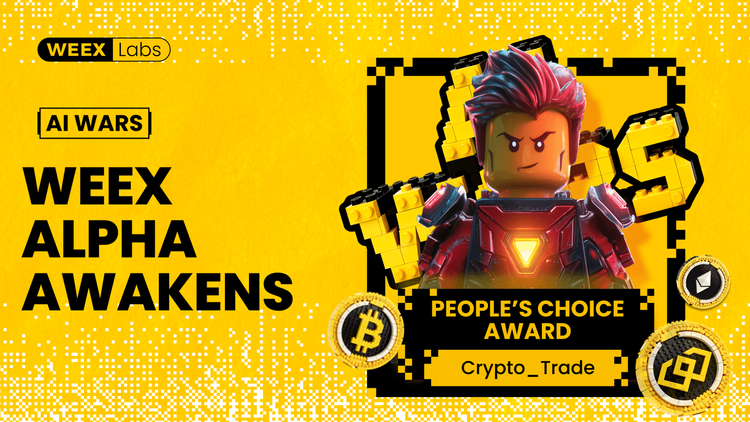
How a Structured AI Crypto Trading Bot Won at the WEEX Hackathon
Crypto_Trade shows how structured inputs and controlled adaptability can build a more stable and reliable AI crypto trading bot within the WEEX AI Trading Hackathon, highlighting a practical path toward scalable AI trading systems.
Particle Founder: The entrepreneurial insights I have gained the most from in the past year
Stop lean startup, stop lightning entrepreneurship, and think carefully about what your product aspirations are.
Huang Renxun's latest podcast transcript: The future of Nvidia, the development of embodied intelligence and agents, the explosion of inference demand, and the public relations crisis of artificial intelligence
The competition in the future is not just about whose model is larger or whose computing power is stronger, but also about who understands the industry better, who can embed AI more deeply into real processes, and who can organize these capabilities into a runnable and scalable system.
OKX Ventures Research Report: AI Agent Economic Infrastructure Research Report (Part 1)
The existing infrastructure is hostile to the Agent economy. Agents can think and act independently at the "capability level," but at the "economic level," they are still locked into infrastructure designed for humans.
The migration of settlement rights: B18 and the institutional starting point of on-chain banks
In the traditional system, banks decide the settlement; in the on-chain system, code begins to take over this responsibility.
From Tencent and Circle: Looking at the Simple and Difficult Questions of Investment
The AI narrative continues to ferment, but the recent performance of related stocks varies, with some in the midst of summer and others as if in winter.
The second half of stablecoins no longer belongs to the crypto circle
What Coinbase doesn't want, Mastercard is eager to buy.


 App
App