
 Buy Crypto
- Markets
 Futures
- Spot
- Copy Trade
- Earn
- More
Musk's Million-Dollar Artistic Creation Reward, Long-Form Content Revival, and Everything App's Ambition

Entering 2026, X (Twitter) has been quite active. While we can't see if anxiety is written on Musk's face, we can see Musk's anxiety written in his tweets.
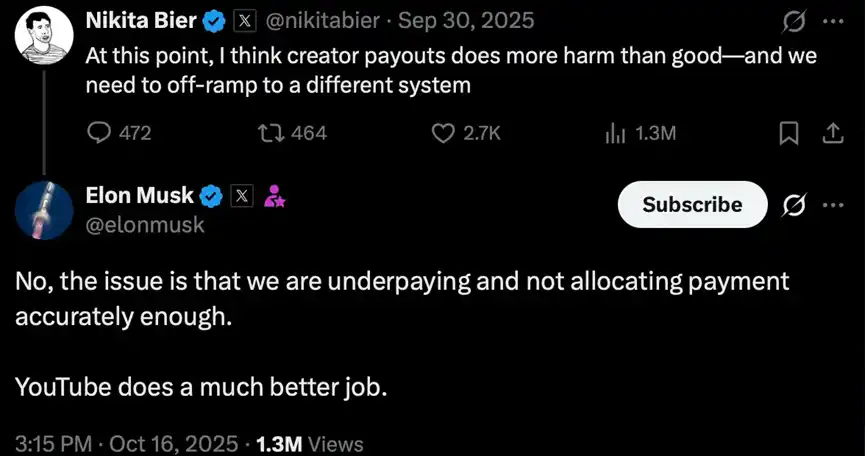
Musk said, "We still pay creators too little money, and the distribution is not done well enough, YouTube does much better in this regard."
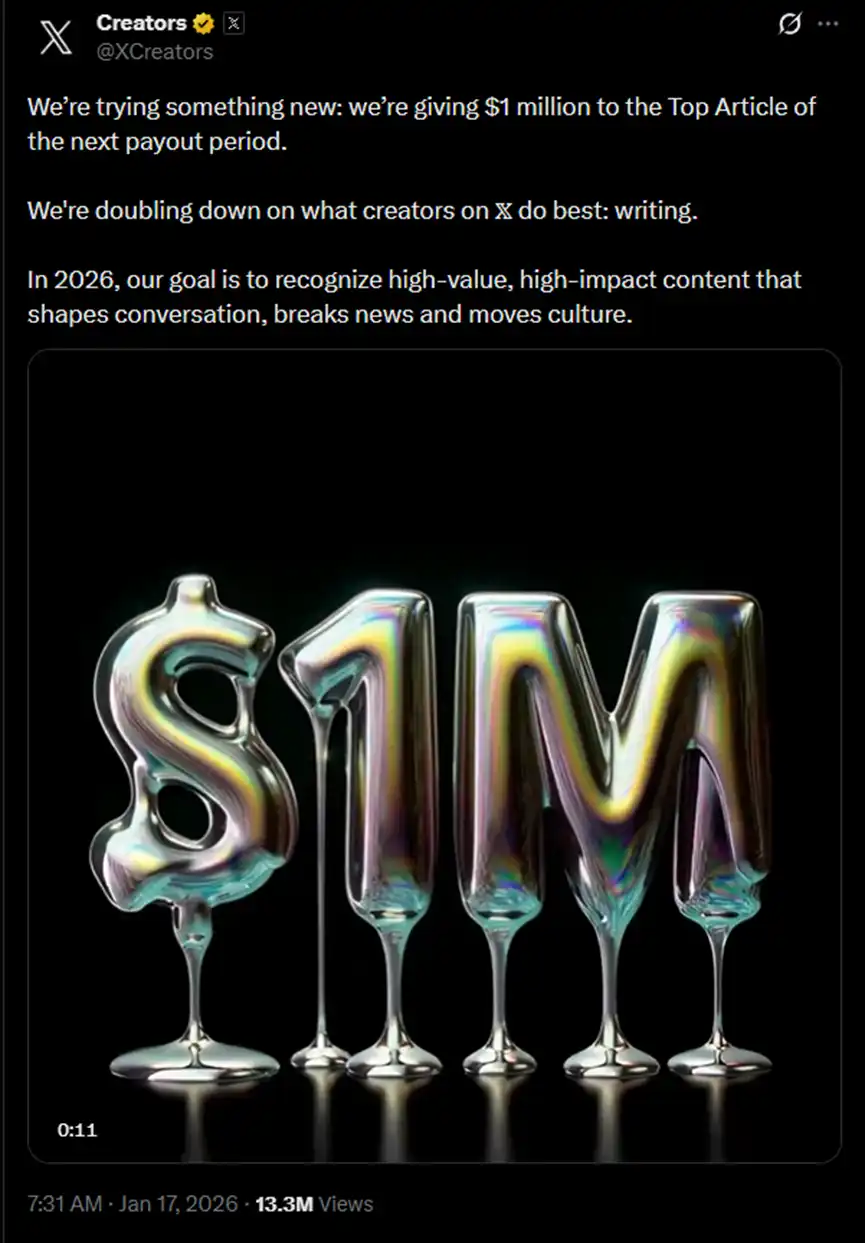
Moreover, last weekend, X officially launched a "Million Dollar Article Reward Event," sparking a wave of "long article fever" on the platform.
Currently, the most impactful article is "How to Fix Your Life in 1 Day" by DAN KOE. This article has received over 1.5 billion reads and has been retweeted by Musk.

Since Musk's acquisition of X several years ago, why has he started vigorously promoting X's creator ecosystem this year? In today's fragmented global user reading habits, why choose long articles as the key content type to promote? Can the revival of long-form content really support Musk's Everything App ambitions?
Musk's Anxiety
Every family has its own challenges, and even geniuses face anxiety. The relentless pressure from competitors and X's financial performance have also made Musk restless.
X is facing fierce competition in user growth and engagement, especially since Meta's Threads were launched in 2023, showing rapid growth and surpassing or closely approaching X in several metrics.
According to data analytics firm Similarweb's latest data released in early January 2026, Threads' global mobile Daily Active Users (DAU) have exceeded X, averaging 143.2 million, while X stands at 126.2 million. Looking at the growth trends, X's global DAU has seen an 11.9% year-on-year decrease, while Threads achieved an astonishing 37.8% growth. Even in X's home market, the United States, although X still leads Threads with 21.2 million DAU compared to Threads' 19.5 million, the gap is rapidly narrowing, with the latter seeing a 41.8% annual growth rate, while X has declined by 18.4%.
In terms of Monthly Active Users (MAU), Threads has also performed well. As of January 2026, its MAU has reached 320 million, and it grew from 350 million to 400 million in 2025. In comparison, X's MAU, although still at around 611 million, has lost approximately 32 million users since Musk's acquisition. This ebb and flow trend undoubtedly has put tremendous pressure on Musk.
The decline in user data has directly impacted X's core revenue source — advertising. According to public data, X's global ad revenue dropped to $25 billion in 2024, almost halving from $44 billion in 2022. Although a slight rebound to $22.6 billion is projected for 2025, the overall decline is still significant, with some institutions predicting that it will only recover to $2.7 billion by 2027.
Meanwhile, competitor Threads is highly anticipated by the capital market. Analysts forecast that Threads' advertising revenue in 2026 could reach $11.3 billion, several times higher than X's estimated revenue. Although X achieved quarterly revenue growth at the end of 2025, the company remains in a loss-making position overall due to high restructuring costs.
Although Premium subscribers (X Premium) saw significant growth in 2025, their revenue contribution is far below Musk's initial target of "50% of total revenue." Therefore, X will link the growth of Premium subscriptions to creator earnings directly, not only providing higher creator revenue but also clearly calculating revenue based on the Verified Home Timeline impressions of paid users to incentivize creators to produce high-quality content that attracts paid users and thus drive more users to subscribe to the Premium service.
So much so that we eventually saw the "Million-Dollar Article Reward" event initiated by the Old Horse. Chinese users joked that in 2026, the Old Horse started the "New Concept Essay Contest" in the United States.
The Renaissance of Long-Form Content
Musk chose to use long-form articles as the breakthrough point for the X platform's creator ecosystem, not on a whim but based on deep strategic considerations of the platform's positioning.
Today, X's recommendation algorithm has a core metric — "Regret-Free User Time," which is the total time users effectively spend on a piece of content. Musk explicitly stated that this mechanism inherently favors long-form content because they can "accumulate more user seconds," thereby enhancing the content algorithm's weight and the platform's overall user engagement.
Due to its depth, context, and complete narrative, long-form content inherently extends user dwell time, contrasting sharply with the fast consumption model of short posts or videos. Recent algorithm updates have introduced "content format weighting," explicitly favoring longer-form content that requires more creative effort and has a greater impact. This is not only an incentive for creators but also a data-driven decision: high-quality long articles can effectively reduce user clicks to external links, keep users on the platform longer, and provide more high-quality training data for Elon Musk's AI project Grok AI.
Musk has repeatedly emphasized his desire to make X the "primary news source on Earth," replacing traditional media with real-time aggregation of "collective wisdom." The long-form content feature allows users to publish "complete articles or even books," enabling domain experts, eyewitnesses, and in-depth creators to directly share their full insights on the platform, rather than fragmented information. Furthermore, compared to other platforms' significant subsidies for short videos, the incentive model for long-form content is more conducive to achieving a commercial closed loop through subscriptions, thereby attracting more professional journalists and writers back to the X platform.
However, a question arises. You may ask, in today's world where global user reading habits have become fragmented, what is Elon doing with this "Renaissance"?
Undeniably, global users' digital reading habits are showing a clear trend of fragmentation, especially under the impact of short-video platforms, where younger groups like Gen Z prefer "fragmented" reading several times a day, 5-10 minutes each time. Nevertheless, data also shows that overall reading volume is actually increasing. As a countermovement, "slow, immersive reading" is on the rise, as people in digital fatigue seek depth, emotional connection, and meaningful content consumption.
What X aims for is not to become another entertainment platform like TikTok but to become more like WeChat, a "life hub" deeply integrated into every American's daily life, which Musk has always referred to as the "Everything App." To achieve this, the platform's content and service ecosystem must be significantly enriched, enhancing users' "time well spent," giving them more reasons to stay on the platform, and accomplish more tasks here.
Ambitions of the Everything App
All of Musk's efforts ultimately point to a grand goal: turning X into an "Everything App" like WeChat. However, to achieve this ambition, X still has a long way to go.
Compared to WeChat, X lags significantly in several key metrics. In terms of Monthly Active Users (MAU), WeChat has over 1.4 billion users, while X has only 557 million, less than a third of the former. Such a huge gap in user numbers makes it difficult for X to establish the robust "network effect" of WeChat—where users cannot leave because all their friends, family, and life services are on the platform. WeChat has become essential in many people's daily lives, while X is still seen by most users as a social media platform for news consumption and opinion sharing, still reminiscent of the old Twitter or the "American Weibo."
When it comes to user engagement, the gap is equally evident. The average daily usage time of WeChat users is as high as 82 minutes, while X users are only at 30-35 minutes. The reason behind this is that users can complete a large number of "productive" tasks within WeChat, such as chatting, payment, shopping, and accessing municipal services, whereas X's content consumption still relies mainly on passive browsing, which easily leads to "browse and leave" behavior.
Old Ma doesn't want X to become TikTok, so he first needs to let X break away from the entertainment-focused user experience of "browse and leave." He needs high-quality, in-depth content to enhance user engagement, attract and retain high-value users, then gradually integrate more services such as payment and e-commerce based on content, ultimately paving the way to the "Everything App."
And the grander this dream is, the deeper Musk's anxiety will be.
You may also like

Tiger Research: What AI services do cryptocurrency companies offer?

The war not only drives up oil prices but also causes Circle's stock price to soar

When agents become consumers, who will rewrite the underlying logic of internet commerce?

AI Agents in Action Summit: March 31, Hong Kong Cyberport, focusing on the deep waters of AI implementation

29 Days In, What Are America’s Options on Iran?

Flash Crash Down 97%+ with Ongoing Unlocking, WLD Completes $65 Million Off-chain Funding: Who Is Still Buying?

Bitcoin for Real Estate? Fannie Mae Teams Up with Coinbase to Launch Crypto Mortgage
Tether Hires Big Four Auditor, USDT Enters First Attestation Phase

Google AI Paper Destroys $900B Storage Stock, Accused of Faking Experiment
Evaporate $2 Trillion, U.S. Stocks See Worst Start in 4 Years, Why is the Market Bearish?

The speed at which AI discovers vulnerabilities has surpassed the speed at which it patches vulnerabilities.

AI Crypto Trading Bot Explained: Aurora's Multi-Factor Strategy in WEEX Hackathon
Aurora demonstrates how structured, multi-agent AI Trading systems can deliver more adaptive and resilient performance in the WEEX AI Trading Hackathon.

Cyber Taoist Fortune Teller: Fake Taoist, AI Fortune Telling, and Northeastern Metaphysics History

Bloomberg: Stablecoin Payments Emerge as Crypto VC's Newest Favorite Thing
BeatSwap is evolving towards a full-stack Web3 infrastructure, covering the entire lifecycle of IP rights.
BeatSwap, a global Web3 Intellectual Property (IP) infrastructure project, is attempting to overcome the current fragmentation limitations of the Web3 ecosystem, building a full-stack system that covers the entire lifecycle of IP rights.
Currently, most Web3 projects are still in the stage of functional fragmentation, often focusing only on a single aspect, such as IP asset tokenization, transaction functionality, or a simple incentive model. This structural dispersion has become a key bottleneck hindering the industry's scale application.
BeatSwap's approach is more integrated, integrating multiple core modules into the same system, including:
· IP authentication and on-chain registration
· Authorization-based revenue sharing mechanism
· User-engagement-driven incentive system
· Transaction and liquidity infrastructure
Through the above integration, the platform builds an end-to-end closed-loop path, allowing IP rights to complete a full cycle of "creation, use, and monetization" within the same ecosystem.
BeatSwap is not limited to existing crypto users but is attempting to take the global music industry as a starting point, actively creating new market demand. Its core strategies include:
Exploring and incubating music creators (Artist discovery)
Building a fan community
Igniting IP-centric content consumption demand
The current global music industry is valued at around $260 billion, with over 2 billion digital music users. This means that the potential market corresponding to the tokenization and financialization of IP far exceeds the traditional crypto user base.
In this context, BeatSwap positions itself at the intersection of "real-world content demand" and "on-chain infrastructure," attempting to bridge the structural gap between content production and financial flow.
BeatSwap's upcoming core product "Space" is scheduled to launch in the second quarter of 2026. This product is defined as the SocialFi layer in the ecosystem, aiming to directly connect creators with users and achieve deep integration with other platform modules.
Key designs include:
A fan-centric interactive mechanism
Exposure and distribution logic based on $BTX staking
User paths connected to DeFi and liquidity structures
Thus, a complete user behavior loop is formed within the platform: Discovery → Participation → Consumption → Rewards → Trading
$BTX is designed to be a core utility asset within the ecosystem, rather than just a simple incentive token, with its value directly tied to platform activity and IP use cases.
Main features include:
· Yield distribution based on on-chain authorized actions
· Value reflection based on IP usage and user engagement dynamics
· Support for staking and DeFi participation mechanisms
· Value growth driven by ecosystem expansion
With the increased frequency of IP use, the utility and value support of $BTX will enhance simultaneously, helping alleviate the "disconnect between value and utility" issue present in traditional Web3 token models to some extent.
Currently, $BTX has been listed on several mainstream exchanges, including:
Binance Alpha
Gate
MEXC
OKX Boost
As the launch of "Space" approaches, BeatSwap is actively pursuing more exchange listings to further enhance liquidity and global accessibility, laying a foundation for future market expansion.
BeatSwap's goal is no longer limited to the traditional Web3 narrative but aims to target over 2 billion digital music users and a trillion KRW-scale content market.
By integrating content creators, users, capital, and liquidity into a blockchain framework centered around IP rights, BeatSwap is striving to build a next-generation infrastructure focused on "IP tokenization."
BeatSwap integrates IP authentication, authorization distribution, incentive mechanism, transaction system, and market construction to establish a unified structure that bridges the full lifecycle path of IP rights.
With the launch of the Q2 2026 "Space," the project is expected to become a key infrastructure connecting content and finance in the IP-RWA (Real World Assets) track.

Mag 7 Evaporates $2 Trillion | Rewire News Morning Edition

Losing $19K per Coin Mined, Bitcoin Mining Firms Collective AI Defection



 App
App