
- Buy Crypto
- Markets
 Futures
- Spot
- Copy Trade
- Earn
- More
Potential Impacts of Steady Rates on Bitcoin and Crypto Markets as Traders Await Key Economic Data
By: en coinotag|2025/05/08 02:30:04
0
Share
The US Federal Reserve’s decision to maintain interest rates at 4.25%–4.50% reflects ongoing economic uncertainties and its impact on crypto markets. With traders keenly observing the Fed’s monetary policies, crypto assets have shown resilience amid market fluctuations. “The balanced perspective from the Fed suggests tighter conditions are unlikely unless inflation resurges,” stated a COINOTAG analyst. Explore how the Fed’s steady interest rates are influencing crypto markets and what upcoming economic data could mean for future trends. Crypto Market Liquidity Conditions Likely to Remain Unchanged In response to the Federal Reserve’s recent announcement, crypto markets exhibited stability, with Bitcoin trading around $96,300 and Ethereum at $1,800. The decision to hold rates steady aligns closely with market predictions and fosters an atmosphere of cautious optimism. Traders are now anticipating insights from Fed Chair Jerome Powell’s subsequent press conference, particularly regarding future interest rate cuts. The central bank’s acknowledgment of recent economic softness — highlighted by a 0.3% GDP contraction in Q1 — tempered by a resilient labor market and inflation trends, indicates a complex landscape ahead. This balanced outlook may suggest that the Fed will avoid tightening policies unless a notable upward shift in inflation occurs. For crypto investors, this sustained interest rate scenario may help retain current market conditions and risk appetites, particularly if Powell signals a possibility of future rate reductions. Lower interest rates typically support crypto by depreciating the dollar and enhancing liquidity for alternative investments. Furthermore, the ongoing shifts toward tokenized US Treasuries and yield-bearing stablecoins continue to capture attention, with on-chain liquidity gravitating towards platforms that offer realistic returns reflecting traditional rates. A protracted pause from the Fed could enable these dynamics to persist, maintaining institutional involvement in the crypto sector. With traders now focused on subsequent CPI and jobs figures, any signs of easing inflation or economic weaknesses could solidify the case for a potential rate cut later in 2025, potentially providing crypto markets with another opportunity for growth. Market Response and Future Outlook The crypto sector’s current trajectory is closely tied to the Federal Reserve’s monetary policies. Many investors are keenly awaiting manufacturing and non-farm payroll data, critical indicators of economic health. Should these reports reveal further signs of economic slowdowns, market sentiment might shift positively towards riskier assets such as cryptocurrencies. Moreover, the current exuberance surrounding yield-bearing instruments suggests that investors are increasingly looking for attractive yields in the crypto realm. As traditional financial markets struggle with overhead pressures, the crypto industry’s appeal could strengthen, particularly for institutional investors seeking innovative solutions. Conclusion In summary, the Federal Reserve’s decision to hold interest rates steady at 4.25%–4.50% has significant implications for crypto markets. The ongoing balance between maintaining economic stability and navigating inflationary pressures will be pivotal in shaping market dynamics. Should economic indicators confirm a trend of reducing inflation, the possibility for rate cuts in H2 2025 could set the stage for a renewed rally in cryptocurrency values.
You may also like

Particle Founder: The entrepreneurial insights I have gained the most from in the past year
Stop lean startup, stop lightning entrepreneurship, and think carefully about what your product aspirations are.

Huang Renxun's latest podcast transcript: The future of Nvidia, the development of embodied intelligence and agents, the explosion of inference demand, and the public relations crisis of artificial intelligence
The competition in the future is not just about whose model is larger or whose computing power is stronger, but also about who understands the industry better, who can embed AI more deeply into real processes, and who can organize these capabilities into a runnable and scalable system.

OKX Ventures Research Report: AI Agent Economic Infrastructure Research Report (Part 1)
The existing infrastructure is hostile to the Agent economy. Agents can think and act independently at the "capability level," but at the "economic level," they are still locked into infrastructure designed for humans.

The migration of settlement rights: B18 and the institutional starting point of on-chain banks
In the traditional system, banks decide the settlement; in the on-chain system, code begins to take over this responsibility.

From Tencent and Circle: Looking at the Simple and Difficult Questions of Investment
The AI narrative continues to ferment, but the recent performance of related stocks varies, with some in the midst of summer and others as if in winter.

The second half of stablecoins no longer belongs to the crypto circle
What Coinbase doesn't want, Mastercard is eager to buy.

Cursor "Shell" Kimi Controversy Reversed: From Copyright Infringement Allegations to Authorized Collaboration, China's Open Source Model Once Again Becomes a Global AI Foundation
Cursor was accused of being based on Kimi K2.5, which sparked controversy, and was later confirmed to be compliant through Fireworks AI due diligence.

The Real Reason Tokens Don't Sell: 90% of Crypto Projects Overlook Investor Relations
Provide an Investor Relations Best Practices Guide for Crypto Projects.

Is the income of pump.fun real, earning a million dollars a day despite the market downturn?
If it can really earn this much, what is the reason for the low price of $PUMP?

The real reason why tokens are not selling: 90% of crypto projects neglect investor relations
Investor Relations Practice Guide for Cryptocurrency Projects.

Who is the true winner of the "Tokenization" narrative?
Virtually everyone benefits, but the reason for the benefit, the timing, and the underlying logic are completely different.

Moss: The Era of AI-Traded by Anyone | Project Introduction
AI Trading Agent is rapidly growing its infrastructure.

Chip Smuggling Case Exposes Regulatory Loophole | Rewire News Evening Update
AI chips have become a strategic asset more sensitive than missiles

How a Structured AI Crypto Trading Bot Won at the WEEX Hackathon
Ritmex demonstrates how disciplined risk control and structured signals can make an AI crypto trading bot more stable and reliable on WEEX, highlighting the importance of combining execution discipline with scalable AI trading systems.

Old Indicator Fails, Three Major New Signals Emerge: BTC True Bottom May Still Be Below $60K
When the grocery shopping auntie on the subway, or Tony the hairdresser, start asking you about BTC, crypto, and cryptocurrency investments, selling immediately will be the only best option.

Meeting OpenClaw Founder at a Hackathon: What Else Can Lobsters Do?
Imperial College London MetaGame: AI Agent × Web3 Landing Three Major Directions.
Huang Renxun's Latest Podcast Transcript: NVIDIA's Future, Embodied Intelligence and Agent Development, Soaring Demand for Inferencing, and AI's PR Crisis
The future of competition is not only about whose model is bigger, whose computing power is stronger, but also about who understands the industry better, who can more deeply integrate AI into real processes, and who can organize these capabilities into a set of executable, scalable systems
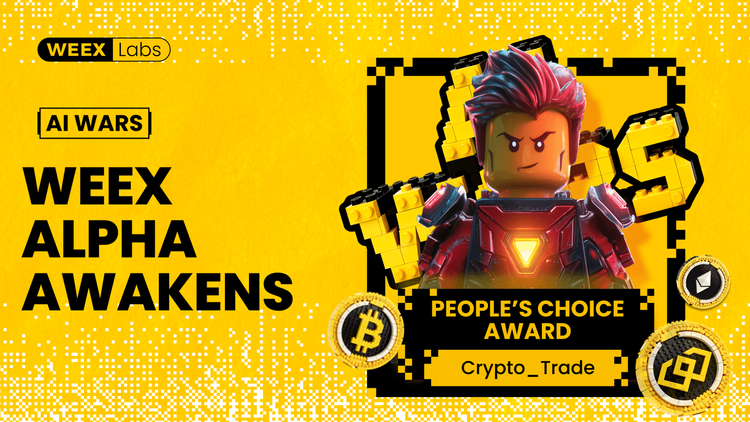
How a Structured AI Crypto Trading Bot Won at the WEEX Hackathon
Crypto_Trade shows how structured inputs and controlled adaptability can build a more stable and reliable AI crypto trading bot within the WEEX AI Trading Hackathon, highlighting a practical path toward scalable AI trading systems.
Particle Founder: The entrepreneurial insights I have gained the most from in the past year
Stop lean startup, stop lightning entrepreneurship, and think carefully about what your product aspirations are.
Huang Renxun's latest podcast transcript: The future of Nvidia, the development of embodied intelligence and agents, the explosion of inference demand, and the public relations crisis of artificial intelligence
The competition in the future is not just about whose model is larger or whose computing power is stronger, but also about who understands the industry better, who can embed AI more deeply into real processes, and who can organize these capabilities into a runnable and scalable system.
OKX Ventures Research Report: AI Agent Economic Infrastructure Research Report (Part 1)
The existing infrastructure is hostile to the Agent economy. Agents can think and act independently at the "capability level," but at the "economic level," they are still locked into infrastructure designed for humans.
The migration of settlement rights: B18 and the institutional starting point of on-chain banks
In the traditional system, banks decide the settlement; in the on-chain system, code begins to take over this responsibility.
From Tencent and Circle: Looking at the Simple and Difficult Questions of Investment
The AI narrative continues to ferment, but the recent performance of related stocks varies, with some in the midst of summer and others as if in winter.
The second half of stablecoins no longer belongs to the crypto circle
What Coinbase doesn't want, Mastercard is eager to buy.


 App
App