
 Buy Crypto
- Markets
 Futures
- Spot
- Copy Trade
- Earn
- More
Token VS Equity: The Aave Controversy

On December 17, Aave founder and CEO Stani.eth posted on social media that after four years, the U.S. Securities and Exchange Commission had completed its investigation into the Aave protocol.
This was supposed to be an inspiring milestone. However, as Web2 finished its entanglement with the SEC, Aave found itself facing a "backyard fire" in Web3 instead. Over the past half month, Aave's community governance dispute has been a hot topic in the English-speaking community. Around this dispute, there have been a series of events including whale sells, founder "buybacks," governance, and trust issues.
Let's take a look at the background of this event.
Cause: Revenue Distribution Sparks Controversy
On December 4, Aave Labs switched the default Swap feature on its front-end interface aave.com from ParaSwap to CoWSwap.
What was originally just a minor update, Aave DAO's senior governance participant and independent delegate EzR3aL discovered that the fee revenue generated by aave.com's default Swap feature was no longer flowing into the Aave DAO treasury as before but rather into an address controlled by Aave Labs. Based on on-chain investigation, EzR3aL stated that at the time of his post, the recent income transfer by Aave Labs was worth at least $200,000, with a rough estimate of at least $10 million in annual loss for Aave DAO based on the weekly revenue data.
However, Aave Labs did not proactively mention the change in fee revenue distribution, leaving many $AAVE holders feeling "betrayed."
Aave Labs responded multiple times to EzR3aL's post, with the main arguments being:
The protocol and the product are different concepts. The frontend interface that sparked the revenue distribution dispute is a product operated by Aave Labs, completely separate from the protocol managed by Aave DAO, and Aave Labs have the right to decide how to operate and profit.
Maintaining the frontend interface requires significant resources, and Aave DAO was never required to bear these costs.
In the original Paraswap-integrated technical architecture, the donation mechanism was based on surplus. When the actual execution price was higher than the quoted price, the surplus would be donated to Aave DAO. This was not a protocol fee, nor was it a mandatory requirement to give to Aave DAO. With the design changes, the original donation mechanism was naturally discontinued.
The new CoWSwap routing option can improve execution quality, including providing MEV protection for interface users, and this routing option was concocted by Aave Labs with its own resources, and it does not replace or disable the adapters owned by the Aave DAO at the protocol level, allowing the Aave DAO to let any interface integrate its owned adapters to enable swap functionality.
Contention Upgrade: Who Owns "Aave"?
Aave Labs' response to EzR3aL's post has not been understood and accepted by the community.
On December 13, @DefiIgnas published a lengthy article titled "Who Owns Aave: Aave Labs or Aave DAO?," which sparked widespread discussion.
On December 16, former Aave Labs CTO Ernesto released a governance proposal titled "$AAVE Alignment Phase 1: Ownership," advocating for Aave DAO and Aave token holders to explicitly control core rights such as protocol IP, brand, equity, and revenue. Aave service providers representative Marc Zeller and others publicly endorsed the proposal, calling it "one of the most influential proposals in Aave's governance history."
In the proposal, Ernesto mentioned, "Due to some events in the past, some previous posts and comments have shown strong animosity towards Aave Labs. However, this proposal aims to remain neutral. The proposal does not imply that Aave Labs should not contribute to the DAO or lacks the legitimacy or ability to contribute, but the decision should be made by Aave DAO."
On December 18, Aave founder and CEO Stani.eth replied to the proposal, stating that they would strengthen communication between Aave Labs and the community but would vote against the proposal because it simplifies a complex legal and operational issue into a simple "yes or no" vote without a practical solution, affecting Aave's overall development progress.
This further escalated the dispute.
Whale Sell-off, Founder's Market "Rescue"
On December 22, according to on-chain analyst yujianguo's monitoring, the whale address holding the second-largest amount of AAVE sold off 230,000 AAVE tokens (approximately $38 million), causing a short-term price drop of over 10%. The whale exchanged all AAVE for 227.8 WBTC and 5869.4 stETH between 5:40 and 7:05 a.m., reportedly acquiring these AAVE from late last year to early this year at an average cost of about $223.4. This selloff at an average price of around $165 is estimated to incur a loss of $13.45 million.
Shortly after the Whale's exit, Aave Labs announced that the issue needed formal governance decision-making and officially initiated a 3-day snapshot vote.
On December 23, Aave founder and CEO Stani.eth spent 1699 ETH (5.15 million USD) to buy 32,660 AAVE tokens at an average price of 157.78 USD. Including this purchase, he bought a total of 84,033 AAVE tokens within a week at an average price of around 176 USD, spending approximately 14.8 million USD.
However, despite the founder's "market rescue," the price turmoil continued. On December 24, the address starting with "0x3c7," known for "Large AAVE Short," opened a 7x leveraged AAVE short position with a 2.42 million USD position size at an average price of 151 USD and a liquidation price of 173 USD.
There were many doubts and concerns in the market regarding the founder's "market rescue" as well. DeFi strategist and liquidity expert Robert Mullins stated in a post that the purpose of this purchase was to increase Kulechov's voting power to support a proposal in an upcoming vote that directly harms the best interests of the token holders. He added: "This is a clear example that the token mechanism has not been adequately designed to effectively deter governance attacks."
Renowned crypto KOL Sisyphus also expressed similar concerns, suggesting that Kulechov may have sold millions of dollars worth of AAVE tokens between 2021 and 2025 and questioned the economic motives behind this buyback.
Outcome
On December 26, Wintermute's founder and CEO Evgeny Gaevoy stated that Wintermute would vote against the ARFC governance proposal to transfer the "brand asset control of AAVE to the holders."
Evgeny mentioned that the current proposal lacks specific details, and it is not clear how the entity owning the front end and brand would govern, whether it is for-profit, and how it operates. Token value capture is a core issue facing AAVE, and there is a clear mismatch in expectations between Aave Labs and a large number of token holders. Wintermute has been investing in AAVE since 2022 and has participated in its governance. Evgeny hopes that Aave Labs will address the issue of token value capture seriously, which will serve as a reference for other tokens.
The voting results were also released this morning, with the proposal ultimately not passing, resulting in 55.29% against, 41.21% abstaining, and only 3.5% in favor.
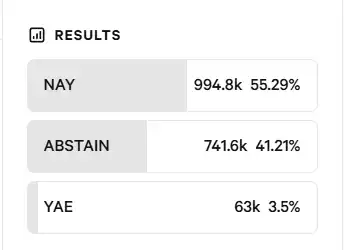
So, is this the end of the dispute? Apparently not, as the lack of trust between the community and Aave Labs remains unresolved. What seemed to be a conflict triggered by poor communication is actually a manifestation of the long-standing contradiction in the crypto world between development/operation teams and governance, where rights and interests are unclear and lack institutional constraints. The entanglement between Aave Labs and Aave DAO actually underscores Aave's success, as there are too many similar examples in the crypto world where such high-quality discussions do not even have the opportunity to occur in an attempt to resolve issues (related reading: Why are projects in the crypto space not asking for tokens in acquisitions?).
This is the problem Aave must face, and it is a problem that the entire cryptocurrency industry will sooner or later have to confront.
You may also like

How long can the Ethereum ecosystem survive after the launch of Mythos?

Morning News | Yi Lihua establishes AI fund OpenX Labs; Pharos Network completes $44 million Series A financing; Iran demands that Hormuz tankers pay Bitcoin as tolls

Ray Dalio's new article: The world is entering a war cycle

IOSG: When Fintech Meets Crypto Native: The Next Decade of Digital Finance

They knew in advance that Trump would tweet about a ceasefire, entered with $20k, and exited with $400k.

The biggest bottleneck in DeFi development

CZ Memoir Released: Reveals a Large Amount of Industry Insider Information, Prompting Intense Rebuttal from Xu Mingxing

a16z: After securities are on the blockchain, why will intermediary institutions be replaced by code?

XRP Tokyo Is Here: What We Learn and What’s Next for XRP Price
Key Takeaways: Ripple’s 2025 XRP Tokyo event highlights a projected $33 trillion on-chain stablecoin volume by 2026. Significant…

Solana’s Future: Navigating the $285M Hack, Rug Pulls, and Milei Libra Scandal
Key Takeaways: Multiple Crises: Solana faces a $285 million hack, allegations of rug pulls, and the Milei Libra…

BTC USD Faces Tension: Markets React to Trump’s Dire Warning
Key Takeaways: Bitcoin’s price drops sharply below $70,000 amid geopolitical tensions, playing off Trump’s dramatic 8 PM ultimatum…
Bitcoin Price Surge: Ceasefire Sparks Optimism Hits $71K
Key Takeaways: After the US-Iran ceasefire announcement, Bitcoin surged beyond $71,000, marking its highest in a month. A…

Ethereum Price Forecast: Record $180 Billion Stablecoin Supply Marks Buyers’ Return
Key Takeaways: Ethereum’s stablecoin supply has surged to a record $180 billion, marking a 150% increase over the…

Emerging Evidence Links Argentina’s Milei to LIBRA Crypto Scandal
Key Takeaways: Evidence unveiled by Argentina’s federal prosecutors links President Javier Milei to the LIBRA token through call…

US Spot Bitcoin ETFs See Surge as BTC Nears $70K; LiquidChain and Layer-3 DeFi Rise
Key Takeaways: U.S. spot Bitcoin ETFs absorbed $471 million in a single day, moving BTC closer to the…

Bitcoin Price Prediction: Decoupling from Tech Stocks, Shaped by Geopolitics and AI Turmoil
Key Takeaways: Bitcoin is decoupling from tech stocks as geopolitical tensions and AI crises reshape the market, currently…

Chaos Labs Departure Leaves Aave Without Risk Management Amidst Governance Conflict
Key Takeaways: Aave, with a $50 billion TVL, is currently operating without a risk manager due to Chaos…
Grayscale Ethereum ETF Staking: A New Catalyst for $5,700?
Key Takeaways: Grayscale’s Ethereum Staking ETF introduces a yield-bearing structure that could significantly reshape investor sentiment. Ethereum’s price…


 App
App