
- Buy Crypto
- Markets
 Futures
- Spot
- Copy Trade
- Earn
- More
Will AI make blockchains conscious?
By: bitcoin ethereum news|2025/05/07 06:30:02
0
Share
This is a segment from the Blockworks Daily newsletter. To read full editions, subscribe . “Consciousness may end up being found in very strange places.” — Christof Koch The canonical question in the philosophy of consciousness was posed by Thomas Nagel in 1974: “What is it like to be a bat?” Nagel’s idea was that consciousness is defined simply by what it feels like to be something — the inner, subjective experience of being alive and aware. “An organism has conscious mental states if and only if there is something that it is like to be that organism,” he explained. Many have found this subjective answer unsatisfyingly circular: What is this something ??? David Chalmers later declared this question “the hard problem of consciousness” because it exposed a gap between subjective experience and objective science. In 2004, however, Giulio Tononi confronted Chalmer’s hard problem with a paper proposing a mathematical model for consciousness: Integrated Information Theory (IIT). Consciousness, he argued, is a mathematical property of physical systems — something that can be quantified and measured. But can a system be conscious? After interviewing the computational neuroscientist Christof Koch, the co-hosts of the New Scientist podcast concluded that computers, being systems, could theoretically achieve consciousness if they were able to “integrate” the information they process. And nearly anything could be a system: Even a rock might register a trace of consciousness if its atoms form the right kind of structure (as proven in the science documentary Everything Everywhere All at Once ). Which got me thinking: Ethereum is a world computer, right? And critics accuse Bitcoin of being a pet rock. So...if computers and rocks can be conscious, surely blockchains can be, too? Blockchains do, in fact, tick a lot of IIT’s boxes. IIT posits, for example, that a system can only be conscious if its current state reflects everything it’s been through — just as your memories shape who you are and each moment builds on the last. Blockchains like Ethereum work in a similar way: A blockchain’s current “state” is a function of its history and each new block depends entirely on the ones before it. That history-dependence gives it a kind of memory — and because thousands of nodes agree on a single shared version of reality, it also creates a unified “now” (or “state”) that IIT says is a characteristic of consciousness. Unfortunately, IIT also says that for a system to be conscious, it has to have “causal autonomy” — which is to say, its parts have to influence each other internally and not just in response to inputs it passively receives from external actors. Blockchains don’t work like that, of course. Instead, they rely on external inputs (like users sending transactions and validators adding blocks) to act on and advance — and the nodes that run the network don’t influence each other internally, they just blindly follow the same set of rules. There’s no spontaneous activity, no internal causation — not even the aimless vibration of molecules you’d get in an inanimate chunk of granite. So I’m sorry to report that, on the IIT spectrum of consciousness, blockchains rank below even rocks — and that the “pet rock” jab might therefore be a compliment to Bitcoin (or an insult to rocks). But maybe not for long! In 2021, the computer scientists (and married couple) Lenore and Manuel Blum co-authored a paper describing how to engineer consciousness into machines. Their framework treats consciousness as a computable property — achievable with AI algorithms designed to produce systems with the “causal autonomy” required for conscious experience. The AI wouldn’t be conscious itself, in this case, but a system that deploys it could be. Now imagine an AI-enabled blockchain that doesn’t just run code, but thinks about running code. Instead of inert ledgers passively waiting for inputs, blockchains could be self-contained, “causally integrated” machines — more like synthetic brains than distributed databases, with the kind of internal autonomy that IIT researchers consider essential for consciousness. This could be useful! A system like that might be able to reason about its own security, detect anomalies in real time, and decide when to fork itself (perhaps after a period of soul-searching introspection). In short, it would do things not because it was told to, but because it understood what was happening — both inside itself and in the outside world. It’s not impossible. Today’s blockchains are more like nervous systems without a brain — wiring without will. But tomorrow? Who knows. If IIT is right, philosophers might soon be asking, “ What’s it like to be a blockchain?” (And also, is it better than being a rock? ) Get the news in your inbox. Explore Blockworks newsletters: Source: https://blockworks.co/news/will-ai-make-blockchains-conscious
You may also like

Oracle "Outage": Aave Faces $27 Million Irregular Liquidation
The guardian has turned into the reaper. An internal configuration mistake caused the largest DeFi lending protocol to **accidentally** liquidate 34 accounts.

A single tweet caused a 17% crash in oil prices, who's not a Meme yet
From the Petrodollar to the Meme Era: Why a Single Tweet Tanked Global Oil Prices

March 11th Market Key Intelligence, How Much Did You Miss?
1. On-chain Fund: $47.1M inflow to Hyperliquid today; $75.4M outflow from Ethereum
2. Largest Price Swings: $XAI, $BTW
3. Top News: G7 Pre-Summit Pledge to "Principally Support Strategic Crude Oil Reserve Use"; Four Whales Open Large Short Positions Against Crude Oil Today

Benefit-Loaded Event | With over 500 sign-ups, how else can this Lobster Tug-of-War Extravaganza be spiced up?
Sign Up Now!
a16z’s Brutal Lesson to Crypto Founders: Why Enterprises Don’t Buy the Best Technology?
If your product is "obviously better" but still can't win, the gap lies not in performance, but in product-market fit.

The rivers and lakes are no more, Li Lin returns
We no longer need a larger exchange or more complex financial products; we hope to see more individuals like Li Lin in the industry, who can drive innovations that truly open up boundaries for the industry.

Earn Up to 300% APR With WEEX Auto Earn: Limited-Time Crypto Passive Income Event
Earn up to 300% APR with WEEX Auto Earn in this limited-time crypto earning campaign. Activate Auto Earn, invite friends, and unlock additional referral crypto rewards before March 25.

BitsLab Deep Production: Nanobot User Security Practice Guide
BitsLab releases AI Agent Security Guidelines: Through a three-pronged strategy of "User Review + Agent Awareness + Script Hard Interception," a zero-trust security defense line is established to prevent prompt injection and sensitive data leakage risks.

What are the common traits of people who founded a $5 Billion+ company before the age of 23?
Trauma, Neurodiversity, Cross-Domain Skills. These characteristics, which may appear as "flaws" on a traditional resume, could instead be the most important signals

Why Hasn't $160 Billion Stripe Gone Public?
The Rise of Private Placements, with Companies like Stripe Rewriting Fundraising Logic.

All the AI News You Need to Know is Here, Lyrical Officially Launches AI News Feed
Users can access key information in real time without switching pages

Bitwise: Why Bitcoin Is Destined to Impact a Million Dollars?
When people talk about Bitcoin, they often overlook one key thing.
Amid Geopolitical Turmoil, Tokenized Gold Emerges Alongside Round-the-Clock On-Chain Markets
When the stock market is closed, the on-chain becomes the sole trading and pricing outlet.

Who Longs War on Polymarket?
The Rug Pull War rages on, with the potential to earn up to 4x gains on your bet
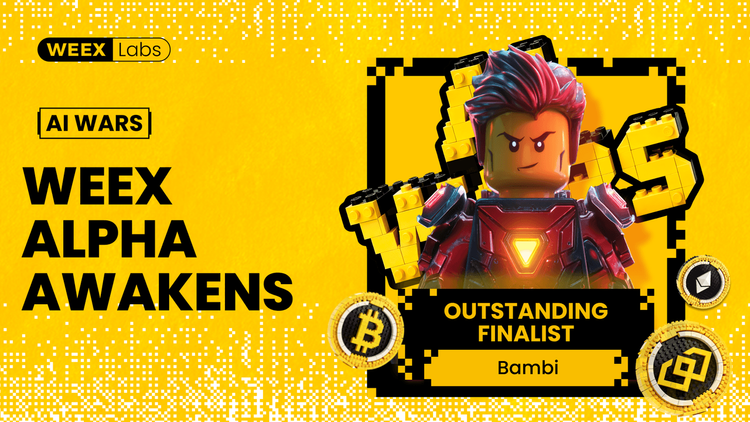
4 AI Trading Strategy Lessons from WEEX Hackathon Finalist
Finalist Bambi shares how AI tools helped turn real trading experience into an automated strategy, why survival-first risk control shaped the system’s design, and how the approach will evolve ahead of WEEX AI Trading Hackathon Season 2.

Hong Kong Crypto Ecosystem 2.0: Stablecoins, RWA, and the New Battleground for Financial Institutions
Hong Kong is no longer just a bystander in the cryptocurrency industry, but may become the core hub of the compliant cryptocurrency market in the Chinese-speaking world and even the entire Asia-Pacific region.

Polymarket Arbitrage Bible: The Real Gap is in the Mathematical Infrastructure
While retail investors are still engaged in simple probability addition, top quantitative teams are systematically harvesting millions of dollars in arbitrage profits on Polymarket using hardcore mathematical infrastructure such as integer programming and Bregman projections.

Crypto Barbarians Jupiter Series: Still Owes the Market an Answer
This entrepreneurial team from Singapore and Malaysia has indeed demonstrated its product execution capabilities to the market over the past three years, but they have also fully arbitraged every regulatory gray area with their business logic.
Oracle "Outage": Aave Faces $27 Million Irregular Liquidation
The guardian has turned into the reaper. An internal configuration mistake caused the largest DeFi lending protocol to **accidentally** liquidate 34 accounts.
A single tweet caused a 17% crash in oil prices, who's not a Meme yet
From the Petrodollar to the Meme Era: Why a Single Tweet Tanked Global Oil Prices
March 11th Market Key Intelligence, How Much Did You Miss?
1. On-chain Fund: $47.1M inflow to Hyperliquid today; $75.4M outflow from Ethereum
2. Largest Price Swings: $XAI, $BTW
3. Top News: G7 Pre-Summit Pledge to "Principally Support Strategic Crude Oil Reserve Use"; Four Whales Open Large Short Positions Against Crude Oil Today
Benefit-Loaded Event | With over 500 sign-ups, how else can this Lobster Tug-of-War Extravaganza be spiced up?
Sign Up Now!
a16z’s Brutal Lesson to Crypto Founders: Why Enterprises Don’t Buy the Best Technology?
If your product is "obviously better" but still can't win, the gap lies not in performance, but in product-market fit.
The rivers and lakes are no more, Li Lin returns
We no longer need a larger exchange or more complex financial products; we hope to see more individuals like Li Lin in the industry, who can drive innovations that truly open up boundaries for the industry.


 App
App