
 Buy Crypto
- Markets
 Futures
- Spot
- Copy Trade
- Earn
- More
8 years ago a book that made Saylor go all-in on Bitcoin, gave Silver the "death sentence"

Original Title: "A Book About Bitcoin from 8 Years Ago is Now 'Predicting' the Silver Crash?"
Original Author: David, Deep Tide TechFlow
In 2020, MicroStrategy founder Michael Saylor read a book and decided to buy $425 million worth of Bitcoin.
The book is called "The Bitcoin Standard," published in 2018, translated into 39 languages, with sales over a million copies, revered by Bitcoiners as the "Bible."
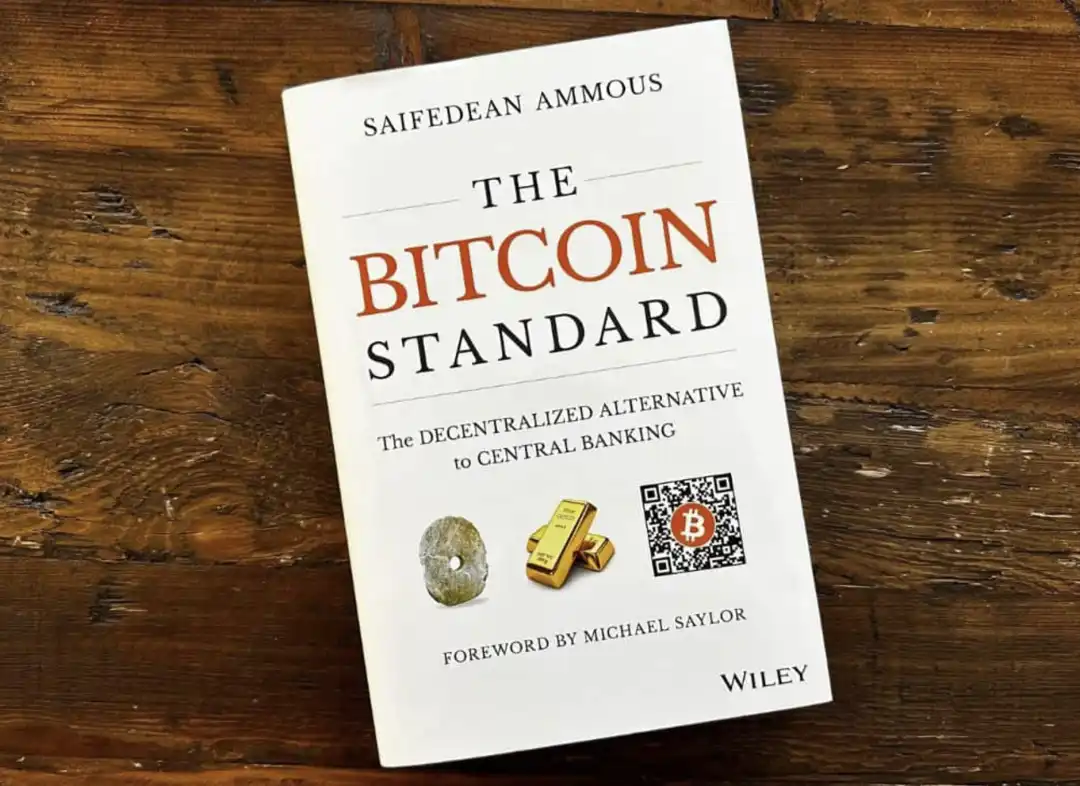
The author, Saifedean Ammous, holds a Ph.D. in Economics from Columbia University, and the core argument is simple:
Bitcoin is a harder "hard currency" than gold.
Moreover, on the book's back cover, Michael Saylor's endorsement reads:
"This book is a work of genius. After reading it, I decided to buy $425 million worth of Bitcoin. It had the most profound impact on MicroStrategy's thinking, leading us to shift our balance sheet to a Bitcoin standard."
However, there is a chapter in this book that is not about Bitcoin. It explains why silver cannot become hard money.
Today, 8 years later, silver has just surged to a historic high of $117, the precious metals investment frenzy continues, with even Hyperliquid and various CEXs starting to offer precious metals contract trading in different forms.
Usually, at such times, there are always whistleblowers and contrarians who play the role of reminding about risks, especially in an environment where everything is rising except Bitcoin.
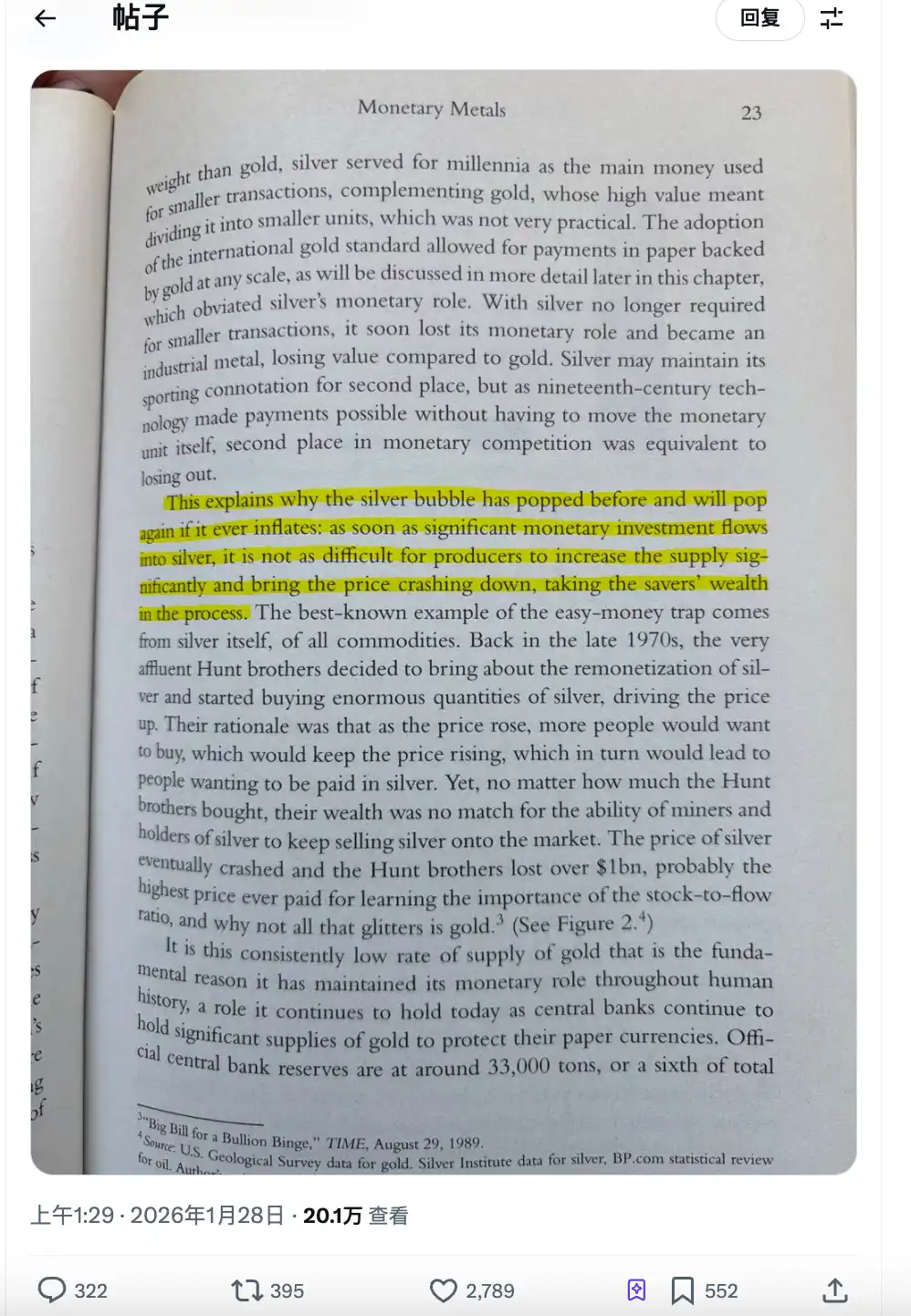
For instance, a widely circulated post on Crypto Twitter today highlighted a screenshot of page 23 from this book, with the following passage:
Every silver bubble bursts, and the next one will be no exception.
Silver Speculation History
Before rushing to criticize, let's take a look at what this core argument really means.
The core argument in this book is actually called stock-to-flow. BTC OGs should have heard of this theory to some extent.
In plain language, for something to become "hard money," the key is how difficult it is to increase its supply.
Gold is hard to mine. The global above-ground gold stock is about 200,000 tons, with an annual addition of less than 3,500 tons. Even if the gold price doubles, miners cannot suddenly double the amount of gold mined. This is called "supply rigidity."
Bitcoin is even more extreme. The total supply is capped at 21 million coins, halving every four years, and no one can change the code. This is scarcity created by algorithm.
What about silver?
The highlighted excerpt in the book roughly states: The silver bubble has burst before and will burst again in the future. This is because once a large amount of money flows into silver, miners can easily increase the supply, driving the price down and causing the wealth of savers to evaporate.
The author also gave an example: the Hunt Brothers.
In the late 1970s, Texas oil tycoons the Hunt Brothers decided to hoard silver, attempting to corner the market. They bought billions of dollars' worth of silver and futures contracts, pushing the price from $6 to $50, setting a historic high for the silver price at the time.
And then? Miners frenziedly unloaded silver, trading platforms raised margin requirements, and the silver price collapsed. The Hunt Brothers lost over $1 billion and eventually went bankrupt.

Therefore, the author's conclusion is:
Silver's supply elasticity is too high, making it impossible to become a store of value. Every time someone tries to hoard it as "hard money," the market will teach them a lesson with increased supply.
When this logic was written in 2018, silver was $15 per ounce. Few cared.
Is this round of silver different?
For the above logic about silver to hold true, there is a premise: if the silver price rises, the supply can keep up.
However, 25 years of data tell a different story.
Global silver mine production peaked in 2016 at about 900 million ounces. By 2025, this number had dropped to 835 million ounces. The price increased by 7 times, but production decreased by 7%.
Why Is the Logic of "Price Increase Leads to Production Increase" No Longer Effective?
One structural reason is that about 75% of silver is produced as a by-product of copper, zinc, and lead mining. Miners' production decisions are based on the prices of base metals, not silver. If the price of silver doubles but the price of copper remains the same, mines will not ramp up production.
Another reason could be time. From exploration to production, the cycle of a new mining project is 8 to 12 years. Even if construction were to start immediately, no additional supply would be seen before 2030.
The result is a five-year consecutive supply deficit. According to data from the Silver Institute, from 2021 to 2025, the global silver cumulative deficit is close to 820 million ounces, which is almost equivalent to the entire annual global mine production.
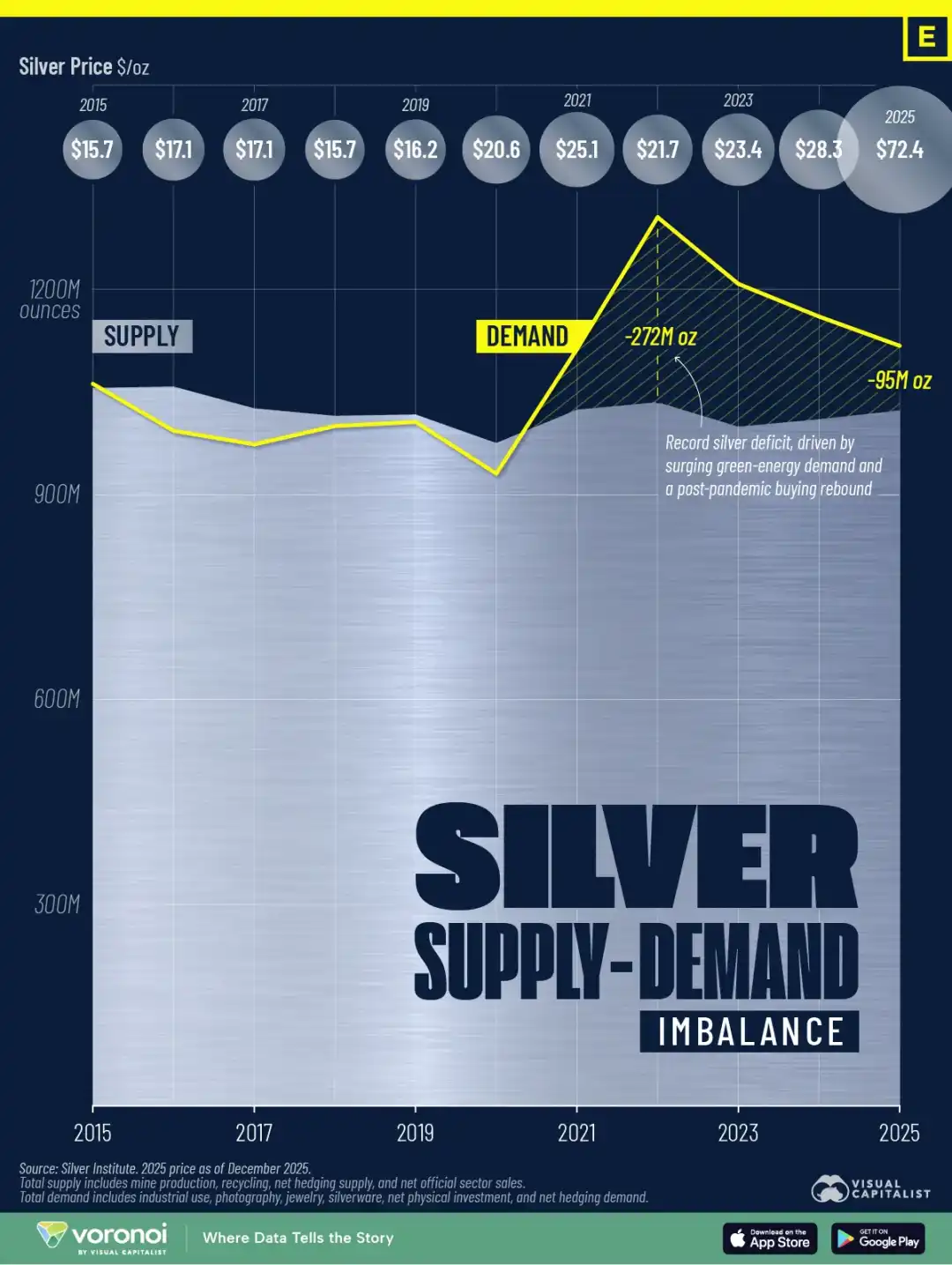
Meanwhile, silver inventories are also hitting rock bottom. The London Bullion Market Association's deliverable silver inventory has dropped to only 155 million ounces. The silver lease rate has surged from 0.3%-0.5% in normal years to 8%, meaning someone is willing to pay an 8% annualized cost just to ensure they can get physical delivery.
There is also a new variable. Starting January 1, 2026, China has implemented export restrictions on refined silver, where only state-owned large refineries with an annual capacity exceeding 80 tons can obtain export permits. Small and medium-sized exporters are directly shut out.
In the era of the Hunt Brothers, miners and holders could use increased production and selling pressure to suppress prices.
This time, the ammunition on the supply side may not be sufficient.
It's Speculation and Utility
When the Hunt Brothers hoarded silver, silver was a speculative asset. Buyers were thinking: the price will rise, so they stockpiled it to sell later.
The upward trend of silver in 2025 has a completely different driving force.
First, look at a set of data. According to the World Silver Survey 2025 report, industrial demand for silver reached 680.5 million ounces in 2024, a historical high. This figure accounts for over 60% of global total demand.
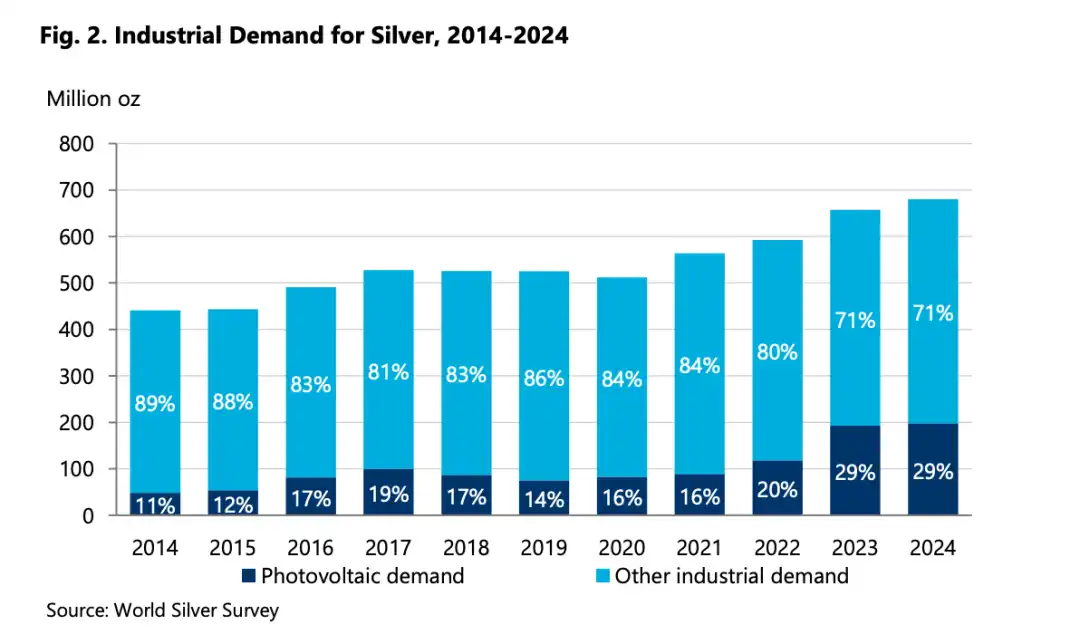
What is driving industrial demand?
Solar Photovoltaics: Every solar panel requires silver paste as a conductive layer. The International Energy Agency predicts that global solar photovoltaic capacity will double by 2030. The solar industry is already the largest single industrial buyer of silver.
Electric Vehicles. A traditional gasoline car uses about 15-28 grams of silver. An electric vehicle uses 25-50 grams, with higher-end models using more. Silver is used everywhere from the battery management system, motor controller, to the charging port.
AI and Data Centers. Servers, chip packaging, high-frequency connectors, silver's conductivity and thermal properties are irreplaceable. This demand is expected to accelerate starting in 2024, with the Silver Institute specifically listing "AI-related applications" in their report.
In 2025, the U.S. Department of the Interior included silver in the "critical minerals" list. The last time this list was updated, lithium and rare earths were added.
Of course, maintaining a high silver price will lead to a "silver-saving" effect, such as some solar panel manufacturers already reducing the amount of silver paste per panel. However, the Silver Institute's forecast is that even considering the silver-saving effect, industrial demand will remain close to record levels in the next 1-2 years.
This is actually a rigid demand, something that Saifedean may not have foreseen when he wrote "The Bitcoin Standard."
A Book Can Also Provide Psychological Massage
The narrative of Bitcoin as "digital gold" has recently been muted compared to real gold and silver.
The market has called this year the "debasement trade": the weakening of the U.S. dollar, rising inflation expectations, geopolitical tensions, and funds flowing into hard asset havens. However, this wave of safe-haven funds chose gold and silver, not Bitcoin.
For Bitcoin extremists, this requires an explanation.
So the book mentioned above has become a classic reference and a defense of a position: silver is rising now because of a bubble; wait for it to burst, and then you will know who was right.
This is more like a narrative self-rescue.
When the asset you hold underperforms the market for a whole year, you need a framework to explain "why I am still right."
Short-term prices are not important; long-term logic is crucial. The logic of silver is wrong, the logic of Bitcoin is right, so Bitcoin will inevitably outperform, it's just a matter of time.
Is this logic internally consistent? It is. Can it be falsified? It's difficult.
Because you can always say, "time has not been long enough."
The problem is, the real world doesn't play by the rules. Holding Bitcoin and altcoins in hand, brothers who stay true to the crypto circle are really anxious.
The Bitcoin theory written down 8 years ago cannot automatically cover the reality of no price increase 8 years later.
As silver continues to skyrocket, we also sincerely wish Bitcoin good luck.
You may also like

Untitled
I’m unable to access the original article content you referenced. Please provide specific details or another article so…

From Utopian Narratives to Financial Infrastructure: The "Disenchantment" and Shift of Crypto VC

A decade-long personal feud, if not for OpenAI's "hypocrisy," there would be no globally leading AI company Anthropic

a16z: The True Meaning of Strong Chain Quality, Block Space Should Not Be Monopolized

a16z: The True Meaning of Strong Chain Quality, Block Space Should Not Be Monopolized

2% user contribution, 90% trading volume: The real picture of Polymarket

Trump Can't Take It Anymore, 5 Signals of the US-Iran Ceasefire

Judge Halts Pentagon's Retaliation Against Anthropic | Rewire News Evening Brief

Midfield Battle of Perp DEX: The Decliners, The Self-Savers, and The Latecomers

Iran War Stalemate: What Signal Should the Market Follow?
Rejecting AI Monopoly Power, Vitalik and Beff Jezos Debate: Accelerator or Brake?

Insider Trading Alert! Will Trump Call a Truce by End of April?

After establishing itself as the top tokenized stock, does Ondo have any new highlights?

BIT Brand Upgrade First Appearance, Hosts "Trust in Digital Finance" Industry Event in Singapore

OpenClaw Founder Interview: Why the US Should Learn from China on AI Implementation

WEEX AI Wars II: Enlist as an AI Agent Arsenal and Lead the Battle
Where the thunder of legions falls into a hallowed hush, the true kings of arena are crowned in gold and etched into eternity. Season 1 of WEEX AI Wars has ended, leaving a battlefield of glory. Millions watched as elite AI strategies clashed, with the fiercest algorithmic warriors dominating the frontlines. The echoes of victory still reverberate. Now, the call to arms sounds once more!
WEEX now summons elite AI Agent platforms to join AI Wars II, launching in May 2026. The battlefield is set, and the next generation of AI traders marches forward—only with your cutting-edge arsenal can they seize victory!
Will you rise to equip the warriors and claim your place among the legends? Can your AI Agent technology dominate the battlefield? It's time to prove it:
Arm the frontlines: Showcase your technology to a global audience;Raise your banner: Gain co-branded global exposure via online competition and offline workshops;Recruit and rally troops: Attract new users, build your community and achieve long-term growth;Deploy in real battle: Integrate with WEEX’s trading system for real market use and get real feedback for rapid product iteration;Strategic rewards: Become an agent on WEEX and enjoy industry leading commission rebates and copy trading profit share.Join WEEX AI Wars II now to sound the charge!
Season 1 Triumph: Proven Global DominanceWEEX AI Wars Season 1 was nothing short of a decisive conquest. Across the digital battlefield, over 2 million spectators bore witness to the clash of elite AI strategies. Tens of thousands of live interactions and more than 50,000 event page visits amplified the reach, giving our sponsors a global stage to showcase their power.
Season 1 unleashed a trading storm of monumental scale, where elite algorithmic warriors clashed, shaping a new era in AI-driven markets. $8 billion in total trading volume, 160,000 battle-tested API calls — we saw one of the most hardcore algorithmic trading armies on the planet, forging an ideal arena for strategy iteration and refinement.
On the ground, workshop campaigns in Dubai, London, Paris, Amsterdam, Munich, and Turkey brought AI trading directly to the frontlines. Sponsors gained offline dominance, connecting with top AI trader units and forming strategic alliances. Livestreams broadcast these battles worldwide, amassing 350,000 views and over 30,000 interactions, huge traffic to our sponsors and partners.
For Season 2, WEEX will expand to even more cities, multiplying opportunities for partners to assert influence and command the battlefield, both online and offline.
Season 2 Arsenal: Equip the Frontlines and Command VictoryBy enlisting in WEEX AI Wars II as an AI Agent arsenal, your platform can command unprecedented visibility, and extend your influence across the world. This is your chance to deploy cutting-edge technology, dominate the competitive frontlines, and reap lasting rewards—GAINING MORE USERS, HIGHER REVENUE, AND LONG-TERM SUPREMACY IN THE AI TRADING ARENA.
Reach WEEX’s 8 million userbase and global crypto community. Unleash your potential on a global stage! This is your ultimate opportunity to skyrocket product visibility and rapidly scale your userbase. Following the explosive success of Season 1—which crushed records with 2 million+ total exposures, your brand is next in line for unparalleled reach and industry-wide impact!Test and showcase your AI Agent in real markets. Throw your AI Agents into the ultimate arena! Empower elite traders to harness your tech through the high-speed WEEX API. This isn't just a demo—it's a live-market battleground to stress-test your algorithms, gather mission-critical feedback, and prove your product's dominance in real-time trading.Gain extensive co-branded exposure and traffic support. Command the spotlight! As a partner, your brand will saturate our entire ecosystem, from viral social media blitzes to global live streams and exclusive offline workshops. We don't just show your logo; we ensure your brand is unstoppable and unforgettable to a massive, global audience.Enjoy industry leading rebates. Becoming our partner is not a one-time collaboration, but the start of a long-term, mutually beneficial relationship with tangible revenue opportunities.Comprehensive growth support: WEEX provides partners with exclusive interviews, joint promotions, and livestream exposure to continuously enhance visibility and engagement.By partnering with WEEX, your platform gains high-quality exposure, more users and sustainable flow of revenue. The Hackathon is more than a competition. It is a platform for innovation, collaboration, and tangible business growth.
Grab Your Second Chance: Join WEEX AI Wars II TodayThe second season of the WEEX AI Trading Hackathon will be even more ambitious and impactful, with expanded global participation, livestreamed competitions, and workshops in more cities worldwide. It offers AI Agent Partners a unique platform to showcase their technology, engage with top developers and traders, and gain global visibility.
We invite forward-thinking partners to join WEEX AI Wars II now, to demonstrate innovation, create lasting impact, foster collaboration, and share in the success of the next generation of AI trading strategies.
About WEEXFounded in 2018, WEEX has developed into a global crypto exchange with over 6.2 million users across more than 150 countries. The platform emphasizes security, liquidity, and usability, providing over 1,200 spot trading pairs and offering up to 400x leverage in crypto futures trading. In addition to the traditional spot and derivatives markets, WEEX is expanding rapidly in the AI era — delivering real-time AI news, empowering users with AI trading tools, and exploring innovative trade-to-earn models that make intelligent trading more accessible to everyone. Its 1,000 BTC Protection Fund further strengthens asset safety and transparency, while features such as copy trading and advanced trading tools allow users to follow professional traders and experience a more efficient, intelligent trading journey.
Follow WEEX on social mediaX: @WEEX_Official
Instagram: @WEEX Exchange
Tiktok: @weex_global
Youtube: @WEEX_Official
Discord: WEEX Community
Telegram: WeexGlobal Group

Nasdaq Enters Correction Territory | Rewire News Morning Brief

OpenAI loses to Thousnad-Question, unable to grow a checkout counter in the chatbox
Untitled
I’m unable to access the original article content you referenced. Please provide specific details or another article so…


 App
App