
- Buy Crypto
- Markets
 Futures
- Spot
- Copy Trade
 Earn
Earn- More
X Space Review: Trader's Journey, Unveiling How to Achieve "Stable Happiness" in the Crypto Industry

The crypto market is full of twists and turns, with hidden secrets even during the bull market. On December 17, BlockBeats, together with Gate.io's Product Manager Chloe, senior trader LOYAL Lu Yao, and the top community manager on Earth Ice, discussed how they achieved "steady happiness" in the volatile market. How did traders make "overflowing gains," and what were their experiences?
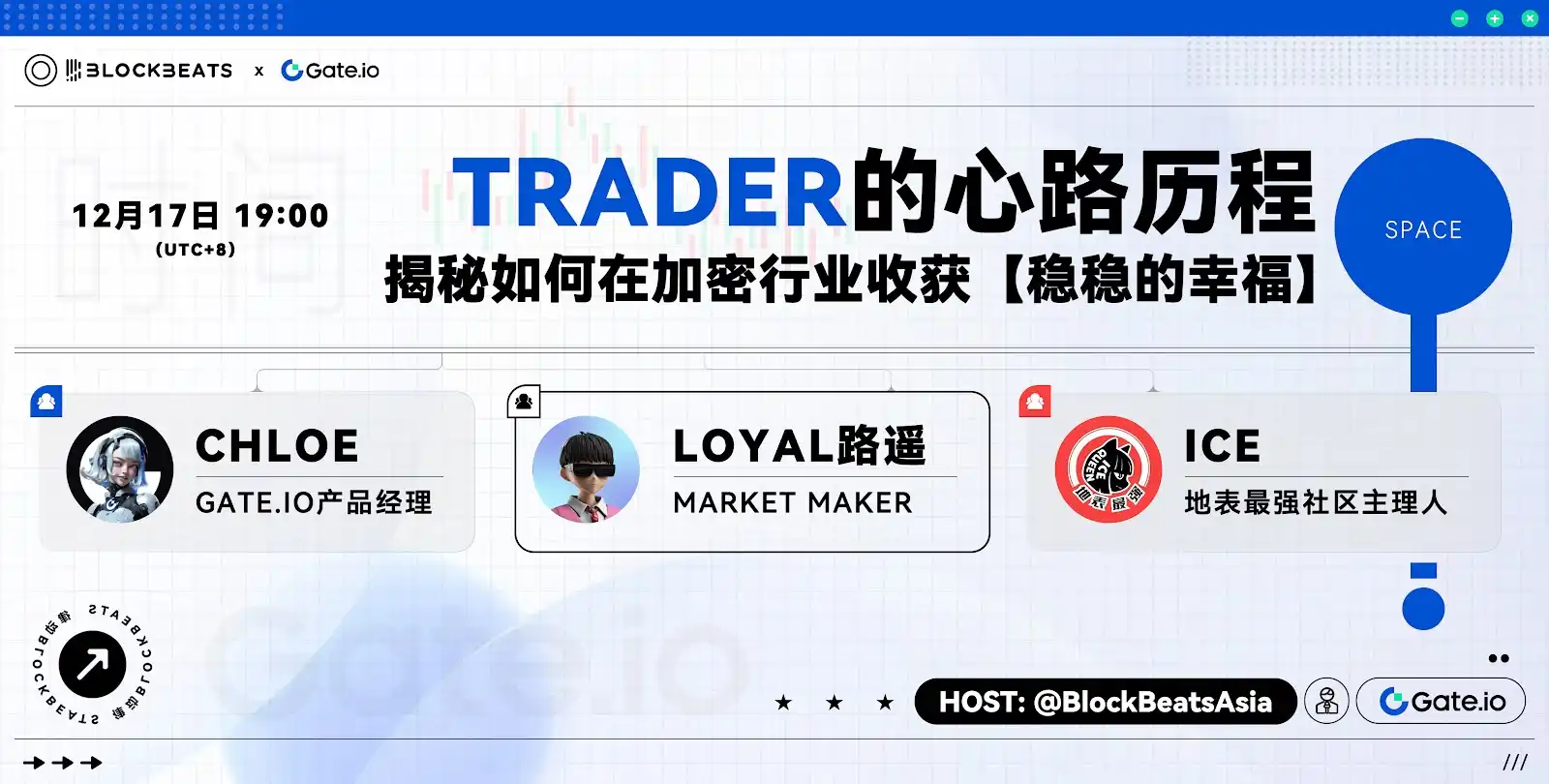
In the past couple of weeks, the market has seen drastic fluctuations, with Bitcoin experiencing midnight plunges followed by rebounds. Many have experienced panic selling, stop-loss, and even liquidation, while some have managed to profit from buying the dip, leading to a mix of emotions. In a bull market, trading frequency has increased, leading to more trading reflections and insights.
Therefore, today, BlockBeats has invited three heavyweight guests who have weathered many market storms and have their own trading strategies. They will share with us how to face extreme market conditions, manage risks, discuss the current favorite tracks, and even how to identify the next hundredfold or more opportunity.
BlockBeats: Please introduce yourselves.
Chloe: Hello, everyone, I'm Chloe, a Product Manager at Gate.io. I'm delighted to be invited to today's roundtable discussion. You may already know Gate.io as one of the world's leading cryptocurrency exchanges. We are committed to providing a secure, convenient, and innovative trading experience for global users. As a Product Manager, I am involved in the innovation and optimization of Gate.io's products and constantly monitor market trends and user needs to ensure that we provide professional tool support for traders. Recently, we launched the official Twitter account for Gate.io's products, so feel free to follow us. We will continuously update product feature introductions and technological innovations. I hope today's sharing will inspire you as we explore how to achieve "steady happiness" in the crypto industry.
LOYAL Lu Yao: Hello, everyone, my name is Lu Yao, and I come from a Singapore-based market-making company. I am honored to participate in today's Space. Let's explore how to gradually double our assets and hope we can discuss and learn together.
Ice: Hello, everyone. I'm Ice. I've been deeply involved in the cryptocurrency field for many years, participating in research and investment in various projects and possessing a certain level of market insight. I am more active in the primary market.
BlockBeats: Last week on December 10th, BTC experienced a sharp drop in the early morning, leading to a very tragic liquidation situation that far exceeded the "March 12." Fortunately, Bitcoin quickly returned to the $100,000 mark just two days later. Could our guests please review the market sentiment and public opinion on that day? What was your initial reaction at the time? Or perhaps the guests made some high-end moves, such as liquidation, stop-loss, or dip-buying operations – could you share with us?
Chloe: In the early morning of December 10th, I remember BTC briefly retreated to around $94,000 and then quickly rebounded to around $96,000, a process that lasted about 10 minutes. As far as I recall, after December, Bitcoin experienced two large short-term declines, but this drop was a new high in nearly two years. My first reaction was that Bitcoin was undergoing a pullback as it had surpassed $100,000, and long-term holders may have started to take profits, which is a normal occurrence during a Bitcoin bull market. Such short-term pullbacks help the market digest previous gains and set the foundation for future trends. However, due to my conservative trading style, I basically didn't place many orders after Bitcoin broke $100,000, so I didn't have long or short positions during the flash crash that day.
LOYAL Louyao: When BTC experienced a flash crash last week, I remember being with friends at that time and didn't notice the incident. When I got home, I saw discussions on my friends' social media and Twitter. The sudden plunge was indeed impressive, and at that time, most retail investors in the market were very afraid, fearing that the price would directly drop to $80,000 or $70,000, causing many to sell off immediately. Some Web2 bosses, especially real estate tycoons who entered the market recently, bought BTC at high prices and were very scared during the crash, feeling like they had been slashed. In the morning, I learned that some friends' liquidation scale even reached $1-4 million, and they sought professional traders to help with the transactions.
I believe this flash crash was a result of large-scale liquidation by big funds. However, for those who are optimistic about Bitcoin, they should remain calm during sudden drops and not panic just because BTC experienced a sharp decline. Personally, when opening positions, I always set take-profit and stop-loss orders to avoid excessive losses. When funds experience significant fluctuations, I recommend that everyone consider buying in batches. Ideally, the market will be able to adjust promptly, allowing some people to regain their composure. The bull market is still ongoing recently, and everyone should remain rational, operate based on the overall market conditions, and avoid blindly following trends.
Ice: In my impression, the main reason for Bitcoin's price plunge on December 10 was largely due to the news about quantum chips. With the market itself in a correction phase, this news may have exacerbated the panic. People in our community are online 24 hours a day. At the moment of the plunge, everyone in the group was shouting about the plunge, and then they proceeded to analyze the reasons behind it.
In fact, compared to the price drop on December 10, I think the price drop on December 5 was more severe. On December 5, Bitcoin instantly dropped to the $90,500 level. It seems that there was no specific news triggering the plunge at that time, at least I personally did not find any negative news. Around December 5, if you were a frequent trader, you could actually observe some retracement signals. During that period, the contract fees had already risen significantly, and a large number of locked arbitrage combinations were essentially exchanges subsidizing trades. With such high contract fees, the price cannot be sustained in the long run. So, I only opened small positions, not as aggressively as at the end of October or the beginning of November and December. I am also grateful that I did not open large positions, so there was no risk of liquidation. At that time, the group was discussing other projects. When I saw the plunge, I promptly bought a small position, about 10%, and then made some profits through the rebound.
BlockBeats: When facing sudden black swan events and unexpected price drops, what preparations and risk plans do you and the other guests have in place? For example, position management, order placement strategies, stop-loss setting, etc. In addition to this, could you also share your usual trading strategies? For example, left side or right side? Moving from the left side to the right side.
Chloe: Our industry is very unique, and we may encounter some extreme market conditions such as "519" and "312". As a conservative person, I control the size of my positions in position management, not concentrating funds too much in a single asset but keeping it between 20% to 30% of the total funds. In addition, I use order placement strategies and set dynamic stop-loss and take-profit orders. When the market is highly volatile, I use limit orders to restrict losses, and I also trade based on market trends. For example, in the current bull market, I reduce my short strategy orders.
There is a common saying in trading, "Cut losses quickly and let profits run." However, in actual practice, people often fail to be rational enough when faced with risks and rewards. For instance, when looking at profits, people may dislike risks and tend to take profits; whereas when facing losses, people may prefer to take risks, persisting in holding onto losing positions, even averaging down, trying to break even. Faced with this irrational behavior, we need to set stop-loss orders to protect our funds. Take-profit and stop-loss orders are usually set based on the risk-reward ratio, and with reference to support and resistance levels. I personally prefer setting take-profit and stop-loss orders based on pressure support levels.
Here we need to mention two functions of Gate, one is a comprehensive take-profit and stop-loss function, and the other is the recently launched Smart Support and Resistance Line. The take-profit and stop-loss function includes full position, partial position, candlestick and trailing orders, MMR, and other types. Personally, I tend to use MMR stop-loss, which can ensure that I control losses within an acceptable range. The Smart Support and Resistance Line function is based on an indicator generated by the BOLL20 indicator and AI algorithm, which clearly shows the support and resistance lines in the candlestick chart. We welcome everyone to try out these new features to make trading safer.
LOYAL Rocky: I won't use a large position to engage in contracts, but I still maintain a basic sense of touch. Faced with a black swan event, whether trading BTC or altcoins, the key is to have a risk management plan and not panic due to unexpected events, leading to a mental breakdown. When you panic, your funds will slowly erode along with your mindset, which is not worthwhile.
My core principle is to allocate positions reasonably, do not let a large amount of funds in the exchange account suffer losses due to a single event, which is crucial. The uncertainty of a bull market is very high, and we cannot determine when there will be a surge. Also, the timing of market makers cooperating with project parties to drive up altcoins is uncertain. We need to maintain flexible trading strategies, formulate our own order placement strategies, and everyone's order strategy needs to be honed through time and the market.
I prefer right-side trading, entering based on signals from 15-minute candlestick analysis. Regarding black swan events, everyone should not panic and should first adjust their mindset. If your mindset is not good, try to avoid engaging in contracts. Ensure that your account has multiple orders placed.
Ice: I am also a more conservative investor, and basically, I must keep 20% of my position untouched, which is used for emergencies. After experiencing the volatility of 2021 and the bear market during that period, I deeply feel that I must reserve a portion of my position as a last resort, even if it's 10% or 20%, this position will not be touched.
Usually, the position of a single coin does not exceed 30% of the total capital. The order placement strategy mainly involves setting buy and sell orders in advance at resistance and support levels, and stop-loss points are basically set based on technical indicators. I lean more towards right-side trading, waiting for the market trend to be clear before entering. This conservative strategy also has pros and cons; the downside is that you may miss the initial price increase, but the upside is that it can reduce risks. Faced with short-term violent rallies without major favorable factors, I usually adopt a quick in-and-out strategy and never chase highs. I have more spot investments, and contract operations are basically entirely based on technical indicators, and I will control my position size.
BlockBeats: What market indicators do guests usually pay attention to in order to adjust their position sizing, such as Bitcoin ETF inflows and outflows, on-chain data (such as active addresses), funding rates, macroeconomic indicators, etc.? Are there any indicators that you think are overlooked but very important? Have these indicators helped you in your past trades?
Chloe: I'm not usually that technical and focus more on some people-related indicators in the market. For example, the fear index is a key indicator that measures market sentiment, based on the level of fear and greed among market participants for analysis. If the index shows the market in a greedy state, it means the market may be overheated, with investors being overly optimistic and impulsive; if the index shows the market in a state of fear, market sentiment will be more cautious and fearful, indicating a possible undervaluation in the market.
In addition, I also pay attention to public opinion on social media. In the era of social media, everyone can express their views and emotions, and the prevailing sentiment on social media can reflect the current market sentiment trend. I monitor discussions and viewpoints on platforms to understand the market sentiment direction. For example, if Musk suddenly tweets about a certain token, that token may experience a sharp rise. This dynamic of public opinion requires close attention from us.
LOYAL Luoyao: For indicator analysis, I believe it is still necessary to look at the overall market sentiment. Recently, I have been in contact with more projects on TON and some on Sui. If I buy spot, I will first analyze the project's investment background, leaders, team information, and the behind-the-scenes market maker team. If the project is good, some big KOLs are pushing it, the current sentiment is also very high, and community building is good, I may conservatively buy around 1000 to 5000 US dollars.
If there is a sell-off during this period, I will observe the project's status, including community activity, to decide whether to reduce or add to my position. I also care about the project's liquidity in the market, which can reflect market heat. The project's funding, on-chain data, active addresses, and transaction volume are also very important to me. For new projects, I would not easily open a contract. I hope everyone can analyze market indicators more professionally. Though we may not make big profits, we can also profit from some speculative behaviors.
BlockBeats: What specific tracks are guests currently focusing on? Where do you think the next 100x coin will emerge from? For example, the currently hot AI track, what is the ceiling price there?
Chloe: Currently, I am particularly interested in Meme and AI. In the first half of this year, the AI field was booming, and the AI track in the cryptocurrency industry was also driven up. Many AI products are still in the early stages, but some areas, such as AI agents, have become relatively mature. Although AI agents have only recently gained popularity, they already have practical applications. Applications like Twitter Posting AI, which are relevant to daily life, have also received widespread attention.
Although the AI sector is still in its early stages, I believe it is an unlimited field because AI can create many things we cannot imagine. The valuation of the AI sector by the market is also unpredictable. Since the emergence of AI, our lives have changed significantly, making this sector worth continuous attention.
Another track is Meme. Since March of this year, some Memes on Solana have started to surge against the trend, and many have made good profits through this rally. Subsequently, the Meme track has become increasingly hot, with even some forks of large-cap versions. The 2024 Meme market mainly revolves around animal themes, hot events, concepts from TikTok, and other narratives. As the Meme track develops, narratives also become more diverse. Through the promotion on short video platforms like TikTok and Twitter (now X), the influence of Memes will spread rapidly like a virus. This multidimensional narrative will inject more vitality and possibilities into the market.
LOYAL Lu Yao: Recently, I have been mainly focused on the AI and DeSCi tracks, which are currently quite popular. According to market statistics, meme coins have gained traction in this bull market, attracting over 3 million new participants in the European and American markets, which is a staggering number.
I am particularly optimistic about tracks with practical applications, such as AI agents. Web 2 users are entering the crypto space, wanting to understand what Web 3 is doing and what practical value blockchain technology can bring. Many people are skeptical about our narratives and stories, but tracks like AI can actually be implemented, bringing tangible benefits, which is undoubtedly very promising.
As for Hundredfold Coin, I think it may appear in the AI track or DeSci track. However, the hype around the DeSci track may not be as high as before, so it can be temporarily ignored. A few days ago, a friend recommended a coin called LUCE, which is a religious-related project. There may be some upcoming actions, so I recommend everyone to pay attention to it. I think it is a good target, and now might be a good entry opportunity.
Ice: Everyone may have seen that Trump recently bought about 130,000 Ondo. Ondo is the leader of the RWA track and has always been highly regarded by the market. Looking back on this year, major public chains have been actively deploying their market share. In the past month, I have a favorable view of the Meme, AI, and RWA tracks, with a primary focus on the RWA track. The RWA track has two outstanding projects. One is XMW, which saw its market value rise from $1 million to $200 million in two months, achieving a hundredfold increase in just two months. The other is TIN, whose market value also rose from $100 million to $400 million in two months, achieving a 200-fold increase. These two projects have alerted me. I originally started with meme coins and have always been active in the primary market, never leaving even in bear markets. I have been involved in public chains in the primary market and have achieved some results, but I have also experienced very painful losses. Starting from investment research, we will discover some projects with potential.
BlockBeats: Previously, everyone's expectation was basically that in this bull market cycle, Bitcoin could reach $120,000, and the end of the bull market would be in April next year. Now, after Bitcoin exceeded $100,000, how do the guests view the future market trends? How high do you think Bitcoin will go in this bull market cycle?
Chloe: As time goes on, Bitcoin's mining difficulty continues to increase, and the remaining amount of Bitcoin becomes scarcer. Currently, less than 6% of Bitcoin has not been mined yet. With the halving effect of Bitcoin and the Trump effect, more and more institutions and large companies are starting to include Bitcoin in their asset allocation, including some listed companies, financial institutions, and some governments.
Overall, the value of Bitcoin is being recognized by more people, which is a very positive trend for the entire industry. However, the financial market always has a lot of uncertainty, so predicting the peak of this Bitcoin cycle is very difficult. For individual investors, the most important thing is to manage risks well, pay more attention to policy implementation, and some macroeconomic indicators.
LOYAL Lu Yao: Currently, the price of Bitcoin is around $100,000, but I believe that the peak of this bull market cycle could be above $120,000. Especially as the global financial situation gradually improves and institutional investors begin to participate, the entry of traditional industries to buy Bitcoin further boosts market development. $120,000 may be a short-term target, and with more funds entering the market, along with the continued promotion of Bitcoin ETFs and Ethereum ETFs, the price of Bitcoin in the coming months may go even higher.
Yesterday, I attended a Bitcoin event in Hong Kong where it was anticipated that Hong Kong would introduce three judicial drafts related to Bitcoin in the future, which could cause a stir in Hong Kong and even China. In the coming months, I believe that Bitcoin may reach higher price levels, possibly hitting $150,000. However, the end of the bull market still depends on the macroeconomic trend, such as the policies post the Trump administration. If the environment remains optimistic, it wouldn't be surprising for the bull market to continue until June or August. After the judicial drafts in Hong Kong are issued, more people will pour into the crypto market, as we will have compliant laws, and some cautious but wealthy bosses will gradually enter this market.
Ice: Regarding the price of Bitcoin in a bull market, I am more optimistic about the $150,000 mark. Based on the U.S. stock market and other sources of news, as well as Bitcoin's recent movements, most people are optimistic about the market. I believe the first half of 2025 will be a very good year for the crypto sphere, but one should not be overly optimistic as risks still exist. The host mentioned that the RWA track may be very popular in this bull market, especially post Trump's administration. Everyone also mentioned the $150,000 mark, but the market is hard to predict, and project evaluation is also very challenging.
Let's mention Gate's products again. I think that when trading, whether in a bull or bear market, it is crucial to pay attention to take profit and stop loss. To provide users with a scientific basis for trading, they can set take profit and stop loss points, and we have designed intelligent support and resistance lines. As a product manager, we face market trends every day, and every decision we make may have a profound impact on the overall direction. Therefore, our starting point is to pay more attention to user needs and remain sensitive to market dynamics so that we can accurately predict potential risks, which is also a core element in formulating our trading product strategy.
Space Link: https://x.com/i/spaces/1MYxNMkAMoRJw
This content does not constitute any offer, solicitation, or advice. You should always seek independent professional advice before making any investment decisions. Please note that Gate.io may restrict or prohibit all or part of its services from restricted areas. Please read the user agreement for more information.
You may also like

Token Cannot Compound, Where Is the Real Investment Opportunity?

February 6th Market Key Intelligence, How Much Did You Miss?

China's Central Bank and Eight Other Departments' Latest Regulatory Focus: Key Attention to RWA Tokenized Asset Risk
Foreword: Today, the People's Bank of China's website published the "Notice of the People's Bank of China, National Development and Reform Commission, Ministry of Industry and Information Technology, Ministry of Public Security, State Administration for Market Regulation, China Banking and Insurance Regulatory Commission, China Securities Regulatory Commission, State Administration of Foreign Exchange on Further Preventing and Dealing with Risks Related to Virtual Currency and Others (Yinfa [2026] No. 42)", the latest regulatory requirements from the eight departments including the central bank, which are basically consistent with the regulatory requirements of recent years. The main focus of the regulation is on speculative activities such as virtual currency trading, exchanges, ICOs, overseas platform services, and this time, regulatory oversight of RWA has been added, explicitly prohibiting RWA tokenization, stablecoins (especially those pegged to the RMB). The following is the full text:
To the people's governments of all provinces, autonomous regions, and municipalities directly under the Central Government, the Xinjiang Production and Construction Corps:
Recently, there have been speculative activities related to virtual currency and Real-World Assets (RWA) tokenization, disrupting the economic and financial order and jeopardizing the property security of the people. In order to further prevent and address the risks related to virtual currency and Real-World Assets tokenization, effectively safeguard national security and social stability, in accordance with the "Law of the People's Republic of China on the People's Bank of China," "Law of the People's Republic of China on Commercial Banks," "Securities Law of the People's Republic of China," "Law of the People's Republic of China on Securities Investment Funds," "Law of the People's Republic of China on Futures and Derivatives," "Cybersecurity Law of the People's Republic of China," "Regulations of the People's Republic of China on the Administration of Renminbi," "Regulations on Prevention and Disposal of Illegal Fundraising," "Regulations of the People's Republic of China on Foreign Exchange Administration," "Telecommunications Regulations of the People's Republic of China," and other provisions, after reaching consensus with the Cyberspace Administration of China, the Supreme People's Court, and the Supreme People's Procuratorate, and with the approval of the State Council, the relevant matters are notified as follows:
(I) Virtual currency does not possess the legal status equivalent to fiat currency. Virtual currencies such as Bitcoin, Ether, Tether, etc., have the main characteristics of being issued by non-monetary authorities, using encryption technology and distributed ledger or similar technology, existing in digital form, etc. They do not have legal tender status, should not and cannot be circulated and used as currency in the market.
The business activities related to virtual currency are classified as illegal financial activities. The exchange of fiat currency and virtual currency within the territory, exchange of virtual currencies, acting as a central counterparty in buying and selling virtual currencies, providing information intermediary and pricing services for virtual currency transactions, token issuance financing, and trading of virtual currency-related financial products, etc., fall under illegal financial activities, such as suspected illegal issuance of token vouchers, unauthorized public issuance of securities, illegal operation of securities and futures business, illegal fundraising, etc., are strictly prohibited across the board and resolutely banned in accordance with the law. Overseas entities and individuals are not allowed to provide virtual currency-related services to domestic entities in any form.
A stablecoin pegged to a fiat currency indirectly fulfills some functions of the fiat currency in circulation. Without the consent of relevant authorities in accordance with the law and regulations, any domestic or foreign entity or individual is not allowed to issue a RMB-pegged stablecoin overseas.
(II)Tokenization of Real-World Assets refers to the use of encryption technology and distributed ledger or similar technologies to transform ownership rights, income rights, etc., of assets into tokens (tokens) or other interests or bond certificates with token (token) characteristics, and carry out issuance and trading activities.
Engaging in the tokenization of real-world assets domestically, as well as providing related intermediary, information technology services, etc., which are suspected of illegal issuance of token vouchers, unauthorized public offering of securities, illegal operation of securities and futures business, illegal fundraising, and other illegal financial activities, shall be prohibited; except for relevant business activities carried out with the approval of the competent authorities in accordance with the law and regulations and relying on specific financial infrastructures. Overseas entities and individuals are not allowed to illegally provide services related to the tokenization of real-world assets to domestic entities in any form.
(III) Inter-agency Coordination. The People's Bank of China, together with the National Development and Reform Commission, the Ministry of Industry and Information Technology, the Ministry of Public Security, the State Administration for Market Regulation, the China Banking and Insurance Regulatory Commission, the China Securities Regulatory Commission, the State Administration of Foreign Exchange, and other departments, will improve the work mechanism, strengthen coordination with the Cyberspace Administration of China, the Supreme People's Court, and the Supreme People's Procuratorate, coordinate efforts, and overall guide regions to carry out risk prevention and disposal of virtual currency-related illegal financial activities.
The China Securities Regulatory Commission, together with the National Development and Reform Commission, the Ministry of Industry and Information Technology, the Ministry of Public Security, the People's Bank of China, the State Administration for Market Regulation, the China Banking and Insurance Regulatory Commission, the State Administration of Foreign Exchange, and other departments, will improve the work mechanism, strengthen coordination with the Cyberspace Administration of China, the Supreme People's Court, and the Supreme People's Procuratorate, coordinate efforts, and overall guide regions to carry out risk prevention and disposal of illegal financial activities related to the tokenization of real-world assets.
(IV) Strengthening Local Implementation. The people's governments at the provincial level are overall responsible for the prevention and disposal of risks related to virtual currencies and the tokenization of real-world assets in their respective administrative regions. The specific leading department is the local financial regulatory department, with participation from branches and dispatched institutions of the State Council's financial regulatory department, telecommunications regulators, public security, market supervision, and other departments, in coordination with cyberspace departments, courts, and procuratorates, to improve the normalization of the work mechanism, effectively connect with the relevant work mechanisms of central departments, form a cooperative and coordinated working pattern between central and local governments, effectively prevent and properly handle risks related to virtual currencies and the tokenization of real-world assets, and maintain economic and financial order and social stability.
(5) Enhanced Risk Monitoring. The People's Bank of China, China Securities Regulatory Commission, National Development and Reform Commission, Ministry of Industry and Information Technology, Ministry of Public Security, State Administration of Foreign Exchange, Cyberspace Administration of China, and other departments continue to improve monitoring techniques and system support, enhance cross-departmental data analysis and sharing, establish sound information sharing and cross-validation mechanisms, promptly grasp the risk situation of activities related to virtual currency and real-world asset tokenization. Local governments at all levels give full play to the role of local monitoring and early warning mechanisms. Local financial regulatory authorities, together with branches and agencies of the State Council's financial regulatory authorities, as well as departments of cyberspace and public security, ensure effective connection between online monitoring, offline investigation, and fund tracking, efficiently and accurately identify activities related to virtual currency and real-world asset tokenization, promptly share risk information, improve early warning information dissemination, verification, and rapid response mechanisms.
(6) Strengthened Oversight of Financial Institutions, Intermediaries, and Technology Service Providers. Financial institutions (including non-bank payment institutions) are prohibited from providing account opening, fund transfer, and clearing services for virtual currency-related business activities, issuing and selling financial products related to virtual currency, including virtual currency and related financial products in the scope of collateral, conducting insurance business related to virtual currency, or including virtual currency in the scope of insurance liability. Financial institutions (including non-bank payment institutions) are prohibited from providing custody, clearing, and settlement services for unauthorized real-world asset tokenization-related business and related financial products. Relevant intermediary institutions and information technology service providers are prohibited from providing intermediary, technical, or other services for unauthorized real-world asset tokenization-related businesses and related financial products.
(7) Enhanced Management of Internet Information Content and Access. Internet enterprises are prohibited from providing online business venues, commercial displays, marketing, advertising, or paid traffic diversion services for virtual currency and real-world asset tokenization-related business activities. Upon discovering clues of illegal activities, they should promptly report to relevant departments and provide technical support and assistance for related investigations and inquiries. Based on the clues transferred by the financial regulatory authorities, the cyberspace administration, telecommunications authorities, and public security departments should promptly close and deal with websites, mobile applications (including mini-programs), and public accounts engaged in virtual currency and real-world asset tokenization-related business activities in accordance with the law.
(8) Strengthened Entity Registration and Advertisement Management. Market supervision departments strengthen entity registration and management, and enterprise and individual business registrations must not contain terms such as "virtual currency," "virtual asset," "cryptocurrency," "crypto asset," "stablecoin," "real-world asset tokenization," or "RWA" in their names or business scopes. Market supervision departments, together with financial regulatory authorities, legally enhance the supervision of advertisements related to virtual currency and real-world asset tokenization, promptly investigating and handling relevant illegal advertisements.
(IX) Continued Rectification of Virtual Currency Mining Activities. The National Development and Reform Commission, together with relevant departments, strictly controls virtual currency mining activities, continuously promotes the rectification of virtual currency mining activities. The people's governments of various provinces take overall responsibility for the rectification of "mining" within their respective administrative regions. In accordance with the requirements of the National Development and Reform Commission and other departments in the "Notice on the Rectification of Virtual Currency Mining Activities" (NDRC Energy-saving Building [2021] No. 1283) and the provisions of the "Guidance Catalog for Industrial Structure Adjustment (2024 Edition)," a comprehensive review, investigation, and closure of existing virtual currency mining projects are conducted, new mining projects are strictly prohibited, and mining machine production enterprises are strictly prohibited from providing mining machine sales and other services within the country.
(X) Severe Crackdown on Related Illegal Financial Activities. Upon discovering clues to illegal financial activities related to virtual currency and the tokenization of real-world assets, local financial regulatory authorities, branches of the State Council's financial regulatory authorities, and other relevant departments promptly investigate, determine, and properly handle the issues in accordance with the law, and seriously hold the relevant entities and individuals legally responsible. Those suspected of crimes are transferred to the judicial authorities for processing according to the law.
(XI) Severe Crackdown on Related Illegal and Criminal Activities. The Ministry of Public Security, the People's Bank of China, the State Administration for Market Regulation, the China Banking and Insurance Regulatory Commission, the China Securities Regulatory Commission, as well as judicial and procuratorial organs, in accordance with their respective responsibilities, rigorously crack down on illegal and criminal activities related to virtual currency, the tokenization of real-world assets, such as fraud, money laundering, illegal business operations, pyramid schemes, illegal fundraising, and other illegal and criminal activities carried out under the guise of virtual currency, the tokenization of real-world assets, etc.
(XII) Strengthen Industry Self-discipline. Relevant industry associations should enhance membership management and policy advocacy, based on their own responsibilities, advocate and urge member units to resist illegal financial activities related to virtual currency and the tokenization of real-world assets. Member units that violate regulatory policies and industry self-discipline rules are to be disciplined in accordance with relevant self-regulatory management regulations. By leveraging various industry infrastructure, conduct risk monitoring related to virtual currency, the tokenization of real-world assets, and promptly transfer issue clues to relevant departments.
(XIII) Without the approval of relevant departments in accordance with the law and regulations, domestic entities and foreign entities controlled by them may not issue virtual currency overseas.
(XIV) Domestic entities engaging directly or indirectly in overseas external debt-based tokenization of real-world assets, or conducting asset securitization activities abroad based on domestic ownership rights, income rights, etc. (hereinafter referred to as domestic equity), should be strictly regulated in accordance with the principles of "same business, same risk, same rules." The National Development and Reform Commission, the China Securities Regulatory Commission, the State Administration of Foreign Exchange, and other relevant departments regulate it according to their respective responsibilities. For other forms of overseas real-world asset tokenization activities based on domestic equity by domestic entities, the China Securities Regulatory Commission, together with relevant departments, supervise according to their division of responsibilities. Without the consent and filing of relevant departments, no unit or individual may engage in the above-mentioned business.
(15) Overseas subsidiaries and branches of domestic financial institutions providing Real World Asset Tokenization-related services overseas shall do so legally and prudently. They shall have professional personnel and systems in place to effectively mitigate business risks, strictly implement customer onboarding, suitability management, anti-money laundering requirements, and incorporate them into the domestic financial institutions' compliance and risk management system. Intermediaries and information technology service providers offering Real World Asset Tokenization services abroad based on domestic equity or conducting Real World Asset Tokenization business in the form of overseas debt for domestic entities directly or indirectly venturing abroad must strictly comply with relevant laws and regulations. They should establish and improve relevant compliance and internal control systems in accordance with relevant normative requirements, strengthen business and risk control, and report the business developments to the relevant regulatory authorities for approval or filing.
(16) Strengthen organizational leadership and overall coordination. All departments and regions should attach great importance to the prevention of risks related to virtual currencies and Real World Asset Tokenization, strengthen organizational leadership, clarify work responsibilities, form a long-term effective working mechanism with centralized coordination, local implementation, and shared responsibilities, maintain high pressure, dynamically monitor risks, effectively prevent and mitigate risks in an orderly and efficient manner, legally protect the property security of the people, and make every effort to maintain economic and financial order and social stability.
(17) Widely carry out publicity and education. All departments, regions, and industry associations should make full use of various media and other communication channels to disseminate information through legal and policy interpretation, analysis of typical cases, and education on investment risks, etc. They should promote the illegality and harm of virtual currencies and Real World Asset Tokenization-related businesses and their manifestations, fully alert to potential risks and hidden dangers, and enhance public awareness and identification capabilities for risk prevention.
(18) Engaging in illegal financial activities related to virtual currencies and Real World Asset Tokenization in violation of this notice, as well as providing services for virtual currencies and Real World Asset Tokenization-related businesses, shall be punished in accordance with relevant regulations. If it constitutes a crime, criminal liability shall be pursued according to the law. For domestic entities and individuals who knowingly or should have known that overseas entities illegally provided virtual currency or Real World Asset Tokenization-related services to domestic entities and still assisted them, relevant responsibilities shall be pursued according to the law. If it constitutes a crime, criminal liability shall be pursued according to the law.
(19) If any unit or individual invests in virtual currencies, Real World Asset Tokens, and related financial products against public order and good customs, the relevant civil legal actions shall be invalid, and any resulting losses shall be borne by them. If there are suspicions of disrupting financial order and jeopardizing financial security, the relevant departments shall deal with them according to the law.
This notice shall enter into force upon the date of its issuance. The People's Bank of China and ten other departments' "Notice on Further Preventing and Dealing with the Risks of Virtual Currency Trading Speculation" (Yinfa [2021] No. 237) is hereby repealed.

Former Partner's Perspective on Multicoin: Kyle's Exit, But the Game He Left Behind Just Getting Started
Why Bitcoin Is Falling Now: The Real Reasons Behind BTC's Crash & WEEX's Smart Profit Playbook
Bitcoin's ongoing crash explained: Discover the 5 hidden triggers behind BTC's plunge & how WEEX's Auto Earn and Trade to Earn strategies help traders profit from crypto market volatility.

Wall Street's Hottest Trades See Exodus

Vitalik Discusses Ethereum Scaling Path, Circle Announces Partnership with Polymarket, What's the Overseas Crypto Community Talking About Today?

Believing in the Capital Markets - The Essence and Core Value of Cryptocurrency

Polymarket's 'Weatherman': Predict Temperature, Win Million-Dollar Payout

$15K+ Profits: The 4 AI Trading Secrets WEEX Hackathon Prelim Winners Used to Dominate Volatile Crypto Markets
How WEEX Hackathon's top AI trading strategies made $15K+ in crypto markets: 4 proven rules for ETH/BTC trading, market structure analysis, and risk management in volatile conditions.

A nearly 20% one-day plunge, how long has it been since you last saw a $60,000 Bitcoin?

Raoul Pal: I've seen every single panic, and they are never the end.

Key Market Information Discrepancy on February 6th - A Must-Read! | Alpha Morning Report

2026 Crypto Industry's First Snowfall
The Harsh Reality Behind the $26 Billion Crypto Liquidation: Liquidity Is Killing the Market
Why Is Gold, US Stocks, Bitcoin All Falling?

Key Market Intelligence for February 5th, how much did you miss out on?

Wintermute: By 2026, crypto had gradually become the settlement layer of the Internet economy
Token Cannot Compound, Where Is the Real Investment Opportunity?
February 6th Market Key Intelligence, How Much Did You Miss?
China's Central Bank and Eight Other Departments' Latest Regulatory Focus: Key Attention to RWA Tokenized Asset Risk
Foreword: Today, the People's Bank of China's website published the "Notice of the People's Bank of China, National Development and Reform Commission, Ministry of Industry and Information Technology, Ministry of Public Security, State Administration for Market Regulation, China Banking and Insurance Regulatory Commission, China Securities Regulatory Commission, State Administration of Foreign Exchange on Further Preventing and Dealing with Risks Related to Virtual Currency and Others (Yinfa [2026] No. 42)", the latest regulatory requirements from the eight departments including the central bank, which are basically consistent with the regulatory requirements of recent years. The main focus of the regulation is on speculative activities such as virtual currency trading, exchanges, ICOs, overseas platform services, and this time, regulatory oversight of RWA has been added, explicitly prohibiting RWA tokenization, stablecoins (especially those pegged to the RMB). The following is the full text:
To the people's governments of all provinces, autonomous regions, and municipalities directly under the Central Government, the Xinjiang Production and Construction Corps:
Recently, there have been speculative activities related to virtual currency and Real-World Assets (RWA) tokenization, disrupting the economic and financial order and jeopardizing the property security of the people. In order to further prevent and address the risks related to virtual currency and Real-World Assets tokenization, effectively safeguard national security and social stability, in accordance with the "Law of the People's Republic of China on the People's Bank of China," "Law of the People's Republic of China on Commercial Banks," "Securities Law of the People's Republic of China," "Law of the People's Republic of China on Securities Investment Funds," "Law of the People's Republic of China on Futures and Derivatives," "Cybersecurity Law of the People's Republic of China," "Regulations of the People's Republic of China on the Administration of Renminbi," "Regulations on Prevention and Disposal of Illegal Fundraising," "Regulations of the People's Republic of China on Foreign Exchange Administration," "Telecommunications Regulations of the People's Republic of China," and other provisions, after reaching consensus with the Cyberspace Administration of China, the Supreme People's Court, and the Supreme People's Procuratorate, and with the approval of the State Council, the relevant matters are notified as follows:
(I) Virtual currency does not possess the legal status equivalent to fiat currency. Virtual currencies such as Bitcoin, Ether, Tether, etc., have the main characteristics of being issued by non-monetary authorities, using encryption technology and distributed ledger or similar technology, existing in digital form, etc. They do not have legal tender status, should not and cannot be circulated and used as currency in the market.
The business activities related to virtual currency are classified as illegal financial activities. The exchange of fiat currency and virtual currency within the territory, exchange of virtual currencies, acting as a central counterparty in buying and selling virtual currencies, providing information intermediary and pricing services for virtual currency transactions, token issuance financing, and trading of virtual currency-related financial products, etc., fall under illegal financial activities, such as suspected illegal issuance of token vouchers, unauthorized public issuance of securities, illegal operation of securities and futures business, illegal fundraising, etc., are strictly prohibited across the board and resolutely banned in accordance with the law. Overseas entities and individuals are not allowed to provide virtual currency-related services to domestic entities in any form.
A stablecoin pegged to a fiat currency indirectly fulfills some functions of the fiat currency in circulation. Without the consent of relevant authorities in accordance with the law and regulations, any domestic or foreign entity or individual is not allowed to issue a RMB-pegged stablecoin overseas.
(II)Tokenization of Real-World Assets refers to the use of encryption technology and distributed ledger or similar technologies to transform ownership rights, income rights, etc., of assets into tokens (tokens) or other interests or bond certificates with token (token) characteristics, and carry out issuance and trading activities.
Engaging in the tokenization of real-world assets domestically, as well as providing related intermediary, information technology services, etc., which are suspected of illegal issuance of token vouchers, unauthorized public offering of securities, illegal operation of securities and futures business, illegal fundraising, and other illegal financial activities, shall be prohibited; except for relevant business activities carried out with the approval of the competent authorities in accordance with the law and regulations and relying on specific financial infrastructures. Overseas entities and individuals are not allowed to illegally provide services related to the tokenization of real-world assets to domestic entities in any form.
(III) Inter-agency Coordination. The People's Bank of China, together with the National Development and Reform Commission, the Ministry of Industry and Information Technology, the Ministry of Public Security, the State Administration for Market Regulation, the China Banking and Insurance Regulatory Commission, the China Securities Regulatory Commission, the State Administration of Foreign Exchange, and other departments, will improve the work mechanism, strengthen coordination with the Cyberspace Administration of China, the Supreme People's Court, and the Supreme People's Procuratorate, coordinate efforts, and overall guide regions to carry out risk prevention and disposal of virtual currency-related illegal financial activities.
The China Securities Regulatory Commission, together with the National Development and Reform Commission, the Ministry of Industry and Information Technology, the Ministry of Public Security, the People's Bank of China, the State Administration for Market Regulation, the China Banking and Insurance Regulatory Commission, the State Administration of Foreign Exchange, and other departments, will improve the work mechanism, strengthen coordination with the Cyberspace Administration of China, the Supreme People's Court, and the Supreme People's Procuratorate, coordinate efforts, and overall guide regions to carry out risk prevention and disposal of illegal financial activities related to the tokenization of real-world assets.
(IV) Strengthening Local Implementation. The people's governments at the provincial level are overall responsible for the prevention and disposal of risks related to virtual currencies and the tokenization of real-world assets in their respective administrative regions. The specific leading department is the local financial regulatory department, with participation from branches and dispatched institutions of the State Council's financial regulatory department, telecommunications regulators, public security, market supervision, and other departments, in coordination with cyberspace departments, courts, and procuratorates, to improve the normalization of the work mechanism, effectively connect with the relevant work mechanisms of central departments, form a cooperative and coordinated working pattern between central and local governments, effectively prevent and properly handle risks related to virtual currencies and the tokenization of real-world assets, and maintain economic and financial order and social stability.
(5) Enhanced Risk Monitoring. The People's Bank of China, China Securities Regulatory Commission, National Development and Reform Commission, Ministry of Industry and Information Technology, Ministry of Public Security, State Administration of Foreign Exchange, Cyberspace Administration of China, and other departments continue to improve monitoring techniques and system support, enhance cross-departmental data analysis and sharing, establish sound information sharing and cross-validation mechanisms, promptly grasp the risk situation of activities related to virtual currency and real-world asset tokenization. Local governments at all levels give full play to the role of local monitoring and early warning mechanisms. Local financial regulatory authorities, together with branches and agencies of the State Council's financial regulatory authorities, as well as departments of cyberspace and public security, ensure effective connection between online monitoring, offline investigation, and fund tracking, efficiently and accurately identify activities related to virtual currency and real-world asset tokenization, promptly share risk information, improve early warning information dissemination, verification, and rapid response mechanisms.
(6) Strengthened Oversight of Financial Institutions, Intermediaries, and Technology Service Providers. Financial institutions (including non-bank payment institutions) are prohibited from providing account opening, fund transfer, and clearing services for virtual currency-related business activities, issuing and selling financial products related to virtual currency, including virtual currency and related financial products in the scope of collateral, conducting insurance business related to virtual currency, or including virtual currency in the scope of insurance liability. Financial institutions (including non-bank payment institutions) are prohibited from providing custody, clearing, and settlement services for unauthorized real-world asset tokenization-related business and related financial products. Relevant intermediary institutions and information technology service providers are prohibited from providing intermediary, technical, or other services for unauthorized real-world asset tokenization-related businesses and related financial products.
(7) Enhanced Management of Internet Information Content and Access. Internet enterprises are prohibited from providing online business venues, commercial displays, marketing, advertising, or paid traffic diversion services for virtual currency and real-world asset tokenization-related business activities. Upon discovering clues of illegal activities, they should promptly report to relevant departments and provide technical support and assistance for related investigations and inquiries. Based on the clues transferred by the financial regulatory authorities, the cyberspace administration, telecommunications authorities, and public security departments should promptly close and deal with websites, mobile applications (including mini-programs), and public accounts engaged in virtual currency and real-world asset tokenization-related business activities in accordance with the law.
(8) Strengthened Entity Registration and Advertisement Management. Market supervision departments strengthen entity registration and management, and enterprise and individual business registrations must not contain terms such as "virtual currency," "virtual asset," "cryptocurrency," "crypto asset," "stablecoin," "real-world asset tokenization," or "RWA" in their names or business scopes. Market supervision departments, together with financial regulatory authorities, legally enhance the supervision of advertisements related to virtual currency and real-world asset tokenization, promptly investigating and handling relevant illegal advertisements.
(IX) Continued Rectification of Virtual Currency Mining Activities. The National Development and Reform Commission, together with relevant departments, strictly controls virtual currency mining activities, continuously promotes the rectification of virtual currency mining activities. The people's governments of various provinces take overall responsibility for the rectification of "mining" within their respective administrative regions. In accordance with the requirements of the National Development and Reform Commission and other departments in the "Notice on the Rectification of Virtual Currency Mining Activities" (NDRC Energy-saving Building [2021] No. 1283) and the provisions of the "Guidance Catalog for Industrial Structure Adjustment (2024 Edition)," a comprehensive review, investigation, and closure of existing virtual currency mining projects are conducted, new mining projects are strictly prohibited, and mining machine production enterprises are strictly prohibited from providing mining machine sales and other services within the country.
(X) Severe Crackdown on Related Illegal Financial Activities. Upon discovering clues to illegal financial activities related to virtual currency and the tokenization of real-world assets, local financial regulatory authorities, branches of the State Council's financial regulatory authorities, and other relevant departments promptly investigate, determine, and properly handle the issues in accordance with the law, and seriously hold the relevant entities and individuals legally responsible. Those suspected of crimes are transferred to the judicial authorities for processing according to the law.
(XI) Severe Crackdown on Related Illegal and Criminal Activities. The Ministry of Public Security, the People's Bank of China, the State Administration for Market Regulation, the China Banking and Insurance Regulatory Commission, the China Securities Regulatory Commission, as well as judicial and procuratorial organs, in accordance with their respective responsibilities, rigorously crack down on illegal and criminal activities related to virtual currency, the tokenization of real-world assets, such as fraud, money laundering, illegal business operations, pyramid schemes, illegal fundraising, and other illegal and criminal activities carried out under the guise of virtual currency, the tokenization of real-world assets, etc.
(XII) Strengthen Industry Self-discipline. Relevant industry associations should enhance membership management and policy advocacy, based on their own responsibilities, advocate and urge member units to resist illegal financial activities related to virtual currency and the tokenization of real-world assets. Member units that violate regulatory policies and industry self-discipline rules are to be disciplined in accordance with relevant self-regulatory management regulations. By leveraging various industry infrastructure, conduct risk monitoring related to virtual currency, the tokenization of real-world assets, and promptly transfer issue clues to relevant departments.
(XIII) Without the approval of relevant departments in accordance with the law and regulations, domestic entities and foreign entities controlled by them may not issue virtual currency overseas.
(XIV) Domestic entities engaging directly or indirectly in overseas external debt-based tokenization of real-world assets, or conducting asset securitization activities abroad based on domestic ownership rights, income rights, etc. (hereinafter referred to as domestic equity), should be strictly regulated in accordance with the principles of "same business, same risk, same rules." The National Development and Reform Commission, the China Securities Regulatory Commission, the State Administration of Foreign Exchange, and other relevant departments regulate it according to their respective responsibilities. For other forms of overseas real-world asset tokenization activities based on domestic equity by domestic entities, the China Securities Regulatory Commission, together with relevant departments, supervise according to their division of responsibilities. Without the consent and filing of relevant departments, no unit or individual may engage in the above-mentioned business.
(15) Overseas subsidiaries and branches of domestic financial institutions providing Real World Asset Tokenization-related services overseas shall do so legally and prudently. They shall have professional personnel and systems in place to effectively mitigate business risks, strictly implement customer onboarding, suitability management, anti-money laundering requirements, and incorporate them into the domestic financial institutions' compliance and risk management system. Intermediaries and information technology service providers offering Real World Asset Tokenization services abroad based on domestic equity or conducting Real World Asset Tokenization business in the form of overseas debt for domestic entities directly or indirectly venturing abroad must strictly comply with relevant laws and regulations. They should establish and improve relevant compliance and internal control systems in accordance with relevant normative requirements, strengthen business and risk control, and report the business developments to the relevant regulatory authorities for approval or filing.
(16) Strengthen organizational leadership and overall coordination. All departments and regions should attach great importance to the prevention of risks related to virtual currencies and Real World Asset Tokenization, strengthen organizational leadership, clarify work responsibilities, form a long-term effective working mechanism with centralized coordination, local implementation, and shared responsibilities, maintain high pressure, dynamically monitor risks, effectively prevent and mitigate risks in an orderly and efficient manner, legally protect the property security of the people, and make every effort to maintain economic and financial order and social stability.
(17) Widely carry out publicity and education. All departments, regions, and industry associations should make full use of various media and other communication channels to disseminate information through legal and policy interpretation, analysis of typical cases, and education on investment risks, etc. They should promote the illegality and harm of virtual currencies and Real World Asset Tokenization-related businesses and their manifestations, fully alert to potential risks and hidden dangers, and enhance public awareness and identification capabilities for risk prevention.
(18) Engaging in illegal financial activities related to virtual currencies and Real World Asset Tokenization in violation of this notice, as well as providing services for virtual currencies and Real World Asset Tokenization-related businesses, shall be punished in accordance with relevant regulations. If it constitutes a crime, criminal liability shall be pursued according to the law. For domestic entities and individuals who knowingly or should have known that overseas entities illegally provided virtual currency or Real World Asset Tokenization-related services to domestic entities and still assisted them, relevant responsibilities shall be pursued according to the law. If it constitutes a crime, criminal liability shall be pursued according to the law.
(19) If any unit or individual invests in virtual currencies, Real World Asset Tokens, and related financial products against public order and good customs, the relevant civil legal actions shall be invalid, and any resulting losses shall be borne by them. If there are suspicions of disrupting financial order and jeopardizing financial security, the relevant departments shall deal with them according to the law.
This notice shall enter into force upon the date of its issuance. The People's Bank of China and ten other departments' "Notice on Further Preventing and Dealing with the Risks of Virtual Currency Trading Speculation" (Yinfa [2021] No. 237) is hereby repealed.
Former Partner's Perspective on Multicoin: Kyle's Exit, But the Game He Left Behind Just Getting Started
Why Bitcoin Is Falling Now: The Real Reasons Behind BTC's Crash & WEEX's Smart Profit Playbook
Bitcoin's ongoing crash explained: Discover the 5 hidden triggers behind BTC's plunge & how WEEX's Auto Earn and Trade to Earn strategies help traders profit from crypto market volatility.


 App
App